

**For most of the industry’s digital history, trust in a banking system was something certified once, at a launch review or a control sign-off, and left largely unexamined thereafter. That model no longer holds for AI. Trust in an AI-first bank is tested repeatedly, at five distinct points across a system’s operating life, and an institution can satisfy every requirement at four of those points and still fail decisively at the fifth.**
This page sets out what engineering trust actually requires: the distinction between AI adoption and AI-first operation, the four foundations that make trust possible, what trust means across different lines of business, a maturity model for getting there, and the five points at which trust is concretely tested, with reference to the independent research that substantiates each argument.
Most institutional conversations about AI trust still resolve into a checklist: fairness, explainability, privacy, reliability, compliance. Each property is necessary. None of them, individually or in combination, indicates when trust is actually tested in practice, what specific capability an institution needs to build first, or how that capability differs by line of business. The analysis that follows addresses all three questions in sequence.
What AI-First Banking Actually Requires
Most banks can already answer yes to “are we using AI.” Far fewer can answer yes to a harder question: does AI sit inside the systems that make credit, fraud, and compliance decisions, or does it sit beside them. AI adoption describes the first pattern, a chatbot here, a fraud score there, each useful and each peripheral to how the institution actually runs. AI-first operation describes the second: AI embedded as the engine driving core decisions, not a capability layered onto processes that predate it.
That distinction is not cosmetic. It is a business revisioning exercise that touches people, process, and technology simultaneously, across four imperatives that apply regardless of an institution’s size: real-time, personalized customer engagement; modernized systems capable of context-specific decisioning rather than static reports; measurable reductions in operational cost; and regulatory compliance and privacy engineered in from the start rather than certified after the fact. For a Tier 2 or Tier 3 institution, this frequently intersects directly with the core banking platform itself, whether Fiserv, FIS, Jack Henry, or Temenos, since how much AI-driven, context-specific decisioning is achievable often depends on what the core vendor’s own roadmap and integration architecture actually permit, not just on the bank’s own ambition. Institutions that treat this as a technology purchase, rather than a structural change to how decisions get made, consistently produce strong pilot results that never convert into enterprise-wide capability.
Related reading: What Is AI-First Banking, and Why Tier 2/3 Banks Can’t Treat It as a Pilot Program · AI-Enabled Core Banking Modernisation
The Numbers Behind the Problem
The distance between AI ambition and AI governance in banking is no longer a matter of anecdote; it is quantified consistently across independent industry research. Accenture’s banking research found that although a large majority of financial services executives have increased their generative AI investment plans, only about a third of organizations have actually scaled AI for a core business process, and that minority reports meaningfully stronger returns than the rest of the industry. Deloitte’s 2026 banking outlook cites Evident’s tracking of the fifty largest global banks, only four of which reported realized ROI from their AI use cases in 2025. Separately, a Deloitte survey of 135 senior leaders at globally and domestically systemic banks recorded more AI-related incidents industry-wide in the first half of 2026 than across all of 2025. Read together, these findings point to a conclusion with direct implications for how AI investment should be governed: the binding constraint on AI value in banking is no longer capability, which most institutions already possess in some form, but the widening distance between how fast AI is deployed and how rigorously it is governed. That distance opens at the earliest stage of a system’s life and compounds across every stage that follows.
The Four Foundations of Engineering Trust
Closing that distance requires four foundations operating together, not in sequence.
The first is embedding AI at the core rather than at the edges. This means moving AI into the systems of record, the credit decision engine, the KYC workflow, and the regulatory reporting pipeline, not running it as a parallel track alongside the systems that actually operate the bank. Isolated pilots produce isolated results; enterprise-scale transformation requires AI inside the decision layers that carry regulatory and reputational weight.
The second is engineering the principles that create trust, rather than auditing for them after deployment. Fairness, explainability, reliability, and privacy have to be specified as requirements before model training begins, with regulatory alignment to frameworks such as BCBS 239, SR 11-7 (now SR 26-2), and applicable fair-lending statutes mapped before a line of code is written. Compliance by design is structurally different from compliance by audit: the former produces evidence as a system output, the latter produces approximation reconstructed under pressure.
The third is a pragmatic, outcome-driven approach to execution. Every AI initiative should be anchored to a measurable business result, faster onboarding, real-time decisioning, reduced cost-to-serve, improved fraud detection, before it begins, not retrofitted as a justification after a pilot succeeds technically. Institutions that skip this discipline consistently produce technology that works without ever producing a business case that scales.
The fourth is deep banking domain knowledge, without which the other three foundations cannot be applied correctly. Generic AI governance frameworks cannot address the specificity that banking regulation demands, because an AI credit scoring model is not simply software under BCBS 239, SR 26-2, or the EU AI Act’s high-risk classification; it is a regulated model, and building trust into it requires understanding what compliance actually means for a specific use case and geography, not a template imported from another industry. For a US-chartered Tier 2 or Tier 3 institution, this also means understanding which prudential regulator actually examines the bank, the OCC for a national bank, the FDIC for a state non-member bank, or the NCUA for a credit union, since supervisory expectations and examination cadence differ across these agencies even where the underlying model risk principles are shared.
Related reading: Trusted AI in Banking: Why Accuracy Isn’t the Bar Anymore · AI in Financial Services
Trust Across the Banking Value Chain
Trust does not mean the same thing in every line of business, because the decisions AI is making, and the audiences those decisions face, differ substantially by segment.
In Retail Banking, trust is most visible in onboarding and servicing, where AI decisions touch nearly every customer directly. Zero-service onboarding, contextual risk stratification, and multimodal servicing all depend on the institution being able to explain, in terms an individual customer understands, why a specific decision was made about their application or account. McKinsey’s Global Banking Annual Review estimates that generative AI and advanced analytics could add between $200 billion and $340 billion in annual value to global banking through productivity gains alone, with a total addressable opportunity approaching $2 trillion annually once revenue generation and risk reduction are included, much of it concentrated in exactly these retail use cases.
In Corporate and Commercial Banking, trust centers on credit decisioning and lending, where the stakes and the disclosure obligations are considerably higher. McKinsey’s research into generative AI in the credit business found that just 12% of North American survey respondents had deployed any generative AI use case at all in credit decisioning, with the majority of institutions still piloting tools for summarizing credit-assessment documentation rather than trusting AI with the decision itself. That caution is rational: no institution in McKinsey’s survey had reached full deployment of AI for synthesizing credit-decision information, reflecting the same explainability and accountability requirements that govern adverse action notices under the Equal Credit Opportunity Act.
In Wealth Management, trust is shifting from a back-office concern to a client-facing one, as advisory platforms move from simple portfolio allocation toward AI-native financial planning. Industry research compiled in Backbase’s 2026 banking predictions describes a segment being redefined simultaneously by hyper-automation in operations and deep personalization in client experience, a combination that only works if clients trust the reasoning behind an automated recommendation as much as they would trust a human advisor’s.
In Capital Markets, trust concentrates on model risk and regulatory examination, where AI-driven decisions increasingly intersect with the same model validation and lineage requirements that have long governed quantitative risk models, now extended to generative and agentic systems operating at a pace no periodic review cycle was designed to match.
Related reading: AI for AML Compliance: Why False Positives Are a Data Problem, Not a Model Problem · Generative AI in Banking: From Static Segmentation to Real-Time Personalization · AI Risk in Banking: The Four Failure Patterns CIOs Need to Design Against
A Maturity Model for Scaling Trusted AI
Institutions tend to fall into one of four stages when their AI trust posture is assessed honestly, and identifying the correct stage matters more than benchmarking against a competitor, since the appropriate next step differs materially by stage.
Institutions in the exploring stage are running isolated pilots without a defined path to production, typically justified by technical curiosity rather than a measurable business case. Institutions in the piloting stage have moved past experimentation but remain in what McKinsey terms pilot purgatory, numerous narrow AI initiatives that do not scale, owing to fragmented deployment and insufficient attention to operating model and governance. Institutions in the governing stage have built repeatable governance, audit trails generated as a system output, and enterprise-wide oversight of agentic workflows, allowing new use cases to move through approval in weeks rather than quarters. Institutions in the compounding stage have reached the point where trust functions as a competitive advantage rather than a compliance requirement, moving new initiatives through governance quickly enough that trust infrastructure becomes a source of speed rather than a constraint on it.
McKinsey’s 2026 AI Trust Maturity Survey found that the average responsible-AI maturity score across roughly 500 organizations improved over the prior year, but that only about a third had reached advanced maturity in governance and agentic AI oversight specifically, and that the minority investing substantively in responsible AI reported significantly stronger financial outcomes, including measurable EBIT impact, than the majority still treating governance as a secondary concern.
Related reading: The AI Trust Gap in Banking: Why Most Banks Are Still Stuck in Pilot Mode · Why Trust Is Becoming the New Competitive Advantage in AI-First Banking
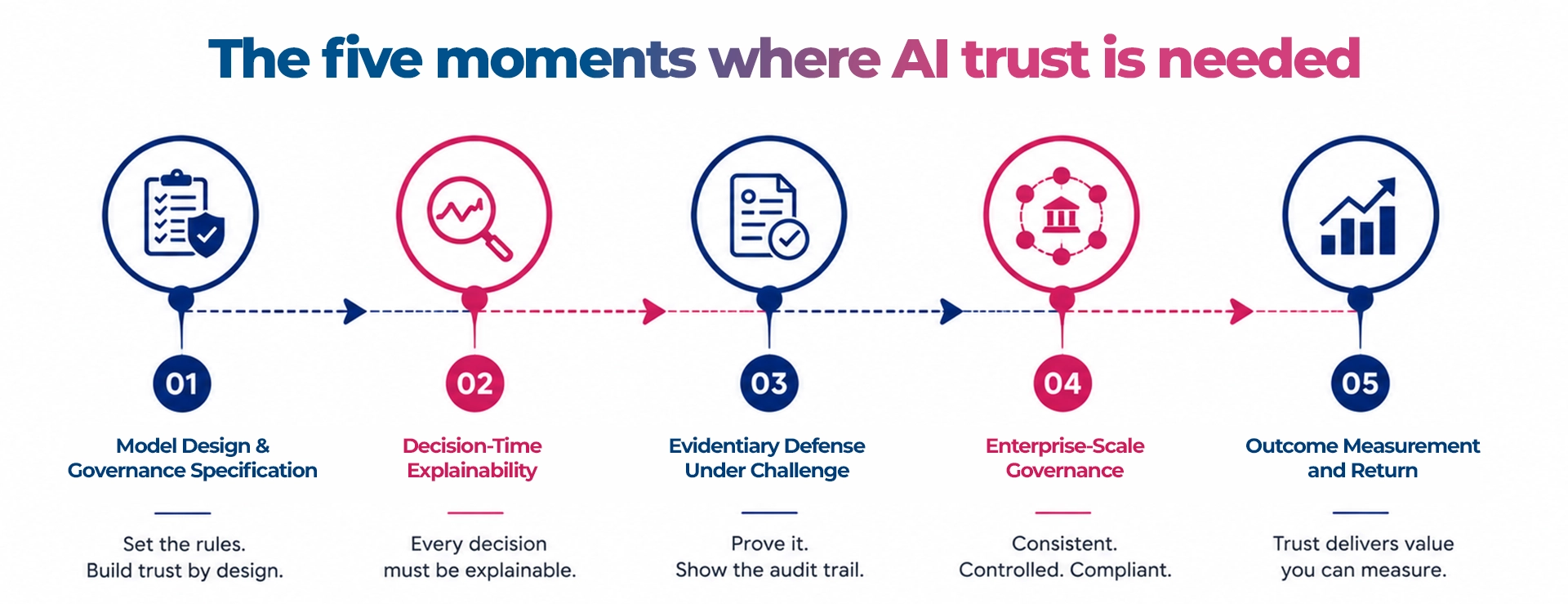
Where Trust Is Tested: Five Critical Moments in an AI System’s Life
The four foundations and the maturity model above describe what an institution needs to build and how far along it is. Neither indicates when that infrastructure is actually put to the test. The five moments below answer that question directly, and each one is where a well-governed program on paper either holds or fails in practice.
Moment One: Model Design and Governance Specification
Trust is established, or forfeited, before a single decision is ever rendered. The determining factor is whether fairness, explainability, and regulatory alignment are specified as engineering requirements ahead of development, or treated as considerations to be reconciled once a model is already operating. Institutions that manage this correctly map the relevant regulatory perimeter, including BCBS 239, SR 11-7 (now SR 26-2), applicable fair-lending statutes, and the expectations of their actual prudential supervisor, whether that is the OCC, the FDIC, or the NCUA, before a line of model code is written, and select architectures capable of a faithful explanation, not merely a plausible one, for every consequential output.
The architectural decisions made at this stage determine how much retrofitting every subsequent AI initiative will require. An institution able to generate customer-specific context on demand occupies fundamentally different ground from one still constrained by predefined services and static reports. Celent’s 2026 IT Dimensions survey of more than 1,000 financial services executives found that data quality and governance have displaced other technology priorities industry-wide, a direct reflection of the premise that AI creates limited value without data an institution can substantiate. Deficiencies established here rarely remain local; they compound at every later stage of the framework.
Moment Two: Decision-Time Explainability
A model that performs well under test conditions is held to a materially narrower standard the first time it renders a decision affecting a real customer: whether it can produce a rationale faithful to its own logic, as opposed to one that is merely statistically plausible. This is where the distinction between accuracy and accountability becomes consequential rather than academic. A credit denial, a fraud flag, a compliance escalation, each must be explainable in terms a regulator or customer can evaluate at the point of decision, not reconstructed after the fact under inquiry.
Equally consequential is whether unstructured data functions as an asset at this stage or remains an unaddressed liability. A model confined to structured fields is reasoning on a fraction of the available context; one capable of interpreting the narrative behind a transaction, or the stated rationale behind a manual override, is working from a materially more complete record. Among 87 banks and 49 insurers surveyed by Deloitte across Europe, the Middle East, and South Africa in 2025, more than half named transparency and explainability as their principal obstacle to AI implementation.
Moment Three: Evidentiary Defense Under Challenge
Every AI-driven decision eventually meets a moment of challenge: a customer disputes an outcome, an examiner requests the evidentiary basis for a determination, an auditor demands the lineage of a validation rule. It is at this point that reconstructed documentation and embedded traceability reveal themselves as categorically different instruments. Reconstruction is approximation, assembled under duress after the fact. Traceability is evidence, produced as a routine output of the system and available before the question is ever asked.
Data governance and compliance-specific AI, AML and KYC in particular, are tested most rigorously at this stage. A false positive that cannot be explained is not simply an operational inefficiency; it is the moment an institution’s AI either substantiates its own reasoning or fails to, in front of an audience with little patience for ambiguity. That audience holds genuine commercial leverage: Deloitte’s 2026 research found that a large majority of consumers would switch financial providers outright following mishandled data, a finding that attaches a direct, quantifiable cost to failure at this stage.
Moment Four: Enterprise-Scale Governance
A use case that performs well within a single team’s pilot is held to an entirely different standard once it must operate across the enterprise, alongside dozens of other AI-driven processes, under one governance framework, without dedicated oversight of each individual decision. This is where most institutions falter, not because the underlying technology fails, but because the organizational and architectural scaffolding required for scale, ownership, repeatable governance, oversight of agentic workflows, was never built. McKinsey has given this pattern a name: pilot purgatory, the condition in which an institution runs numerous narrow AI pilots that never scale, owing to fragmented deployment, point solutions layered onto existing processes, and insufficient attention to operating model, talent, and governance.
It is also where unaddressed risk accumulates fastest: AI tools adopted outside formal governance, agentic workflows no one individually approved, vendor-embedded AI functionality that changes without the institution’s knowledge. Celent’s research on AI governance places most financial institutions early in this discipline, observing that governance scope has expanded rapidly, from siloed model risk monitoring to continuous scrutiny of both the data feeding every model and the outcomes each one produces.
Moment Five: Outcome Measurement and Return
The final test is not technical. It is whether the institution can demonstrate, in commercial terms, that an AI investment produced a measurable result, faster onboarding, lower fraud losses, reduced cost-to-serve, and defend that result as durable rather than incidental to a single pilot cycle. Institutions that defined an output anchor and attribution framework before an initiative began are positioned to answer that question directly. Those that did not typically cannot, regardless of how well the underlying model actually performed.
This is also the stage at which trust converts from a static requirement into a compounding advantage. An institution capable of moving new AI initiatives through governance in weeks rather than quarters, because the underlying infrastructure already exists, holds a structural advantage that a competitor negotiating trust from first principles on every initiative cannot easily close.
Related reading, by moment: What Is AI-First Banking · Trusted AI in Banking · Explainable AI in Banking · Data Governance in Banking · The Hidden AI Risk Layer Banks Are Not Prepared For · The AI Trust Gap in Banking · AI Risk in Banking · Quality Engineering in Banking · AI Transformation in Banking · Why Trust Is Becoming the New Competitive Advantage.
Implications for Bank Leadership
None of these five points operates in isolation. A weakness introduced at the design stage resurfaces later as an unexplainable decision, which resurfaces as an indefensible position under examiner challenge, which resurfaces as a use case unable to scale, and resurfaces, ultimately, as an AI program the board cannot credit with a return. Trust in an AI-first bank is not a compliance function’s obligation to discharge once. It is a property that has to hold continuously, across the entire operating life of every system the institution deploys.
The strategic implication is straightforward, though still underappreciated at many institutions. AI capability is converging rapidly across the industry: most banks now have practical access to comparable models, comparable tooling, and comparable talent. What does not converge as easily is the discipline required to deploy that capability across each of these five points without failing at one of them. That discipline is difficult to build quickly, and once built, difficult for a competitor to replicate on a comparable timeline. For an industry now moving from AI experimentation to AI-first operation, trust is not the obstacle to velocity. It is, increasingly, the only durable source of it.
Questions Worth Asking Before the Next AI Initiative
The correct starting point differs by institution, which is why the analysis above resists a single prescribed sequence. What it does suggest is a set of questions worth working through deliberately before committing to the next AI initiative, rather than assuming the answers.
Where does the institution actually sit on the exploring-to-compounding curve, based on governance evidence rather than stated intent? Which of the five moments represents the largest exposure right now: design-stage specification, decision-time explainability, evidentiary defense under challenge, enterprise-scale governance, or outcome measurement? Is the next AI initiative anchored to a defined business outcome before development begins, or is that question being deferred until after a pilot has already succeeded technically? Can the institution already produce, on demand, the audit trail and lineage evidence that Moment Three requires, or would that evidence need to be reconstructed under pressure if an examiner asked for it tomorrow?
None of these questions has a universal answer, and the honest answer will differ across institutions and even across business lines within the same institution. What the five points above share is a common thread: institutions able to answer these questions with evidence, rather than intent, are the ones positioned to convert AI investment into a durable operating advantage rather than another initiative that performs well in isolation and never scales.
The Full Cluster, at a Glance
Section | Related reading
- What AI-first banking requires: What Is AI-First Banking AI-Enabled Core Banking Modernisation
- The four foundations: Trusted AI in Banking AI in Financial Services
- Trust across the value chain: AI for AML Compliance, Generative AI in Banking, AI Risk in Banking
- Maturity model: The AI Trust Gap in Banking Why Trust Is a Competitive Advantage
- Moment 1: Model design and governance specification: What Is AI-First Banking AI-Enabled Core Banking Modernisation
- Moment 2: Decision-time explainability: Trusted AI in Banking Explainable AI in Banking
- Moment 3: Evidentiary defense under challenge: Data Governance in Banking AI for AML Compliance, The Hidden AI Risk Layer
- Moment 4: Enterprise-scale governance: The AI Trust Gap in Banking AI Risk in Banking Quality Engineering in Banking AI Transformation in Banking
- Moment 5: Outcome measurement and return: Why Trust Is Becoming the New Competitive Advantage
Our Latest Whitepapers
- The Architecture of Trust in AI-Driven Banking
- The CIO’s Guide to AI-Enabled Core Banking Modernization
- From Digital-First to AI-First: The Mandate Reshaping the Banking CIO Agenda
- Engineering Trust in AI-First Banking: The Definitive Guide, the flagship research report covering the Four-Layer Trust Architecture, the AI Maturity Spectrum, the CIO mandate framework, generative AI governance, core banking modernization, and compliance assurance in full depth.
FAQ
1) Why organize AI trust around five distinct points rather than a checklist of principles?
Fairness, explainability, and compliance are properties a system either satisfies or does not, but they are tested at specific, predictable points across an AI system’s operating life: at development, at the point of decision, under subsequent challenge, at enterprise scale, and at business evaluation. Structuring the framework around these points allows an institution to identify precisely where its own exposure is likely to surface.
2) What is the difference between AI adoption and AI-first banking?
AI adoption describes AI added as a feature alongside existing processes, useful but peripheral to how decisions actually get made. AI-first banking means AI is embedded inside the systems that render credit, fraud, and compliance decisions, functioning as the decision engine rather than a capability layered on top of one.
3) Which of the five points do most banks find most difficult?
Enterprise-scale governance, the fourth stage, is where most institutions encounter difficulty. Accenture’s banking research found that only about a third of organizations have actually scaled AI for a core business process despite widespread investment, and McKinsey identifies this specific pattern as “pilot purgatory.” The constraint is typically organizational and governance-related rather than technical.
4) Does trust mean the same thing in retail banking as it does in capital markets?
No. Retail banking trust centers on explaining individual customer decisions clearly; corporate and commercial banking trust centers on credit decisioning and disclosure obligations; wealth management trust centers on client confidence in automated advice; and capital markets trust centers on model risk validation and regulatory examination. Each requires a different emphasis within the same underlying governance framework.
5) How does an institution know which stage of AI trust maturity it is actually in?
By assessing evidence, not intent: whether governance is repeatable across use cases, whether audit trails are generated as a system output rather than reconstructed under pressure, and whether new AI initiatives move through approval in weeks or negotiate trust from first principles each time. McKinsey’s research finds that only about a third of organizations have reached advanced governance maturity despite most reporting AI as a strategic priority.
6) Is scaling AI trust across an enterprise primarily a technology problem or an organizational one?
For most institutions, it is primarily organizational. The models and infrastructure validated during a pilot generally continue to function at scale; what is typically absent is defined ownership, a repeatable governance process, and monitoring capable of identifying drift and unaddressed risk before it accumulates across numerous AI-driven processes.
7) Does investment in AI governance produce a financial return, or does it function only as a compliance cost?
Independent research indicates a measurable return. McKinsey’s 2026 AI Trust Maturity Survey found that organizations investing substantively in responsible AI report significantly higher maturity scores and are considerably more likely to realize material AI benefits, including measurable EBIT impact, relative to organizations that treat governance as a secondary concern.