



Explainable AI in banking means a model can produce a human-readable rationale for a specific decision, in terms a regulator, examiner, or customer can actually evaluate, not merely a confidence score or a feature-importance chart a data scientist can interpret but a compliance officer cannot.
For a bank deploying AI in credit, fraud, or compliance decisions, that distinction determines whether a model is deployable at all in a regulated environment, regardless of its accuracy.
Black-Box Accuracy Is a Liability in Banking, Not an Advantage
In most industries, a model that outperforms a simpler, more interpretable alternative is the obvious choice. Banking inverts that calculus for a specific reason: a subset of the decisions AI now makes, adverse credit actions foremost among them, carry a legal obligation to be explained. Under the Equal Credit Opportunity Act and Regulation B in the United States, enforced by the CFPB alongside each institution’s own prudential regulator, whether the OCC, the FDIC, or the NCUA, a lender denying credit must provide specific, accurate reasons for that denial. A model unable to produce those reasons in a form genuinely faithful to its own decision logic is not merely harder to audit; it can place the institution in violation of adverse action notice requirements the moment it denies a real applicant
This is the practical reason black-box models do not survive in banking the way they might in a recommendation engine or a logistics optimization system. The constraint is not a general preference for simpler models out of caution. It is that a model’s explanation must be legally and factually accurate to the decision it actually made, and a black-box model, by definition, cannot guarantee that the explanation it produces, if it produces one at all, reflects its real reasoning rather than a plausible-sounding approximation generated after the fact.
Why Post-Hoc Explanation Tools Fall Short
A common response to this constraint is to attach a post-hoc explainability tool to an existing black-box model, generating feature-importance scores or approximate decision boundaries after the model has already rendered its output. These tools carry real value for internal model debugging, but they share a structural limitation that matters considerably in banking: a post-hoc explanation approximates what likely influenced a decision without guaranteeing that the explanation matches the model’s actual internal reasoning. For an examiner or a customer challenging a specific decision, an approximate account of probable influence is a materially weaker position than a faithful account of what actually happened, and regulators evaluating AI-driven credit and risk decisions are increasingly drawing that distinction explicitly.
What Explainability-by-Design Actually Requires
The alternative is building explainability into the model architecture and the decisioning pipeline from the outset, so that a human-readable rationale is generated as a natural output of the decision rather than reconstructed afterward as a compliance exercise. In practice, this requires several specific engineering choices:
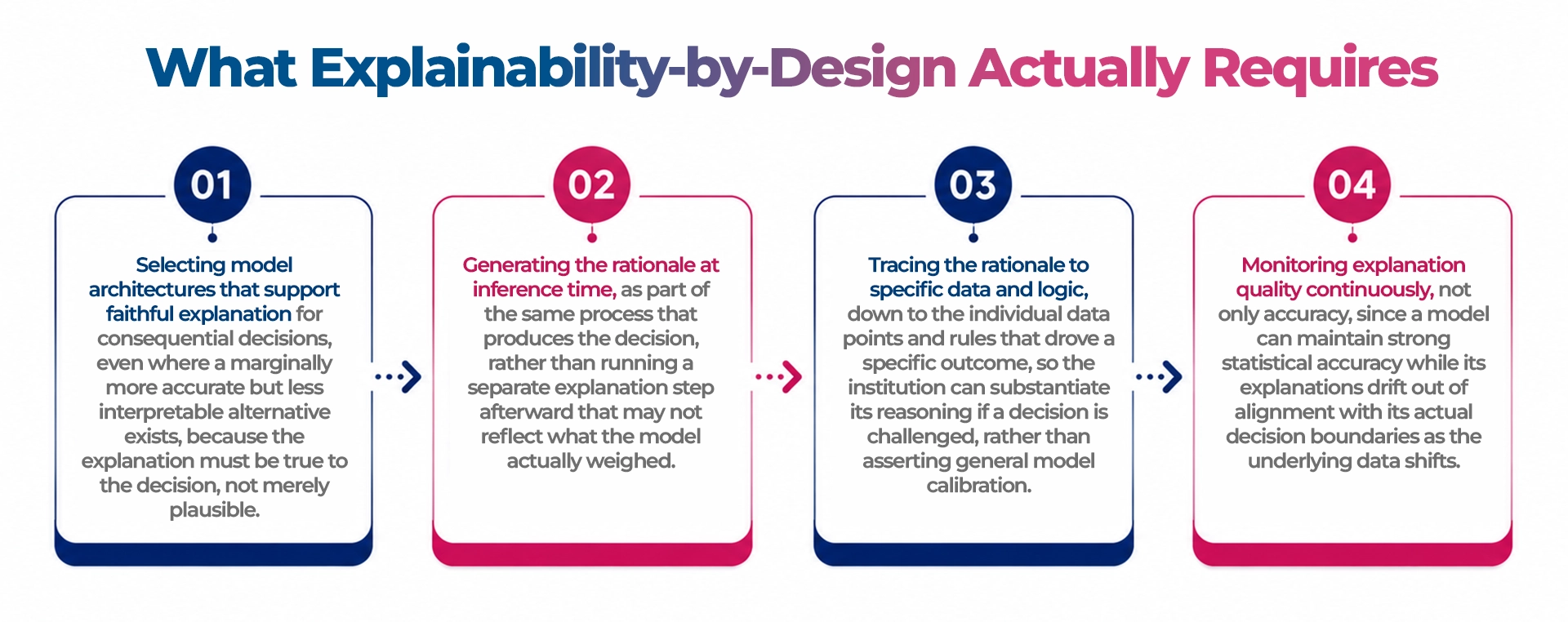
- Selecting model architectures that support faithful explanation for consequential decisions, even where a marginally more accurate but less interpretable alternative exists, because the explanation must be true to the decision, not merely plausible.
- Generating the rationale at inference time, as part of the same process that produces the decision, rather than running a separate explanation step afterward that may not reflect what the model actually weighed.
- Tracing the rationale to specific data and logic, down to the individual data points and rules that drove a specific outcome, so the institution can substantiate its reasoning if a decision is challenged, rather than asserting general model calibration.
- Monitoring explanation quality continuously, not only accuracy, since a model can maintain strong statistical accuracy while its explanations drift out of alignment with its actual decision boundaries as the underlying data shifts.
Explainability Requirements Are Becoming More Specific, Not Less
Model risk management guidance, including SR 11-7 as updated to SR 26-2, explicitly requires validation of every model before deployment, and that validation increasingly addresses explainability as a distinct criterion, separate from accuracy and stability. The EU AI Act extends this further for institutions operating internationally, classifying credit scoring and risk assessment tools as high-risk AI systems subject to pre-market conformity assessments that specifically examine transparency and explainability. The direction of regulatory travel is consistent across jurisdictions: explainability is moving from a best practice to an explicit, examinable requirement, meaning institutions treating it as optional today are accumulating technical debt that will surface at the next examination cycle rather than avoiding a cost.
The Trade-Off Is Real, and Usually Worth Making
None of this implies banks should avoid sophisticated models altogether. It means the trade-off between marginal accuracy gains and explainability must be made deliberately, on a case-by-case basis, with the regulatory and reputational stakes of the specific decision in view. A fraud model flagging transactions for internal review has more latitude for black-box complexity than a credit model issuing adverse action notices to individual customers, because the consequences and the disclosure obligations differ. Applying the same explainability bar to every AI use case, whether too strict or too permissive, is typically a sign that the trade-off is not being made deliberately at all.
What This Means for the CIO and CRO Agenda
The relevant test for any consequential AI model is not how accurate it is in aggregate, but whether the institution can produce a rationale for any single decision that model makes, one that is both faithful to its logic and comprehensible to the person challenging it. If that test cannot be met, the model is not deployment-ready for that use case, regardless of its benchmark performance.
Further reading: Where Trust Is Won or Lost in AI-First Banking and The Architecture of Trust in AI-Driven Banking whitepaper.
FAQ
1. What makes a model “explainable” in a banking context specifically?
It is a model that can produce a human-readable rationale for an individual decision, one that is factually true to its actual decision logic and understandable to a regulator, examiner, or customer, not merely an approximate, post-hoc explanation of what probably influenced the outcome.
2. Why can’t banks rely on post-hoc explainability tools for black-box models?
Because post-hoc tools approximate what likely influenced a decision rather than guaranteeing the explanation matches the model’s real reasoning. For decisions subject to legal disclosure requirements, such as credit denials, that gap between probable and actual influence carries real regulatory risk.
3. What US regulation requires banks to explain credit decisions?
The Equal Credit Opportunity Act and Regulation B require lenders to provide specific, accurate reasons when denying credit. A model unable to produce a rationale faithful to its own decision logic can place the institution at risk of an inaccurate or non-compliant adverse action notice.
4. Does explainability mean banks must use simpler, less accurate models everywhere?
No. It means the trade-off between accuracy and explainability should be made deliberately, based on the regulatory and reputational stakes of the specific decision. A model flagging transactions for internal review can tolerate more complexity than a model issuing adverse action notices to individual customers.
5. Is explainability becoming a stricter regulatory requirement over time?
Yes. Model risk management guidance such as SR 11-7, now updated to SR 26-2, requires explainability as part of model validation, and the EU AI Act’s high-risk classification for credit and risk assessment tools adds explicit pre-market transparency assessments for institutions operating internationally.