

Regional banks do not lack AI ideas. They lack a reliable way to sequence them across customer experience, core modernization, operations, risk, and engineering. A strong AI transformation strategy starts with enterprise constraints and reusable capabilities, then funds use cases that create business value while reducing the cost and risk of the next deployment.
How should a regional bank prioritize AI investments?
Prioritize AI investments by business materiality, data readiness, control complexity, integration effort, and reuse potential. Begin with use cases that deliver a measurable outcome and create capabilities such as governed data access, evaluation, observability, and exception management that future deployments can reuse.
The use-case backlog is becoming a distraction
Most banks can produce a long list of promising ideas in a workshop: service copilots, fraud alerts, document processing, developer assistants, next-best actions, credit analysis, and compliance monitoring. A list creates activity, but it does not create a transformation strategy.
For Tier 2 and Tier 3 banks, the cost of fragmented experimentation is especially high. Scarce architects, risk specialists, product owners, and data engineers are spread across pilots. Each team solves access, evaluation, security, and approval differently. A successful prototype then meets production realities: legacy integrations, incomplete lineage, vendor constraints, model risk review, and operating ownership.
The result is an AI portfolio with many starts and few compounding advantages.
Sequence around four enterprise outcomes
A practical portfolio can be organized around four outcomes: contextual customer engagement, intelligence-ready core capabilities, predictive operations, and trusted delivery. These are connected. Better servicing depends on reliable customer context. Operational intelligence depends on access to transaction and policy data. Faster engineering depends on validation that understands banking rules.
Sequencing should expose these dependencies. A customer-service assistant may appear attractive, but if knowledge content is stale and access controls are inconsistent, the first investment belongs in governed knowledge retrieval. An underwriting model may promise faster decisions, but if reason codes cannot be reconstructed, decision lineage comes first.
Use a five-factor investment test
Every candidate should be assessed against five questions. First, is the outcome material enough to matter to the business? Second, is the required data sufficiently available, permitted, and reliable? Third, can the bank define acceptable behavior and test it? Fourth, can the capability be integrated without creating fragile workarounds? Fifth, will the investment create assets that other use cases can reuse?
This final question is often neglected. A single document-intelligence workflow may create reusable classification, retrieval, human-review, and evidence capabilities. A narrow chatbot may create little beyond its own interface. The portfolio should reward compounding architecture, not only near-term visibility.
Balance quick value with control learning
The first production deployments should be meaningful but bounded. Internal knowledge assistance, document triage, test-design support, or employee decision support can expose weaknesses in retrieval, permissions, evaluation, and feedback without delegating an irreversible customer decision.
Bounded does not mean trivial. The deployment should have a named business owner, target metrics, production data controls, monitoring, and a defined path for expansion. This builds institutional muscle while producing value. It also gives risk and compliance teams evidence on how controls work under real operating conditions.
Modernize only where the decision requires it
An AI program should not become a pretext for indiscriminate modernization. Some use cases need real-time events and granular transaction context. Others can operate safely through governed data products and existing interfaces. The architecture should follow the decision.
Regional banks gain flexibility by separating the system of record from systems of intelligence. Stable APIs, event streams, governed retrieval, and policy services can allow new intelligence to evolve while the core changes at a controlled pace. This reduces dependency on a single transformation milestone.
Fund the control plane as a shared product
Evaluation harnesses, prompt and context versioning, access controls, lineage, model monitoring, exception routing, and human-review workflows are often charged to individual pilots. That makes each use case appear expensive and encourages shortcuts.
Treating these capabilities as a shared product changes the economics. The first use case carries more foundation cost, but subsequent use cases move faster and inherit tested controls. The CIO can then report not only delivery progress but also the bank’s growing capacity to deploy intelligence responsibly.
What this means for banking leaders
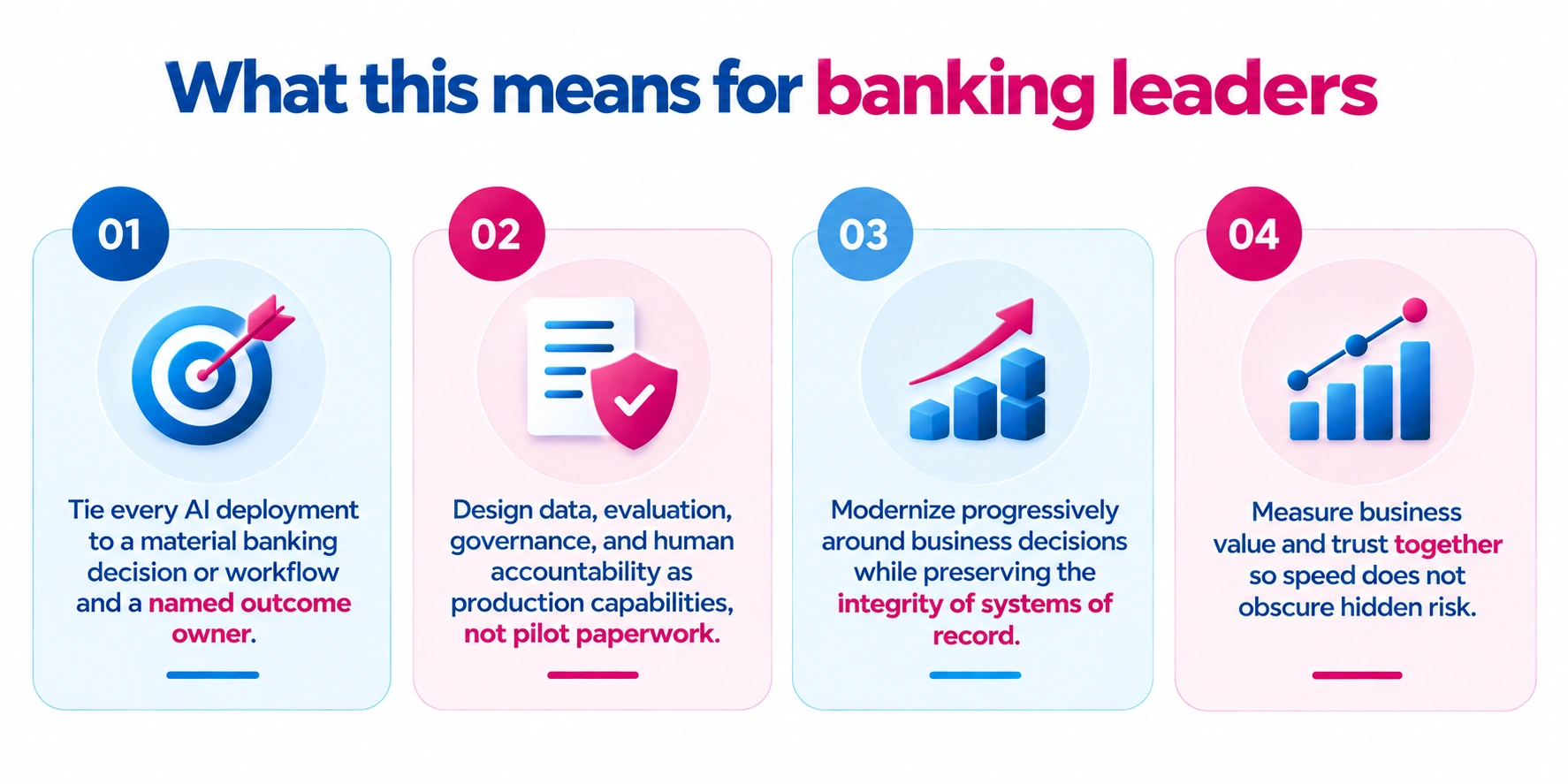
- Tie every AI deployment to a material banking decision or workflow and a named outcome owner.
- Design data, evaluation, governance, and human accountability as production capabilities, not pilot paperwork.
- Modernize progressively around business decisions while preserving the integrity of systems of record.
- Measure business value and trust together so speed does not obscure hidden risk.
A regional bank will not win by maintaining the longest AI backlog. It will win by choosing a sequence in which each deployment improves the economics, evidence, and control of the next. The strategic unit is therefore not the isolated use case. It is the reusable capability that connects business value with trusted execution.
Explore the full executive perspective
From Digital-First to AI-First The Mandate Reshaping the Banking CIO Agenda develops the architecture, operating implications, and leadership priorities behind this shift.
FAQ
Why do bank AI pilots fail to scale?
Common causes include fragmented data, unclear ownership, legacy integration, weak evaluation, incomplete lineage, and controls designed after the pilot.
What is a good first AI use case for a regional bank?
Choose a bounded but material workflow with measurable effort or delay, adequate data, clear ownership, and a path to reuse the underlying capabilities.
Should AI strategy be owned by technology?
Technology should lead architecture and delivery, but business, risk, compliance, security, legal, and operations must share ownership of outcomes and controls.
How can banks compare AI use cases?
Score business materiality, data readiness, testability, integration effort, control complexity, and reuse potential using consistent evidence.
What shared AI capabilities should be funded centrally?
Common capabilities include governed retrieval, evaluation, observability, access control, lineage, exception routing, and human oversight.