

For many regional banks, the barrier to better quality engineering is not a lack of ambition. It is the assumption that meaningful change requires another multiyear replacement program.
Most institutions already have a test management platform, automation frameworks, CI/CD pipelines, defect tools, device farms, reporting, and controls. These investments may be uneven, but they are embedded in delivery. Replacing them all would create cost, disruption, retraining, and new operational dependencies.
Continuous quality should therefore be approached as an intelligence and operating-model evolution, not a tool purge.
Start with the decision the bank needs to improve
A common transformation mistake is beginning with platform installation. A stronger approach begins with a business decision that remains too slow or uncertain.
For example:
- Can we identify the full impact of a lending change?
- Can we reduce regression time for a high-change digital journey?
- Can we preserve quality knowledge held by a few specialists?
- Can we produce clearer release-readiness evidence?
This defines a bounded first use case and a measurable outcome. It also avoids trying to standardize every team before value is demonstrated.
Add an intelligence layer around existing assets
Continuous quality depends on connections that conventional tools may not provide on their own. Requirements, business rules, process documentation, test cases, automation, defects, and execution data need to inform one another.
The objective is not to move every artifact into one repository. It is to create a governed knowledge layer that can retrieve and relate the information needed for quality decisions.
For a regional bank, this has practical advantages. Existing systems remain systems of record. Teams continue using familiar workflows. New intelligence can be introduced for story assessment, impact analysis, scenario design, regression prioritization, and release evidence.
A phased path to continuous quality
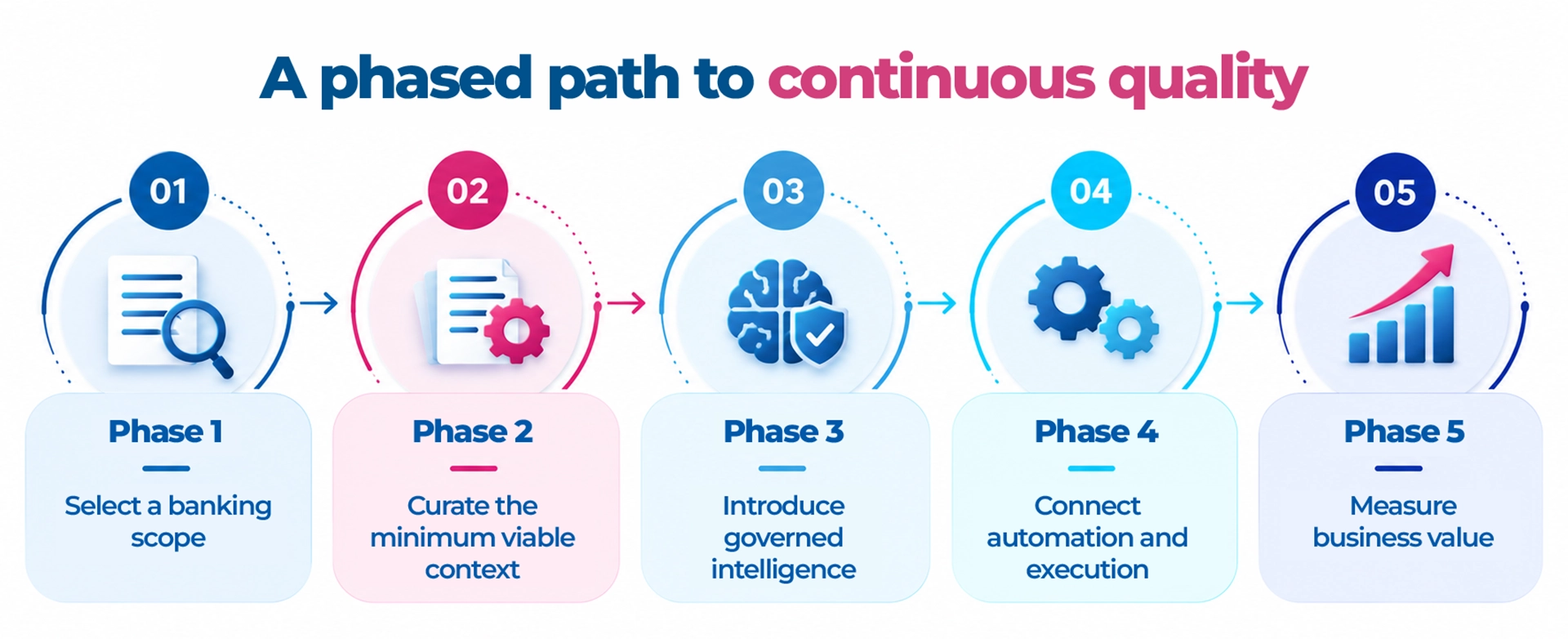
Phase 1: Select a banking scope
Choose one line of business, application stack, or change journey with visible quality friction. Lending, onboarding, payments, or a core-adjacent modernization release can provide a credible starting point.
Phase 2: Curate the minimum viable context
Connect approved source artifacts such as user stories, requirements, business rules, test cases, process documents, and defect history. Establish access controls and align with the bank’s AI governance requirements.
Phase 3: Introduce governed intelligence
Use AI-assisted workflows to refine stories, map dependencies, identify risk, and propose scenarios. Keep specialists responsible for review and approval.
Phase 4: Connect automation and execution
Translate approved scenarios into automation-ready outputs and integrate with current test management, DevOps, data, device, and reporting components.
Phase 5: measure business value
Track improvements in design productivity, meaningful coverage, regression focus, execution time, maintenance effort, escaped defects, and release lead time. Scale only where evidence supports it.
What CIOs should require from a continuous quality platform
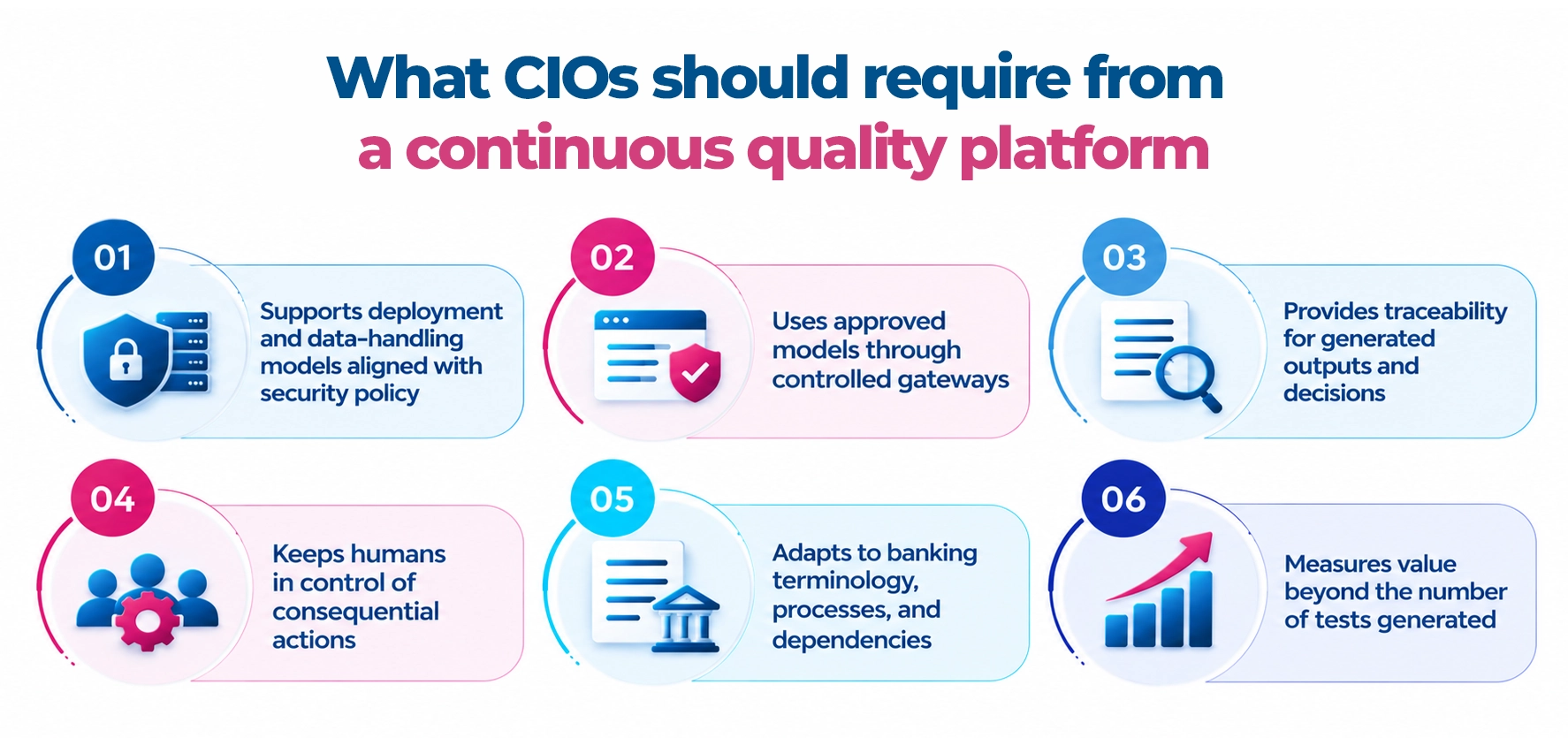
Integration is necessary but insufficient. A bank should also assess whether the platform:
- Supports deployment and data-handling models aligned with security policy
- Uses approved models through controlled gateways
- Provides traceability for generated outputs and decisions
- Keeps humans in control of consequential actions
- Adapts to banking terminology, processes, and dependencies
- Measures value beyond the number of tests generated
Interagency guidance from the Federal Reserve, FDIC, and OCC emphasizes that using third parties does not reduce a bank’s responsibility to manage risk. That principle applies directly to AI-enabled quality platforms: adoption must fit the institution’s governance, oversight, and control environment.
How PULSEAI supports incremental adoption
PULSEAI is designed to integrate with a bank’s existing AI, test management, reporting, infrastructure, and DevOps ecosystem. A scoped deployment can establish a Knowledge Fabric for an agreed business area, configure banking context and quality engineering agents, and connect approved outputs with existing automation and execution workflows.
This allows a regional bank to modernize the intelligence behind quality decisions while protecting the value of its current toolchain.
The strategic choice is not between standing still and replacing everything. It is whether to make existing investments work together with more context, focus, and accountability.
Architecture principles for low-disruption adoption
Incremental adoption depends on several architectural choices. The intelligence layer should connect through supported interfaces rather than duplicate every source. Identity and access should follow the bank’s existing control model. Approved large language models should be accessed through governed inference gateways. Deployment should align with the bank’s infrastructure and data-residency requirements.
The platform should also tolerate a heterogeneous estate. Regional banks rarely have one automation framework or a perfectly consistent delivery process. A viable strategy supports gradual standardization while allowing teams to preserve functioning investments. This is especially important during core modernization, mergers, or vendor transitions, when forcing an immediate tool standard can add risk.
Build the business case around avoided friction
The value case should not depend only on license consolidation or headcount reduction. Continuous quality can create value by reducing repeated impact-analysis meetings, unnecessary regression execution, automation maintenance, late defect discovery, release delays, and reliance on scarce specialists.
A baseline should capture how much time teams spend finding information, reviewing test scope, maintaining packs, triaging false failures, and assembling release evidence. The pilot can then compare the same measures for a defined journey.
This produces a more credible executive decision than a generic claim about AI productivity. It shows where intelligence changed work, what controls were maintained, and whether the outcome can scale.
The right banking transformation partner should be able to support this operating change as well as the technology. Domain contextualization, knowledge curation, governance alignment, workflow integration, and user adoption determine whether a continuous quality platform becomes an enterprise capability or another isolated tool.
Explore a practical path to Continuous Quality Intelligence for your bank. Schedule a PULSEAI demo.
FAQ
1. Must a bank replace its testing tools to adopt continuous quality?
No. A continuous quality platform can add knowledge, orchestration, and risk intelligence around existing systems of record, automation frameworks, and CI/CD pipelines.
2. Where should a regional bank start?
Start with one business-critical change journey where manual impact analysis, regression duration, knowledge dependency, or release uncertainty creates measurable friction.
3. How should success be measured?
Measure business-relevant outcomes such as coverage of material risk, time to design and execute tests, maintenance effort, escaped defects, and release lead time, not only automation volume.