


Regression testing in banking often presents an uncomfortable tradeoff. Run the full suite and feedback may arrive too late. Run a reduced suite and teams may worry that the wrong scenario was excluded.
The root problem is not always execution capacity. It is weak selection intelligence.
Static regression packs were built for a more predictable release model. Modern banking applications span cores, digital channels, product engines, payment rails, third-party services, data platforms, and regulatory workflows. The tests relevant to one change are not necessarily relevant to the next.
What makes regression “context-aware”?
Context-aware regression uses more than test tags or code proximity. It interprets a change through several connected lenses:
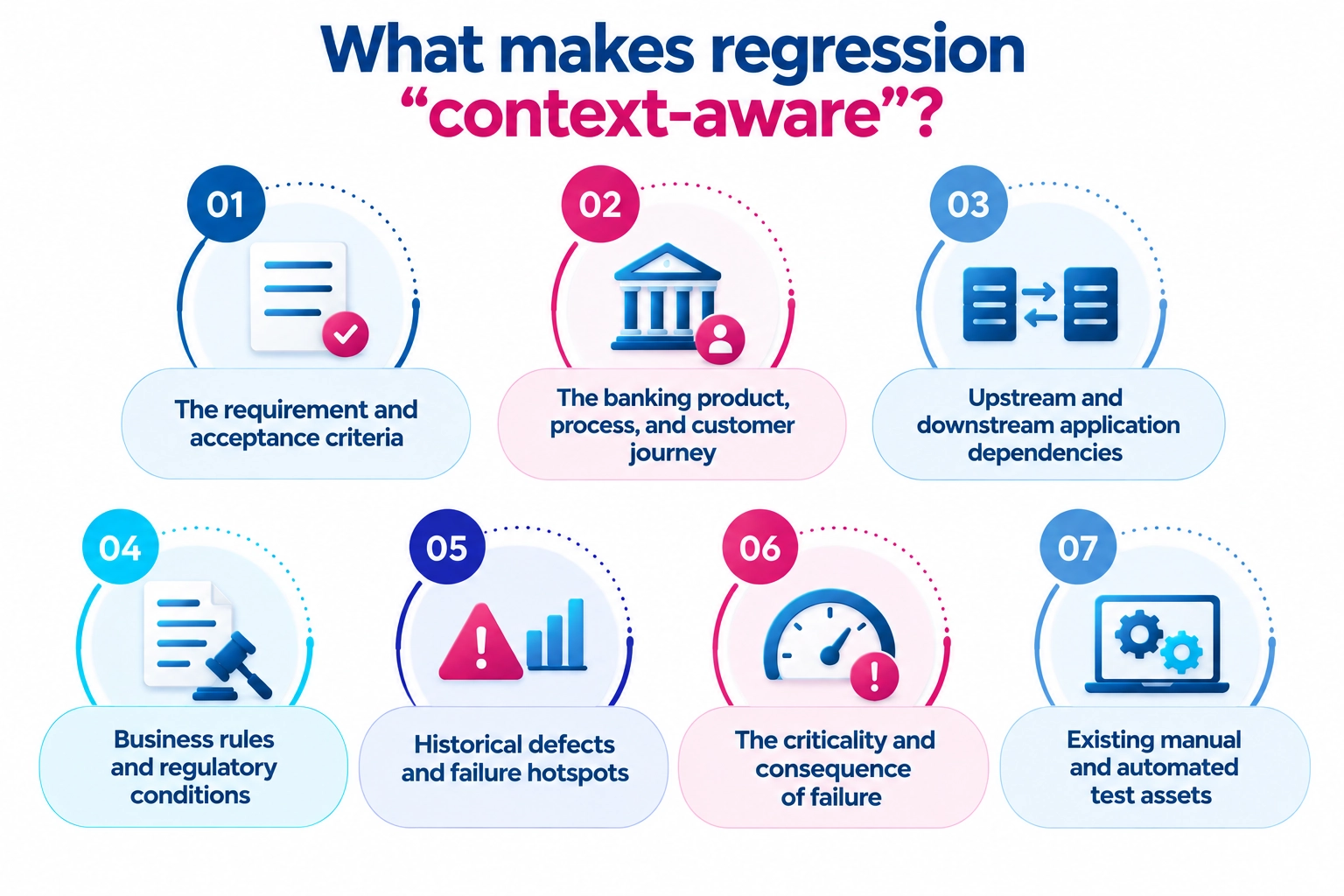
- The requirement and acceptance criteria
- The banking product, process, and customer journey
- Upstream and downstream application dependencies
- Business rules and regulatory conditions
- Historical defects and failure hotspots
- The criticality and consequence of failure
- Existing manual and automated test assets
These signals help answer a more useful question than “Which suite do we run?” The question becomes “Which evidence do we need for this change?”
A regional-bank lending example
Assume a bank introduces bullet repayment for an SME lending product. A static regression approach may select tests based on the loan origination module where the story was raised.
A context-aware approach expands the view. It identifies effects on product configuration, repayment schedules, servicing events, payment posting, delinquency triggers, collections, statements, accounting entries, and downstream reporting. It checks prior defects associated with repayment variations and affected interfaces. It then proposes scenario coverage across normal, negative, boundary, and integration conditions.
This can reveal risks that keyword matching or code-based selection alone may miss. It can also avoid running unrelated tests simply because they belong to a large inherited pack.
Five ways context-aware regression improves the release decision
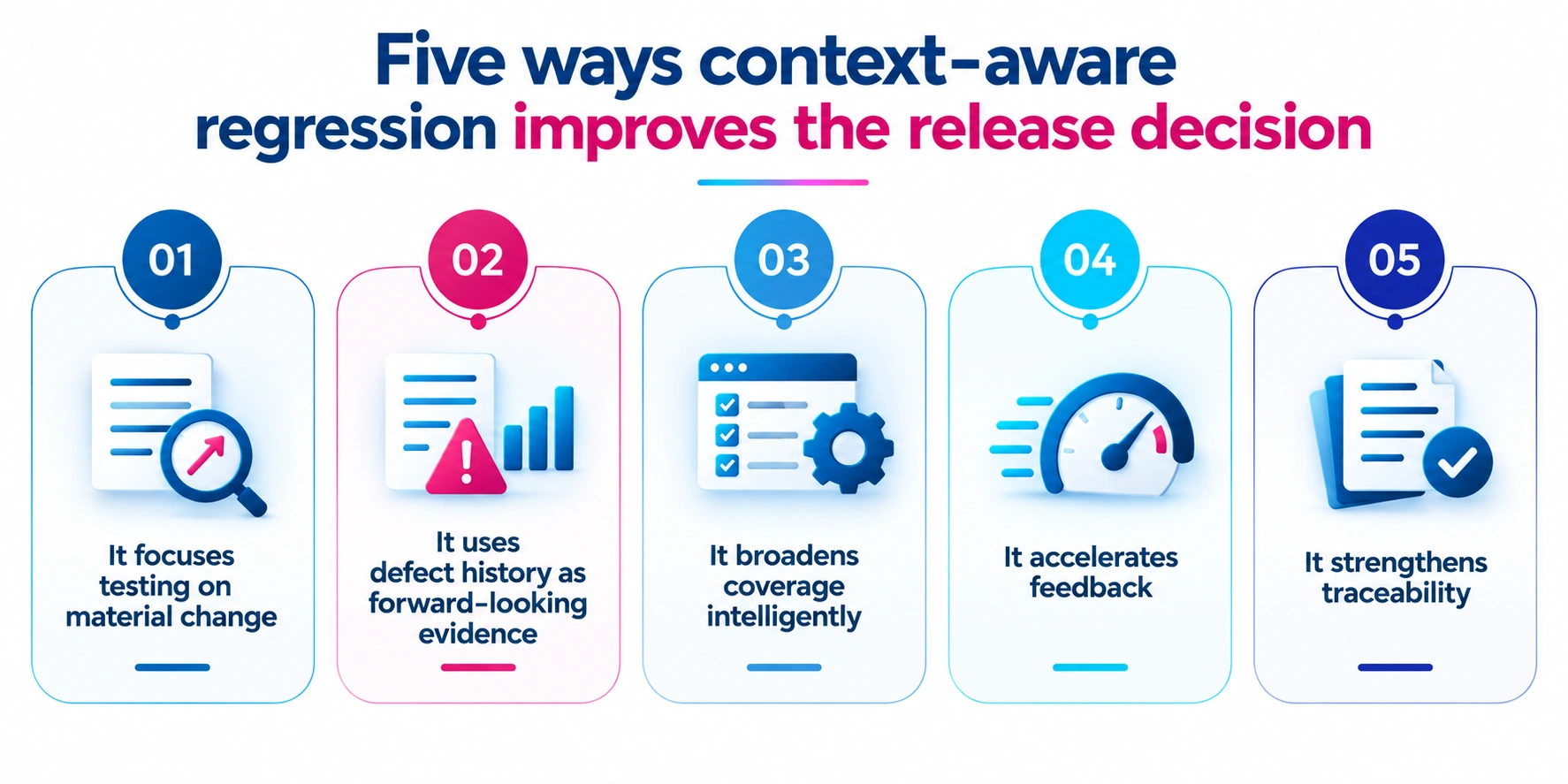
1. It focuses testing on material change
The suite is shaped by actual business and system impact rather than historical habit.
2. It uses defect history as forward-looking evidence
Past failures can expose fragile paths, recurring integration problems, and scenarios that deserve higher priority.
3. It broadens coverage intelligently
Relevant boundary, negative, regulatory, and cross-system scenarios can be added without equating quality with raw test volume.
4. It accelerates feedback
Focused regression can reduce unnecessary execution, helping CI/CD banking pipelines return a meaningful signal sooner.
5. It strengthens traceability
Teams can show how the selected tests connect to the change and risk assessment, supporting review and auditability.
Context requires a knowledge foundation
AI regression testing is only as dependable as the context available to it. If requirements are incomplete, dependencies are outdated, or defect records are inaccessible, an algorithm can produce precise-looking recommendations built on weak evidence.
Effective implementation therefore begins with knowledge curation. Banks need governed ingestion, clear access controls, domain taxonomies, feedback from specialists, and ongoing validation. Human reviewers should be able to see and challenge the basis for recommendations.
This is particularly important in regulated environments. The aim is not an opaque model that silently removes tests. It is a governed workflow that makes selection more evidence-led and reviewable.
PULSEAI and risk-aligned dynamic regression
PULSEAI uses a banking Knowledge Fabric, domain ontology, historical defect intelligence, and purpose-built agents to support change-impact identification and risk-based regression selection. It can generate automation-ready scenarios, connect with low-code automation, and support on-demand or pipeline-based execution. SME review and approval remain part of the workflow.
The result is a regression strategy designed to stay relevant as the system changes, not simply a faster version of a static pack.
Where context-aware regression can fail
The approach is not automatically reliable. Three implementation weaknesses deserve attention.
First, poor source quality can distort recommendations. Requirements that omit exceptions, stale dependency maps, and inconsistent defect classification all limit what the intelligence layer can infer. Banks need ownership for source curation and a mechanism for specialists to correct the knowledge base.
Second, risk scores can create false precision. A numerical ranking is useful only when leaders understand the factors behind it. Teams should be able to inspect why a scenario was prioritized and which evidence influenced the recommendation.
Third, aggressive optimization can remove useful tests. The purpose of context-aware selection is not to minimize the suite at all costs. It is to match coverage to change and consequence. Banks should introduce thresholds, approval rules, and periodic full-suite validation where appropriate.
A practical adoption sequence
A regional bank can begin with one application and one recurring release type. The team should map the current regression-selection process, connect a limited set of approved artifacts, and run context-aware recommendations alongside existing practice. Comparing the two approaches will reveal missed dependencies, redundant execution, and differences in reviewer confidence.
The next step is controlled integration with test management and CI/CD. Automated selection should initially remain visible and reviewable, with clear override mechanisms. As the bank builds evidence, it can expand the scope to additional journeys and use defect outcomes to improve future prioritization.
This measured approach helps the institution gain efficiency without creating a new opaque dependency. Context-aware regression becomes a learning system, strengthened by every reviewed change and every release outcome.
Governance should evolve with that learning. Teams can periodically review selection accuracy, overrides, escaped defects, and tests that repeatedly add little signal. This keeps the regression model aligned with changes in products, architecture, controls, and customer behavior instead of allowing a new form of static logic to emerge.
See context-aware regression intelligence applied to a banking change. Schedule a PULSEAI demo
FAQ
1. What is context-aware regression testing?
It is a regression approach that selects and prioritizes tests using the meaning and impact of a change, including business processes, dependencies, risk, and defect history.
2. How is it different from test impact analysis?
Test impact analysis often maps code changes to tests. Context-aware regression can extend that view to business rules, customer journeys, system relationships, regulatory scenarios, and historical defects.
3. Does risk-based regression mean running fewer tests?
Not necessarily. It means directing effort according to risk. Depending on the change, the appropriate scope may shrink, expand, or shift toward different scenario types.