

Still stuck at 33% coverage?
It’s not the tools. Two thirds of every bank release still runs manually and has for a decade. The ceiling is an operating model problem. We know exactly how to break it.
Why Automation stalls? Your last fix
didn't stick. Here's the real reason.
Most programmes tried a new tool, a larger team, or a framework migration. None produced sustained coverage growth, because they addressed symptoms, not the seven structural root causes.

Fragmented Operating Model
Built per-project, not enterprise-wide. Coverage resets with every programme end.

Talent Concentration Risk
One or two engineers own the entire estate. When they leave, it degrades fast.

Test Data Dysfunction
Production data off-limits. Synthetic data underfunded. Environments always contended.

Wrong Automation Candidates
UI tests break constantly. The real value - API and business-process - is under-automated.

Script Brittleness
30-40% of QE bandwidth on maintenance. Nothing left for new coverage.

Isolated from CI/CD
Batch-mode suites can't gate releases. Automation that doesn't run continuously can't do its job.

Legacy Platform Exclusion - Temenos, Finastra, FLEXCUBE
Core banking sits almost entirely outside the automated perimeter. Automate 80% of digital channel tests and you may still only reach 40% total coverage.
OUR APPROACH
Five pillars. Not in sequence - together.
Organizations that break through 33% treat automation as an engineering discipline embedded across the delivery lifecycle, not a downstream QA phase.
The Maveric Edge
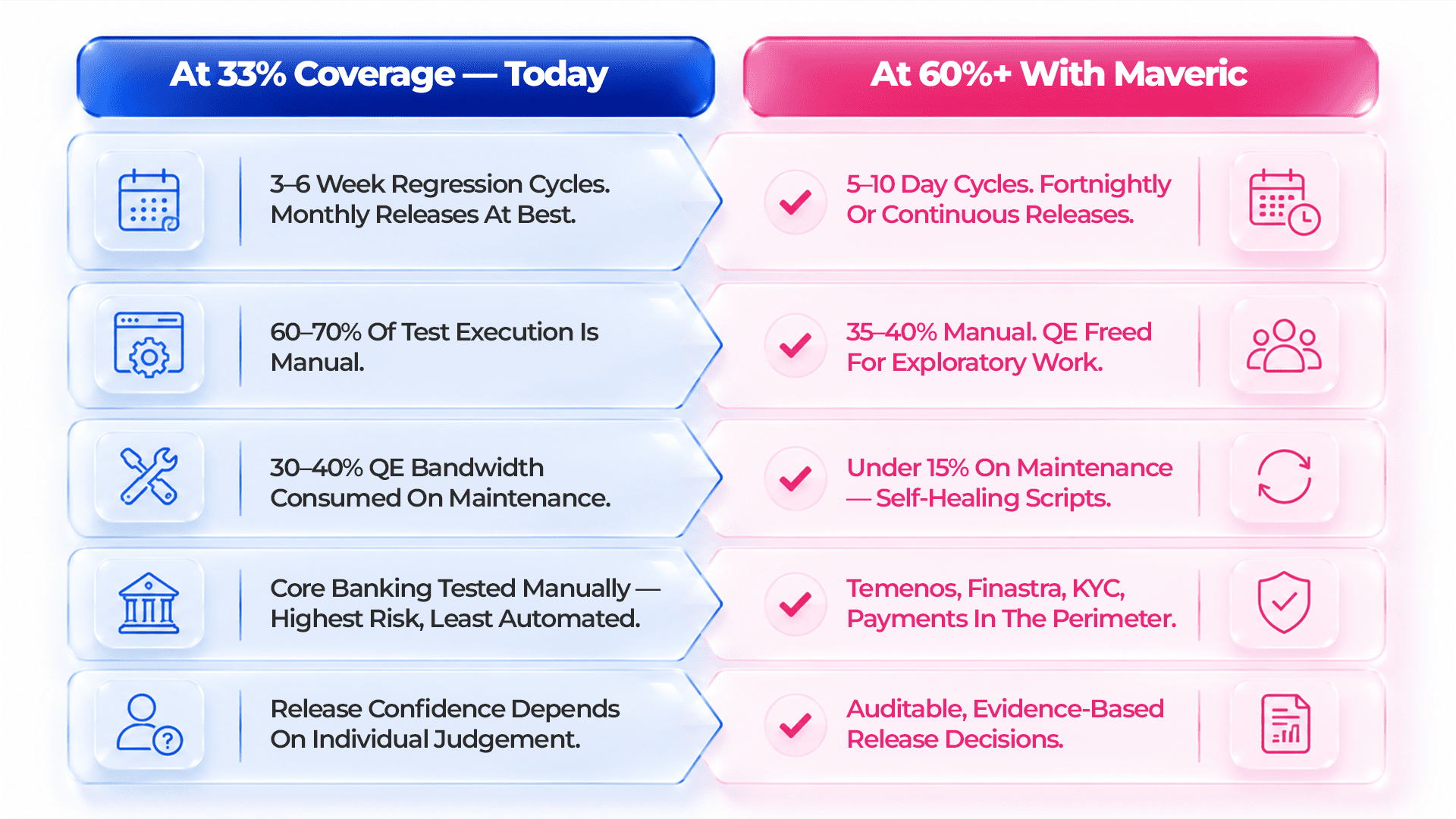
What changes when coverage doubles
Delivery economics, not just quality metrics.
60%+
Automation Coverage
Up from the industry 33% average in 12-18 month
70%
Reduction in Manual Effort
QE team freed for exploratory, edge-case, and strategic work
5× faster
Regression Cycles
From 3-6 weeks to 5-10 days, enabling continuous releases
< 70%
Maintenance Overhead
Self-healing and process-aligned libraries cut script upkeep dramatically
100%
Pipeline Integration
Every build gated by automated evidence, including legacy core banking layers
Audit-ready
Release Confidence
Quantifiable, auditable coverage metrics - not individual tester judgement

Breaking the 33% Ceiling
How banking enterprises can industrialize test automation and scale to 60%+ coverage
What’s inside the whitepaper
- Why 33% is a structural ceiling – not a resourcing problem
- Seven root causes and how they compound each other
- The five-pillar industrialization model in full
- What changes operationally when coverage doubles
- Automating Temenos, Finastra, and legacy core banking layers
- The Coverage Assessment – scope, deliverables, ROI modelling