


Development moved faster this year. Most quality engineering functions did not move with it. Here is how to tell if yours is one of them.
Ask most CIOs, CTOs, and Heads of Engineering at regional and challenger banks whether their development teams got faster this year, and the answer comes quickly: yes, obviously. Ask the same leaders whether quality engineering in their bank got 40 percent more capable over the same period, to match the productivity gains their developers are already reporting from generative AI, and the room tends to go quiet. For most regional banks and credit unions, the honest answer is no. That gap does not announce itself. It shows up gradually, in patterns that feel normal until they are named.
Five of those patterns turn up again and again in conversations with technology and operations leadership at Tier 2 and Tier 3 institutions. None of them, on their own, is alarming. Together, they describe a quality engineering function, and the software testing in banking
it is responsible for, that is still built for a release cadence the rest of the bank has already left behind.
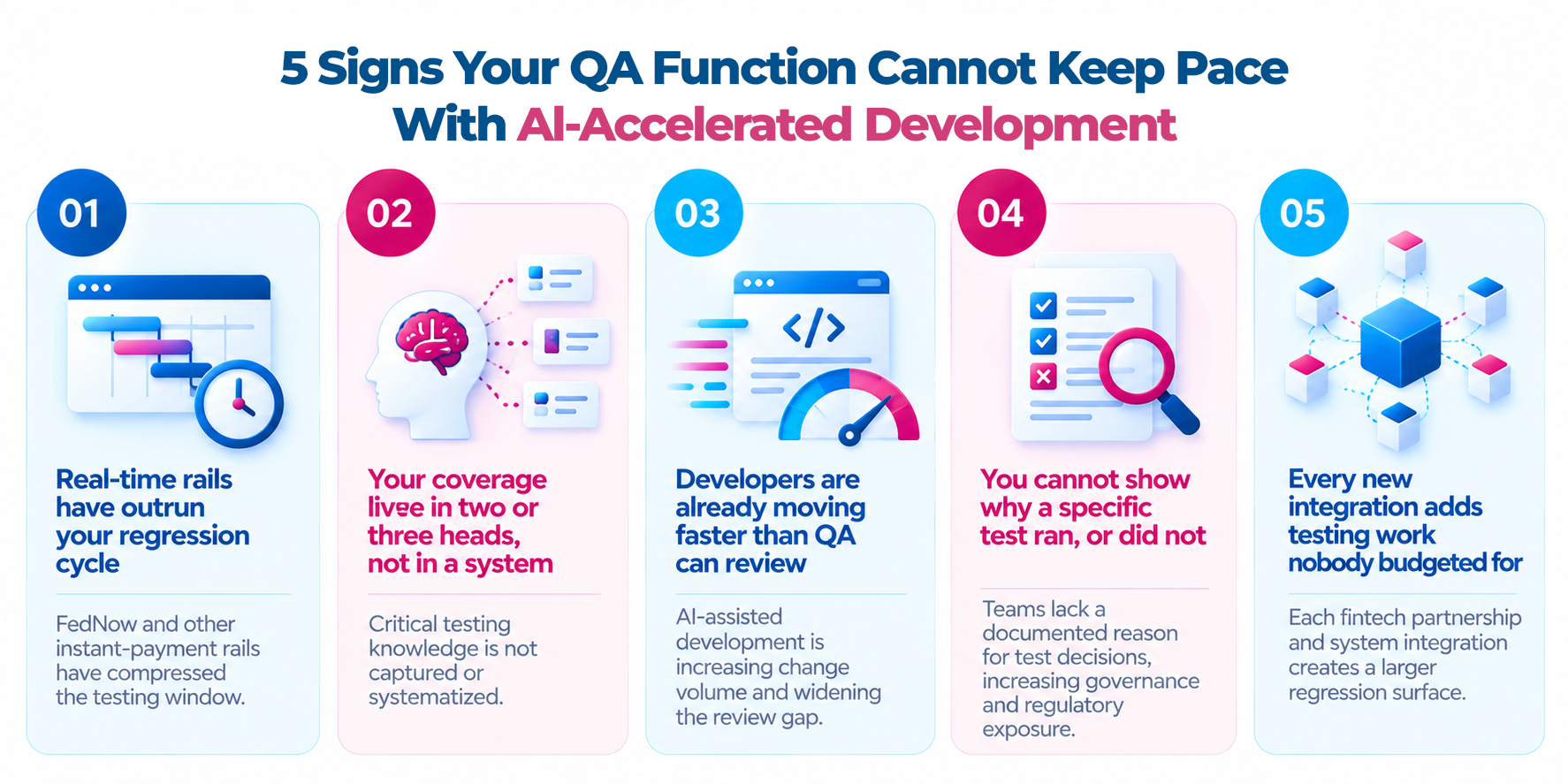
1. Real-Time Rails Have Outrun Your Regression Cycle
FedNow and other instant-payment rails do not simply add a feature to test. They compress the testing window for anything touching payments from a multi-day, batch-era schedule down to same-day, sometimes same-hour. A regression cycle built for quarterly or monthly release cadences was never designed to clear that bar. If yours still runs on that older schedule, every payments-related change ships with a gap already built into it, whether or not it has surfaced yet.
2. Your Coverage Lives in Two or Three Heads, Not in a System
A useful test: ask what happens to test coverage the day your most senior QA engineer leaves. If the honest answer is uncertainty, that is not primarily a staffing risk. It is an architecture gap. The knowledge of what to test, why, and what has historically broken in a given area was never captured anywhere a system could reuse it. It lived in one person’s memory, and memory does not survive turnover.
3. Developers Are Already Moving Faster Than QA Can Review
Regional banks are, on the whole, already ahead of megabanks on generative AI adoption in software delivery, moving faster through the ideation and deployment stages of AI-assisted coding. In one McKinsey case study, a regional bank saw developer productivity increase 40 percent after adopting generative AI in its coding workflow, with more than 80 percent of its engineers reporting that the tools made their day-to-day coding better. If QA did not get faster over the same period, the bottleneck has already moved. It just is not measured yet.
4. You Cannot Show Why a Specific Test Ran, or Did Not
FINRA’s 2026 Annual Regulatory Oversight Report introduced a standalone section on generative AI for the first time, including explicit guidance on the risks of autonomous AI agents, also a first. The expectation is not that firms adopt any particular technology. It is that they can document how AI is used, monitor its outputs, and keep records of AI-assisted decisions. Telling an examiner that the regression suite ran is no longer a complete answer. The next question is who approved what, and why, and a QA function without a documented answer is carrying more exposure than most technology roadmaps currently account for.
5. Every New Integration Adds Testing Work Nobody Budgeted For
A large majority of banks and credit unions in the mid-size asset range already prioritize fintech partnerships as part of their growth strategy. Each of those partnerships is a new regression surface: new data flowing in, new failure modes to account for, new dependencies layered onto systems that were not designed with that integration in mind. Features get budgeted for. The testing they require rarely does, and the gap compounds quietly with every partnership added.
What to Do With This List
Most teams that work through these five patterns honestly recognize three or more. That is not a diagnosis of failure. It is simply where most regional banks and credit unions sit right now, because the underlying shift, AI-accelerated development outpacing QA capacity, is recent enough that most quality functions have not yet been rebuilt around it. What separates institutions that close this gap from institutions that let it compound is whether the question gets asked deliberately, in this year’s planning cycle, or left to surface on its own in a production incident or an examination.
Where Maveric Fits
Maveric Systems built a short, five-question self-assessment for exactly this purpose: a structured way to see, in under five minutes, how many of these patterns apply to your own QA function, and what closing each one is actually worth. PULSEAI, Maveric’s continuous quality intelligence platform, is built to close all five gaps directly, connected knowledge, dependency mapping, risk-based prioritization, intelligent test design, and governance, in one system instead of scattered across people and tools.
Before your next planning cycle closes: if a developer’s AI-assisted change touched three systems your QA team did not expect, would you find out before release, or after?
FAQ
1. What is quality engineering in banking?
Quality engineering in banking is the discipline of deciding what to test, why, and how urgently, across a bank’s core, digital, and integration layers, and building a system that can make and document those decisions consistently. It is broader than test execution, which only carries out what quality engineering has already decided matters.
2. How do I know if my bank’s QA function is falling behind on AI?
Compare how much faster your developers report shipping code against how much more testing capacity your QA function has gained over the same period. If development accelerated and QA capacity did not grow at a comparable rate, the gap already exists, whether or not it has surfaced in a release yet.
3. Why does quality engineering lag behind AI-accelerated development?
Traditional test automation scales with headcount: more releases and integrations require proportionally more people writing and maintaining scripts. AI-accelerated development is not bound by that constraint, so the two capacities drift apart unless the QA function itself becomes AI-native.