

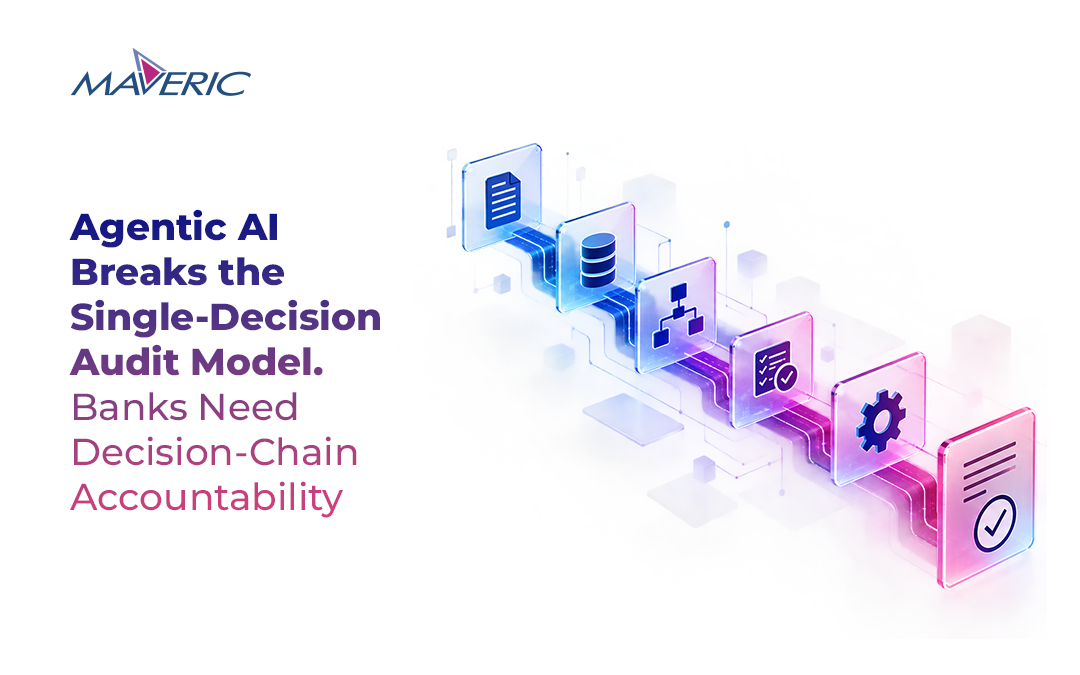
Traditional AI governance assumes a model produces an output that a person reviews. Agentic AI can retrieve data, call tools, update records, route cases, and execute multiple steps before a human sees the result. The auditable unit is no longer one model output. It is the complete decision chain, including context, actions, authority, exceptions, and outcomes.
How should banks audit agentic AI?
Banks should audit the full agent decision chain: the initiating request, identity and permissions, retrieved evidence, model and prompt versions, tool calls, intermediate decisions, system changes, confidence thresholds, human interventions, exceptions, and final outcome. Controls should be proportionate to consequence and designed before autonomous authority is granted.
The human-review assumption is disappearing
Most governance frameworks were built around a visible handoff. A model produces a score, recommendation, or alert. A person reviews it and decides what happens next. Accountability can therefore focus on the model output and the human decision.
Agentic AI changes the architecture. An agent may break a goal into tasks, retrieve data from several systems, invoke tools, make intermediate judgments, and act. In loan origination, treasury reconciliation, payment repair, fraud case triage, or software delivery, one apparently simple outcome can contain dozens of machine-selected steps.
If only the final answer is recorded, the institution cannot explain which earlier choice shaped it.
The model is only one actor in the system
An agent’s behavior depends on more than the underlying model. System prompts define priorities. Context determines what the agent knows. Retrieval selects evidence. Tool permissions define what it can change. Orchestration determines the sequence. Memory can influence later steps. Human feedback can alter future behavior.
This means a conventional model record is insufficient for reconstruction. Even a thoroughly tested model can create unacceptable outcomes if the agent retrieves stale policy, calls the wrong tool, exceeds its authority, or compounds a small error across several steps.
Governance must move from model-level assurance to system-level accountability.
What a decision-chain record must capture
The record should begin with the initiating identity, purpose, and request. It should capture the approved agent, model, prompt, policy, and tool versions in force. It should identify the data and document passages retrieved, including permissions and freshness. It should log tool calls, parameters, intermediate outputs, confidence or validation results, and changes made to systems.
Where a human reviews or overrides the agent, that intervention should be visible. Where no human is involved, the authority rule permitting autonomous action should be traceable. Exceptions, fallback behavior, and final business outcomes should complete the chain.
The objective is not unlimited logging. It is evidence sufficient to reconstruct a material decision without depending on the model to explain itself after the fact.
Authority must be designed step by step
A bank should not label an entire workflow human-in-the-loop when a person reviews only the final summary. Material actions earlier in the chain may already have changed the risk.
Authority should be assigned at the action level. Retrieval may be automated within access policy. A reversible case update may proceed below a confidence threshold. A payment release, adverse credit action, sanctions disposition, or customer communication may require additional validation or maker-checker approval.
Controls should consider consequence, reversibility, monetary value, customer impact, and the possibility that several low-risk actions combine into a high-risk outcome.
Testing must cover trajectories, not only answers
Traditional evaluation often compares model output with an expected answer. Agentic evaluation must also examine whether the system took an acceptable path.
Test cases should include incomplete data, conflicting sources, unavailable tools, permission failure, ambiguous customer identity, policy changes, adversarial instructions, repeated retries, and cascading exceptions. The agent should know when to stop, seek more evidence, escalate, or roll back.
Banks should measure unsafe tool calls, unauthorized actions, unsupported steps, exception quality, override patterns, recovery success, and outcome variance. A correct final answer reached through an uncontrolled path is still a governance failure.
Regional banks need bounded autonomy first
The practical starting point is a workflow with measurable manual effort and clearly separable actions. Run the agent in observation or recommendation mode before granting execution authority. Compare its proposed trajectory with human handling. Identify where evidence is missing, where judgment is irreducible, and where controls can be deterministic.
Expand autonomy only when monitoring shows that the decision chain is reliable and exceptions are well handled. Preserve a safe mode that limits action when data, tools, or confidence fall outside approved conditions.
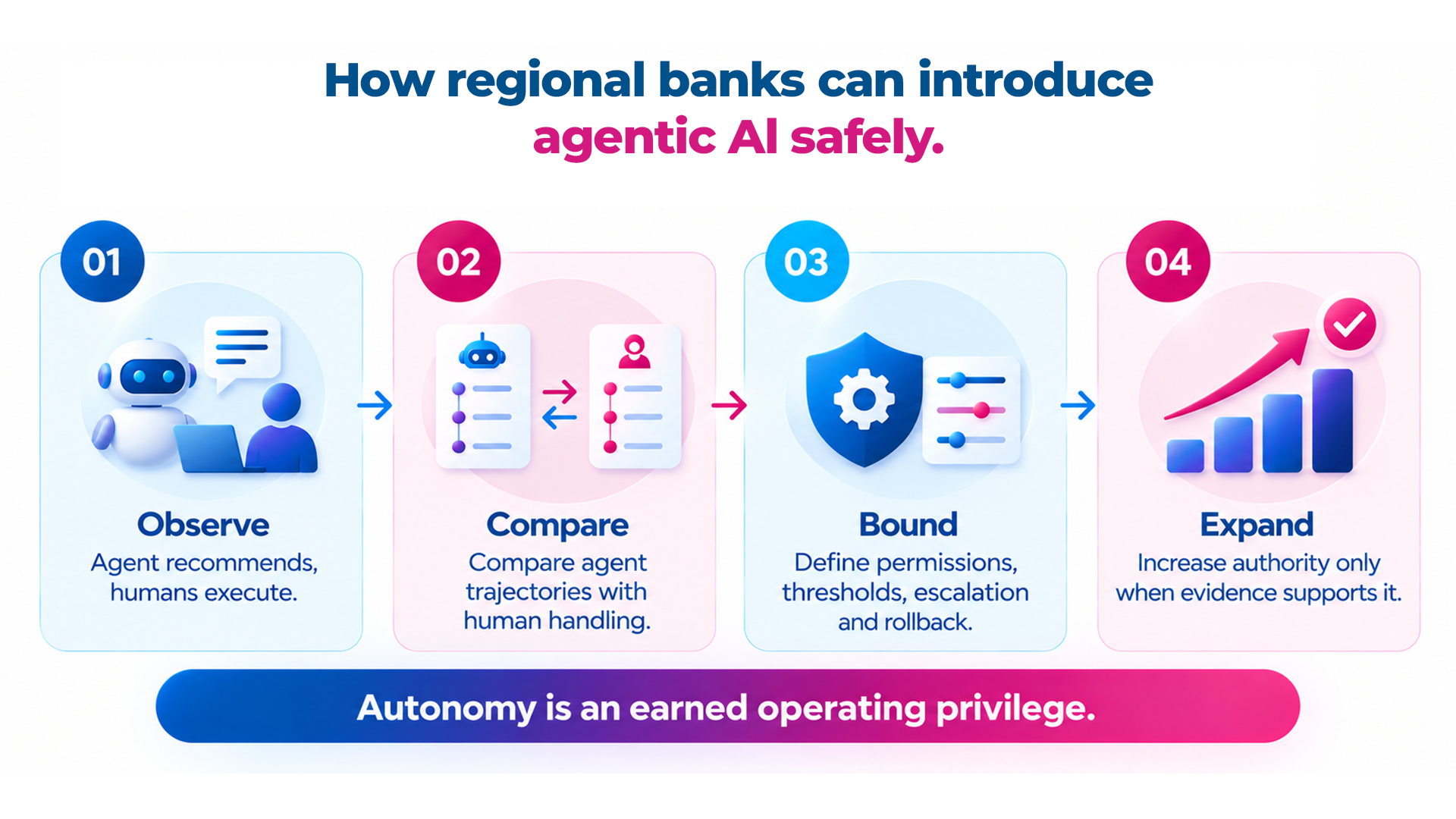
This approach turns autonomy into an earned operating privilege, not a feature enabled at deployment.
What this means for banking leaders
• Treat the auditable object as an end-to-end chain of decisions and actions.
• Version and record the model, prompts, context, policies, tools, and authority rules that shaped the outcome.
• Assign human approval at material action points, not only at the end of the workflow.
• Test failure paths, escalation, rollback, and cumulative risk before expanding autonomy.
Conclusion
Agentic AI can compress complex banking work, but it also distributes decision-making across steps that traditional controls may not see. Banks that create decision-chain accountability can preserve the evidence, authority, and intervention points needed to make autonomous workflows defensible. Those that log only the final output will discover that the most important decision happened earlier and left no record.
Explore the full CIO and CRO mandate
The fifth paper in Maveric Systems’ CIO Mandate Series sets out the Enterprise AI Accountability Architecture, regulatory convergence, governance maturity model, and 24-month implementation roadmap.
FAQ
What is decision-chain accountability?
It is ownership and traceability across every material step an AI agent takes, from request and retrieval through tool use, human intervention, and final outcome.
Why is a model audit trail insufficient for an AI agent?
The model is only one component. Prompts, context, tools, permissions, orchestration, and intermediate actions can materially change the result.
What actions should always require human review?
Requirements depend on the bank’s risk appetite, but high-consequence, irreversible, customer-impacting, or legally material actions usually need stronger validation or accountable approval.
How can banks test agentic workflows?
Test both results and trajectories, including incomplete evidence, conflicting data, permission failures, tool outages, adversarial input, escalation, and rollback.
Can regional banks deploy agentic AI safely?
Yes, by starting with bounded workflows, running in observation mode, logging complete decision chains, and expanding authority only when evidence supports it.