

Almost every AI governance framework in banking today – including the regulatory instruments written to enforce them – assumes the same basic shape of decision: a model produces an output, a human reviews it, and the human is the accountable party if something goes wrong. A credit score, a fraud flag, a recommended product offer. Someone downstream looks at it and acts.
Agentic AI does not work this way, and the gap between how these systems actually operate and how governance frameworks assume they operate is widening faster than most institutions’ governance programmes have caught up to.
The Shift From a Decision to a Decision Chain
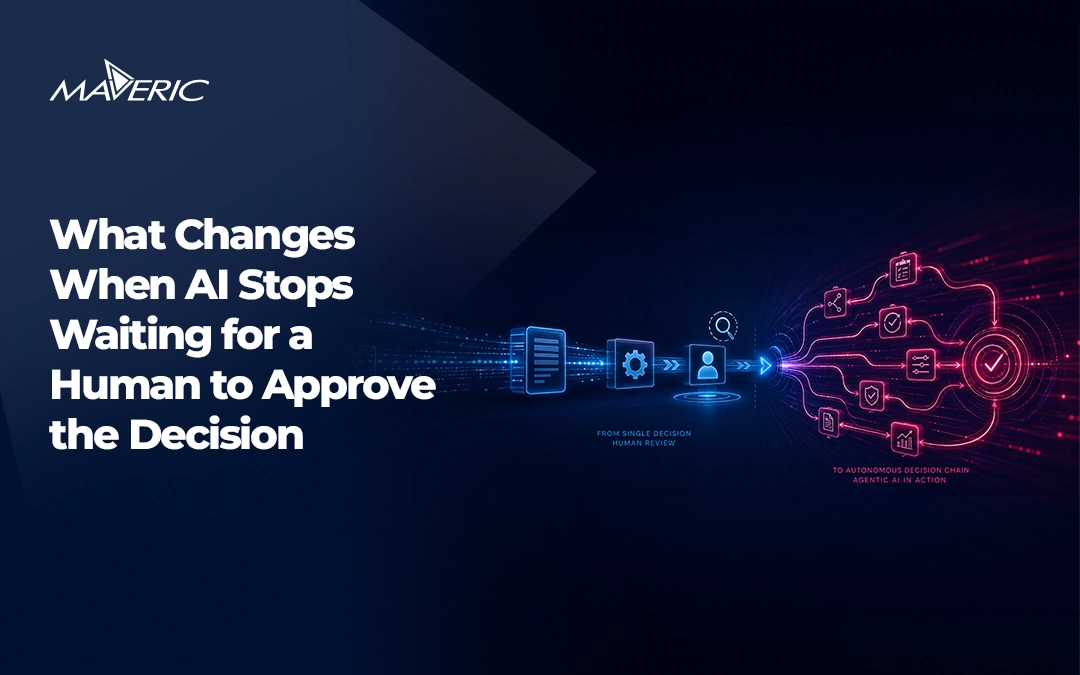
An agentic system doesn’t produce a single output a human then acts on. It executes a multi-step workflow autonomously – initiating a loan origination check, running the verification steps, reconciling the result against policy, and moving to the next stage, all without a human reviewing each individual step along the way. The “decision” a customer or a regulator would want explained is no longer one event. It is a chain of dozens of smaller agent actions, several of which may never surface as an event a compliance function would think to examine on its own.
There is no single decision point left for a human to review, because the decision itself no longer exists as a single point.
This is not a hypothetical future scenario institutions can plan for once agentic deployment eventually arrives. It is already in production, in some form, at most of the institutions this series has been written for – agentic patterns showing up in software delivery pipelines, in autonomous fraud disposition, in AI-driven compliance monitoring that is itself making determinations without a human reviewing every one.
Why Current Regulation Hasn’t Caught Up – and Why That’s an Opportunity, Not Just a Gap
SR 26-2 and the EU AI Act are both, at their core, still built around the assumption of a human accountable for reviewing an AI-assisted outcome. Neither instrument yet fully addresses what accountability means when the outcome is the product of an autonomous decision chain with no single human review point. That regulatory gap will close eventually – it always does. The genuine strategic question for a CIO or CRO today is whether their institution wants to be the one whose internal practice ends up defining what that standard looks like, or the one examined against a standard someone else-a regulator, a competitor, an incident – wrote first.
What Has to Be Redesigned, Specifically
The layer that breaks first is accountability and audit – the part of any governance architecture responsible for outcome ownership and the audit trail. In a single-decision model, the auditable unit is straightforward: one model, one output, one reviewer. In an agentic system, the auditable unit has to become the decision chain itself – every agent action in the sequence, traceable and attributable, with a clear answer to “who is accountable for this outcome” that doesn’t depend on identifying a single human who reviewed a single step.
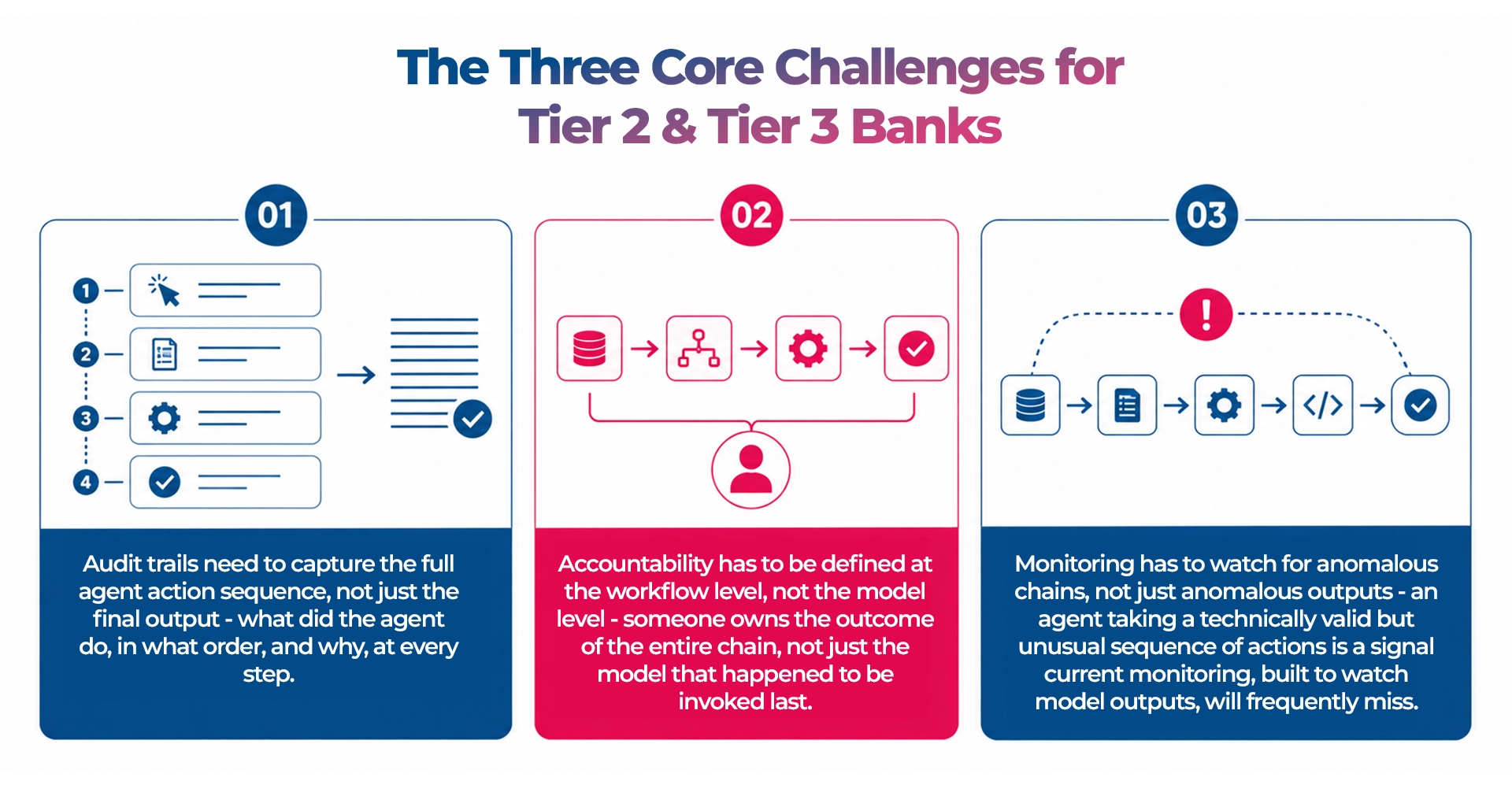
- Audit trails need to capture the full agent action sequence, not just the final output – what did the agent do, in what order, and why, at every step.
- Accountability has to be defined at the workflow level, not the model level – someone owns the outcome of the entire chain, not just the model that happened to be invoked last.
- Monitoring has to watch for anomalous chains, not just anomalous outputs – an agent taking a technically valid but unusual sequence of actions is a signal current monitoring, built to watch model outputs, will frequently miss.
The Institutions Building This Now Are Setting the Standard
This is precisely why the shift matters strategically, not just technically. The banks building agentic governance capability now – before a regulator has specified exactly what “accountability” needs to mean for autonomous decisioning – are, in effect, the ones defining the practical standard their peers will eventually be examined against. That is a materially better position than waiting for the standard to be written and then retrofitting governance to match it after the fact, under an examination timeline rather than one the institution controls.
The question is not whether agentic AI is coming to banking operations. Every whitepaper in this research series has already documented it in production. The question is whether the accountability architecture underneath it gets built deliberately, ahead of the regulatory requirement, or reactively, after the requirement – or the incident – arrives first.
Making This Concrete
Consider a trade finance operation running an agentic workflow that handles document verification, sanctions screening, and initial approval routing for a routine letter of credit – the kind of workflow institutions are already deploying to reduce processing time from days to hours. In the single-decision model of governance, there would be one point to review: did the system flag or clear the transaction, and was a human satisfied with that output. In the agentic version, the system has made a sequence of smaller determinations along the way – which documents it treated as sufficient, which sanctions list matches it treated as false positives, which routing exception it decided didn’t warrant escalation – several of which never generate an event a compliance dashboard, built to watch final outputs, would ever surface.
If that transaction is later questioned – by a customer, an auditor, or a regulator – the institution needs to reconstruct not one decision but the entire reasoning chain behind it. Governance frameworks built around single-output review simply don’t capture the information needed to do that. This is not a reason to slow agentic deployment; the efficiency case for it is real and growing. It is a reason to build the audit and monitoring layer for the chain before deployment scales further, rather than discovering the gap when the first transaction actually gets questioned.
This is the forward-looking argument set out in Paper 5 of Maveric’s CIO Mandate Series :
AI Compliance and Regulatory Governance: A CIO & CRO Mandate for Global Banks
including what the Accountability & Audit layer of an enterprise governance architecture needs to become for agentic systems specifically.