

Digital banking made services accessible through more channels. AI-first banking changes the operating logic behind those channels. It embeds intelligence into decisions, workflows, core systems, and software delivery. For regional bank CIOs, the priority is not accumulating AI use cases. It is creating an operating model that can turn context into governed action at scale.
What is the defining shift from digital-first to AI-first banking?
Digital-first banking digitizes predefined services and workflows. AI-first banking uses data and context to shape decisions dynamically. The shift is from systems that execute instructions to systems that interpret situations, recommend actions, and increasingly orchestrate outcomes within governed boundaries.
Digital banking optimized access, not decision logic
North American banks have spent years improving mobile journeys, automating back-office tasks, moving workloads to the cloud, and exposing services through APIs. Those investments reduced friction, but much of the underlying decision logic remained static. A digital loan application can still depend on sequential document checks. A mobile servicing journey can still hand an incomplete case to an employee. A modern front end can still sit above fragmented customer and transaction data.
AI changes the problem. The relevant question is no longer whether a process is digital. It is whether the bank can assemble the right context, make a defensible decision, and act while the opportunity or risk is still live. This matters for Tier 2 and Tier 3 institutions because they cannot outspend national banks across every channel. They can, however, compete through faster decisions, lower customer effort, and more focused operations.
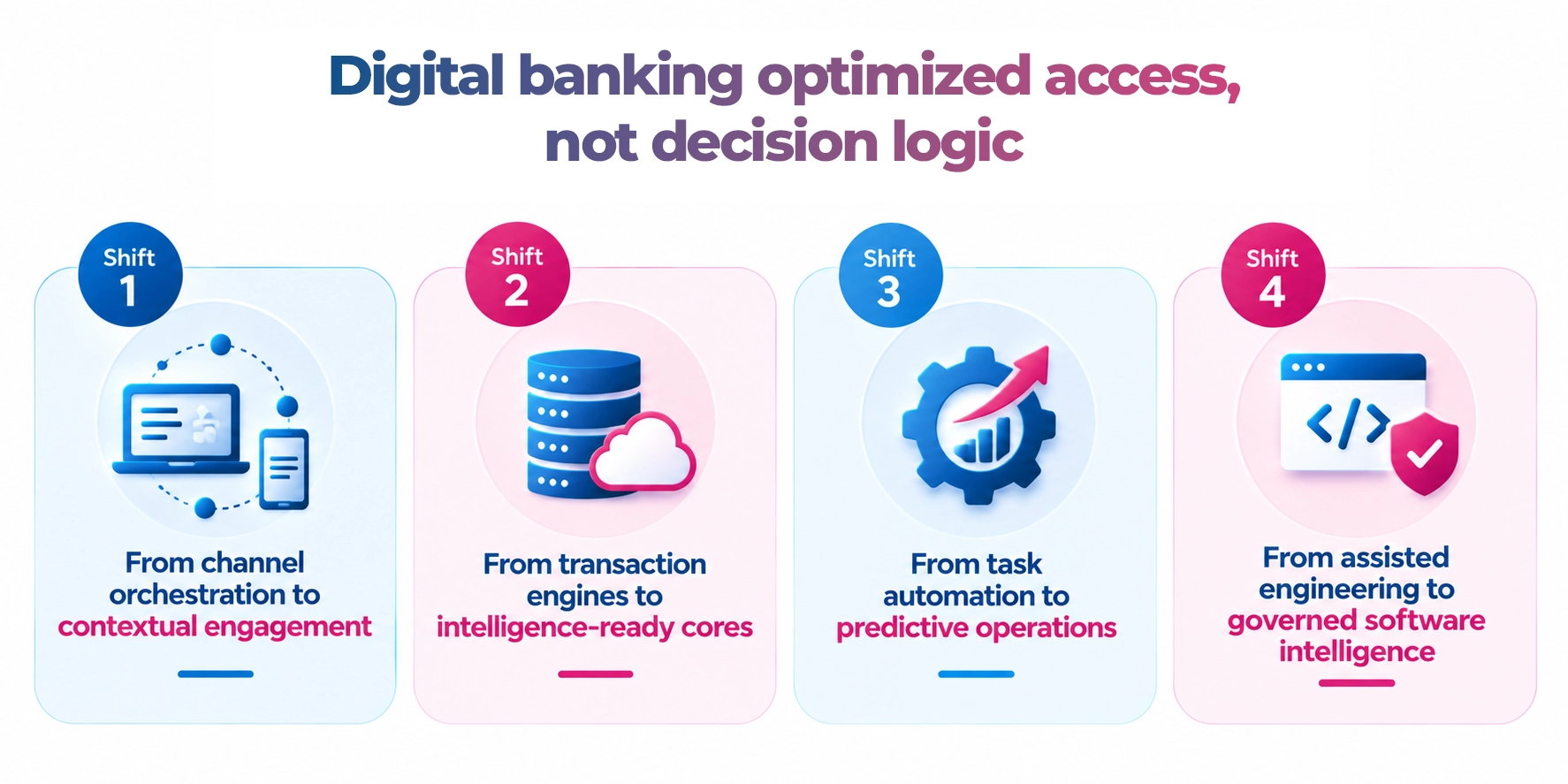
Shift 1: From channel orchestration to contextual engagement
Digital transformation organized customer experience around channels and journeys. AI-first banking organizes it around intent and context. A customer asking about a declined payment may also be traveling, nearing a credit limit, and showing behavior inconsistent with fraud. The best response cannot be selected from the channel alone. It requires a current, permissioned view of the customer, the transaction, applicable policy, and risk.
For CIOs, this changes architectural priorities. Customer data must be retrievable across systems with clear consent and lineage. Models must work with both structured records and unstructured content. Escalation must carry the evidence and reasoning that an employee needs. The outcome is not simply personalization. It is a servicing model that can resolve more needs without sacrificing control.
Shift 2: From transaction engines to intelligence-ready cores
A core banking system remains the system of record, but an AI-first bank needs more than accurate posting and balances. It needs an intelligence layer capable of interpreting transaction narratives, product rules, documents, customer history, and real-time signals.
This does not require a reckless core replacement. Regional banks can use progressive modernization: expose stable domains through APIs, separate data and decision services from legacy constraints, introduce event-driven patterns where the business case is clear, and govern the context supplied to AI. The architectural objective is to let intelligence operate close enough to the core to affect outcomes without weakening the controls that protect the ledger.
Shift 3: From task automation to predictive operations
Traditional automation follows a known path. AI can recognize patterns, propose next actions, and coordinate work across exceptions. In deposit operations, payments, disputes, lending, and financial crime operations, this can move teams from queue management toward risk-based intervention.
The operational model must still define authority. Low-risk, reversible actions may be automated. Material decisions may require maker-checker review. Ambiguous cases should be routed with a confidence score, supporting evidence, and a clear reason for escalation. The business value comes from combining automation with judgment, not from maximizing touchless processing at any cost.
Shift 4: From assisted engineering to governed software intelligence
Generative AI can help create requirements, code, test cases, documentation, and release evidence. The larger opportunity is an engineering system that connects those activities, preserves traceability, and identifies risk before release.
For a regional bank with limited specialist capacity, this can increase delivery throughput. It can also magnify defects if generated artifacts are accepted without context-aware validation. CIOs should measure escaped defects, coverage of material business rules, change failure rate, and audit evidence completeness alongside developer productivity.
A practical agenda for regional bank CIOs
Start with a business decision or workflow where delay, inconsistency, or manual effort has a measurable cost. Map the data, policies, systems, human approvals, and evidence required to produce a defensible outcome. Then decide what should be inferred, what should remain deterministic, and where human accountability belongs.
This sequence prevents an AI portfolio from becoming a collection of pilots. It also creates reusable capabilities: governed context, evaluation methods, observability, exception routing, and decision lineage. Each new use case should strengthen that foundation.
The board-level conversation should therefore move beyond the number of models deployed. More useful measures include time to a trusted decision, percentage of outcomes with complete lineage, exception resolution time, customer effort, and value realized per production use case.
What this means for banking leaders
- Tie every AI deployment to a material banking decision or workflow and a named outcome owner.
- Design data, evaluation, governance, and human accountability as production capabilities, not pilot paperwork.
- Modernize progressively around business decisions while preserving the integrity of systems of record.
- Measure business value and trust together so speed does not obscure hidden risk.
Conclusion
AI-first banking is a redesign of how the bank senses, decides, and acts. Digital channels remain important, but they are no longer the center of transformation. The differentiator will be the operating system behind them: intelligence embedded in the core, governed across the lifecycle, and measured through business outcomes. For regional banks, disciplined sequencing offers a credible path to compete without copying the scale or spending patterns of the largest institutions.
Explore the full executive perspective
From Digital-First to AI-First: The Mandate Reshaping the Banking CIO Agenda develops the architecture, operating implications, and leadership priorities behind this shift.
FAQ
1. What is AI-first banking?
AI-first banking embeds AI into enterprise decisions, workflows, core systems, and customer interactions so the bank can interpret context and act within governed boundaries.
2. How is it different from digital banking?
Digital banking makes predefined services available through digital channels. AI-first banking changes how decisions and services are generated using current context.
3. Does a regional bank need to replace its core first?
No. Progressive modernization can expose core domains, improve data access, and introduce governed intelligence without a single high-risk replacement program.
4. Which AI use cases should regional banks prioritize?
Prioritize decisions or workflows with measurable delay, manual effort, inconsistency, fraud exposure, or customer friction, and where adequate data and control ownership exist.
5. How should success be measured?
Combine operational, business, and trust measures, including cycle time, loss reduction, customer effort, decision explainability, lineage completeness, and exception quality.