

AI transformation in banking, applied to onboarding and servicing, means moving customer processes from self-service, in which the customer performs the data entry a teller once handled, to zero-service, in which the bank’s AI proactively assembles what it needs and the customer simply confirms it
For CIOs and COOs at regional and community banks, onboarding is typically the first place this transformation produces a figure the board can evaluate directly: hours reduced to minutes, or minutes reduced to clicks.
Why Onboarding Has Remained Expensive Despite a Decade of Digital Investment
Onboarding remains one of banking’s most expensive and fragile processes, positioned at the intersection of two competing demands that no purely digital solution has fully reconciled: regulators require absolute thoroughness, and customers expect instant access. Digital Banking’s answer to this tension was self-service, which meant the customer entered data a teller had previously entered. It removed friction from the bank’s side of the process without removing the underlying manual review, document validation, and address checking that made onboarding slow in the first place.
AI transformation reconciles that tension through three structural shifts rather than a single interface redesign.
Three Structural Shifts Behind AI-Driven Onboarding
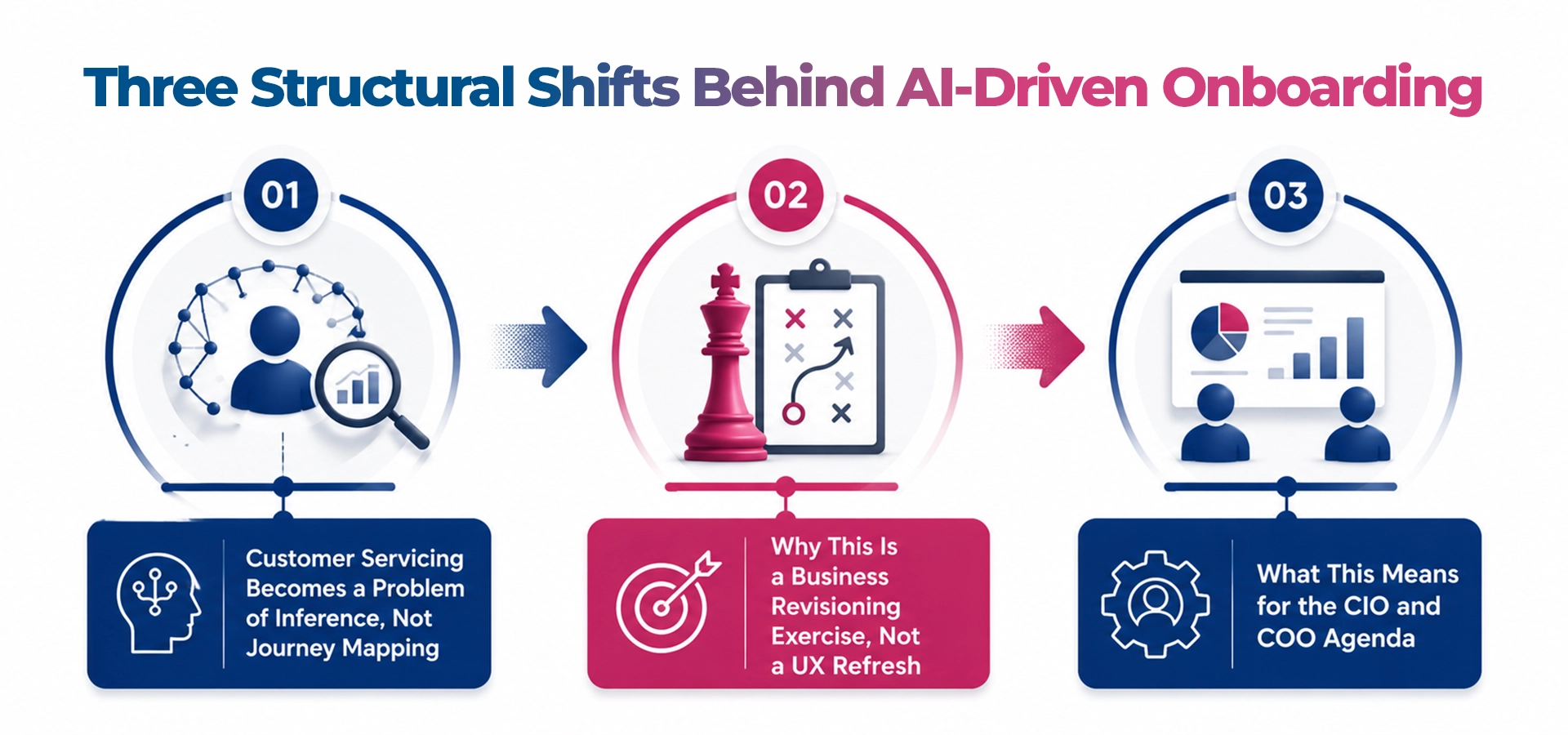
The first shift moves onboarding from self-service toward zero-service. Through intelligent data orchestration, the system proactively draws contextual information from CRM records, government registries, third-party data providers, and digital behavioral footprints, rather than requiring the customer to supply it manually, while still satisfying the Customer Identification Program requirements the Bank Secrecy Act imposes on every new account regardless of how the underlying data was gathered. In Maveric’s recent regional banking implementations, this capability has reduced customer onboarding times from hours to roughly 8 to 10 clicks through AI-powered verification and account opening, an illustrative implementation result rather than an independently benchmarked industry figure.
The second shift replaces static checklists with contextual status validation. The traditional source of onboarding delay is the human effort required to review documents, validate addresses, and pursue missing information against a rigid checklist. Agentic workflows handle this validation continuously, using contextual stratification rather than static, rule-based processing: evaluating a specific customer’s risk profile in real time, processing low-risk applicants straight through instantly, and routing genuinely high-risk anomalies to compliance officers with a summarized explanation of why the escalation occurred.
The third shift unifies KYC, AML, and FCM infrastructure. Know Your Customer, Anti-Money Laundering, and Financial Crime Management have historically been managed as separate compliance programs with siloed tooling, creating data redundancy and elevated false-positive rates. AI enables convergence of these disciplines by processing structured and unstructured data concurrently. Institutions that build this convergence as unified infrastructure from the outset tend to realize substantially higher fraud-loss reductions and avoid the integration debt of reconciling the systems afterward.
Customer Servicing Becomes a Problem of Inference, Not Journey Mapping
In the digital era, customer servicing centered on journey mapping: banks invested heavily in UI and UX design to identify friction points across digital interfaces. That approach was largely an operations problem solved by shifting the burden of data entry onto the customer through self-service. AI transformation reframes the underlying objective, from optimizing a predefined digital journey to dynamically orchestrating the correct outcome without requiring the customer to do the work.
That shift is most evident in how contact centers operate. First-generation, rule-based chatbots functioned as rigid decision trees; the moment a customer’s issue fell outside the programmed rules, the system failed, and escalation to a human agent became inevitable. AI resolves this by introducing genuinely multimodal capability, processing and pivoting seamlessly between text, voice, image, and video within a single interaction, rather than offering multiple separate channels in the manner of digital banking. When a customer struggles with textual instructions, the system interprets the confusion and dynamically switches modes, generating a personalized visual walkthrough rather than repeating the same text. When escalation to a human agent is genuinely necessary, the system transfers complete context, including sentiment analysis and recommended resolution steps, rather than requiring the customer to restate the problem. Deployments combining AI-driven Agent Assist with an intelligent knowledge management platform have pushed First Call Resolution rates as high as 90% for some institutions in Maveric’s implementation work, an illustrative result rather than an industry-wide benchmark, but a meaningful reduction in both cost-to-serve and customer friction where it has been achieved.
Why This Is a Business Revisioning Exercise, Not a UX Refresh
shorter flows, more responsive chat interfaces. AI transformation requires something more structural. It involves re-architecting how the institution sources data, drawing dynamically on internal and external sources rather than relying on pre-structured data lakes built for anticipated queries, how it processes decisions, applying context-driven stratification and continuous pattern validation rather than static rule-based workflows, and how it engages customers, through multimodal interaction rather than multi-channel self-service. That architectural investment costs more upfront and takes longer to ship than a UX refresh, which is precisely why so many institutions choose the UX refresh instead and see proportionally smaller results. None of these three shifts occurs as a byproduct of a UX redesign; each has to be deliberately engineered into the underlying architecture.
What This Means for the CIO and COO Agenda
Banking has always been built on trust and efficiency, and AI transformation changes how both are earned. Trust is no longer established by how quickly a customer can click through a form, but by how precisely the institution’s intelligence can anticipate the customer’s needs and orchestrate the solution independently, with governance and auditability engineered into the process from the outset rather than layered on afterward. Institutions that treat onboarding and servicing as an architectural investment, rather than a periodic redesign, are the ones that convert this transformation into a durable operating advantage.
Further reading: From Digital-First to AI-First: The Mandate Reshaping the Banking CIO Agenda, part of Maveric Systems’ research on AI-first banking.
FAQ
1. What is “zero-service” onboarding in banking?
It is the stage beyond digital self-service, in which AI proactively draws contextual customer information from CRM records, government registries, and third-party data providers instead of requiring the customer to enter it manually, while still meeting Bank Secrecy Act Customer Identification Program requirements. In practice, this has reduced onboarding from hours to roughly 8 to 10 clicks in some regional banking implementations, an illustrative result rather than an audited industry figure.
2. How does AI reduce onboarding delays without weakening compliance?
Through contextual stratification: evaluating a customer’s specific risk profile in real time, processing low-risk applicants straight through instantly, and routing genuinely high-risk anomalies to compliance officers with a summarized explanation of why the escalation occurred, rather than applying the same rigid checklist to every applicant regardless of risk.
3. Why should banks unify KYC, AML, and FCM infrastructure during an AI transformation?
Because managing them as separate, siloed compliance programs creates data redundancy and elevated false-positive rates. Building unified infrastructure from the outset, rather than integrating the systems afterward, tends to produce substantially higher fraud-loss reduction and lower long-term integration costs.
4. How does AI change customer servicing beyond adding another chatbot?
It introduces genuine multimodal capability, allowing the system to pivot seamlessly between text, voice, image, and video within a single interaction, and it transfers full context, including sentiment and recommended resolution steps, when escalation to a human agent is necessary. Some deployments combining this with Agent Assist tooling have reached First Call Resolution rates around 90%.
5. Is AI-driven onboarding and servicing transformation realistic for a bank without a large digital team?
Yes, though it requires treating the initiative as a business revisioning exercise rather than a UX refresh: re-architecting how data is sourced, how decisions are processed, and how customers are engaged, rather than simply redesigning existing forms and chat interfaces.