
Displaying search results for ""

BAAS (Business Banking as a Service) is Empowering Your Customers

BAAS (Business Banking as a Service) is Empowering Your Customers

Commercial banking is confronted with a potentially more complex environment than ever before: customer needs, rapid improvement in digital capabilities, digitization, and new sources of competition are compelling banks to innovate immediately.

For one, customers demand immediate, smooth, and omnichannel banking. Secondly, the pressures for product and service innovations are made more complex by the embedded demand for financial services in corporate processes.

Data, Digital, and Technology impact Business Banking and Empowers Customers

As superior technology systems integrators like Maveric would report, banks are preparing for cloud- and API-enabled ecosystems with the help of AI-enabled, networked technology.
the-rise-as-banking-as-a-service

Cloud and API technology adoption

Commercial banks collaborate with modern infrastructure providers to upgrade or overhaul legacy technologies. Digital services, such as lending origination and onboarding, replace manual processes and antiquated systems with a single, end-to-end solution that serves SMEs, corporations, and commercial clients. As part of digital transformation, banks have made substantial investments in automating their origination platforms. Moreover, APIs facilitate new collaborations and partnerships between banks, digital banking enterprises, and Fintechs. Moreover, with lower entry barriers, new cloud-based lending services are being rapidly implemented.

There is an immediate need to accelerate the time to market

Digital disruptors innovate through automated document population, e-verification, and verified external data validation to ease servicing evaluations, financial spreading, and deal structuring. As a result, the time required to make a credit judgment quickly decreases.

Data value creation will differentiate performance

Leading commercial banks are transforming their roles to become both producers and consumers of data, for instance, by selling their payment, trade finance, and lending capabilities to other entities. The vast amounts of data created enable commercial banks to strengthen their client connections by personalizing digital experiences and sending highly customized, timely messages based on in-depth consumer information. Niche solutions can be incorporated in a data environment where rivals can be partners.

Integrating financial crime prevention, cybersecurity, data privacy, and regulatory requirements into the engineering and design lifecycle

By integrating new technologies, collaborating throughout the ecosystem, and focusing on data and client security, banks are altering their capacity to combat financial crime. Cybersecurity, once considered the final frontier is now the de-facto foundation of trust and an integral part of every product and service.

Architecting the modern-day commercial banking ecosystem

Leading commercial banks have created platform-based ecosystems that extend beyond traditional banking and cater to a broad spectrum of customers’ growing needs. The future of commercial banking is platform-based service models and competitive ecosystems enabled by data and cloud technology with API access. This situation allows banking systems of the next generation to service multiple individualized client segments. “Platformization” will increase the availability and velocity of innovation for products and services and dramatically cut the time required to gain mainstream adoption. It can also enhance banks’ data collection and analytical capabilities, giving them a significant advantage over non-financial competitors.

Conclusion

Commercial banking is undergoing fast change through digitization, more competition, and stricter regulation. Small and medium-sized commercial banks are adapting to remain competitive. The way forward for Banks and leading FIs lies in evaluating their maturity, shaping their transformation agenda and strategies, and deploying enterprise-wide enhancements to the goal of value maximization.

About Maveric Systems

Starting in 2000, Maveric Systems is a niche, domain-led Banking Tech specialist partnering with global banks to solve business challenges through emerging technology. 3000+ tech experts use proven frameworks to empower our customers to navigate a rapidly changing environment, enabling sharper definitions of their goals and measures to achieve them.

Across retail, corporate & wealth management, Maveric accelerates digital transformation through native banking domain expertise, a customer-intimacy-led delivery model, and a vibrant leadership supported by a culture of ownership.

With centers of excellence for Data, Digital, Core Banking, and Quality Engineering, Maveric teams work in 15 countries with regional delivery capabilities in Bangalore, Chennai, Dubai, London, Poland, Riyadh, and Singapore.


View

5 Ways FinTech’s are Transforming Banking

5 Ways FinTech’s are Transforming Banking

Banks have used technology to deliver financial services for decades – Credit cards in the ’50s, internet banking in the ’90s, and contactless payments in the ’00s. However, the stratospheric use of technology has only upped the ante. Some instances highlight this. Like the Neo banks (Brazil’s Nu Bank, Berlin’s N26, and the American Chime) operate their complex operations purely on tech without physical branches.

Innovations that FinTech’s represent are primarily focused on improving customer-facing facets. The three growth levers that drive Fintech growth rates are – superior CX driven by the high trust earned, new-age branding, and marketing approaches, including gamification and cost optimization possible because of deep venture capital and leaner virtual operations.

FinTech’s straddles a complex intersection of financial services and technology sectors that disrupt the traditional value chain.


5 Ways FinTech’s are Transforming Banking


1.  Disintermediation is the most decisive Fintech impact. 

Fintechs have primarily disrupted consumer banking, fund transfer & payments, and consumer & commercial lending by offering new customer-centric solutions, leveraging data and analytics to enhance interactions, build trust, and even powering business outcomes with sophisticated operational abilities. As the industry grapples with changing customer behavior, new technologies, and new distribution and business models, Fintechs’ product focus on millennials and Gen Z is characterized by enhanced accessibility, convenience, and tailored products.

2.  With Blockchain technology, Fintech’s game-changing prowess grows stronger.

As Blockchain tech pushes for a democratized financial landscape, Fintechs eye its unprecedented disruption potential. Be it through the use cases of borderless payments, altering KYC forever, bankless financial management, and revolutionary optimization, Blockchain’s digital ledger systems attract because of its un-hackable nature and by removing third-party intermediaries. Like ERP software allows functions and entities to optimize enterprise processes by sharing data and logic, Blockchain enables entire industries to optimize operations by sharing data between businesses with competing economic objectives. With infrastructure cost reduction as a key differentiator, the blockchain trend will likely throw up the highest Fintech winners in the next few years.

3.  Fintech’s infuse agility like never before

As mentioned earlier, Fintech innovations reimagine customer-facing digital experience blocks. With advanced self-service capabilities, Fintechs have revitalized the customer banking possibilities. Today opening new accounts, applying for loans, buying insurance, understanding financial positions, and making better financial decisions are seamless activities customers use and love because of Fintechs. These functions (also how mobile wallets ‘ talk’ to banks) are possible because of API development (Application Program Interfaces). In the same vein, POS terminals have revolutionized the way consumers spend and receive funds. Any discussion on agility is incomplete without acknowledging the growing influence of conversational banking (or voice bots) and the continual advancements in user authentication and security.

4.  Bank-as-a-service – The change agent of 2020s. 

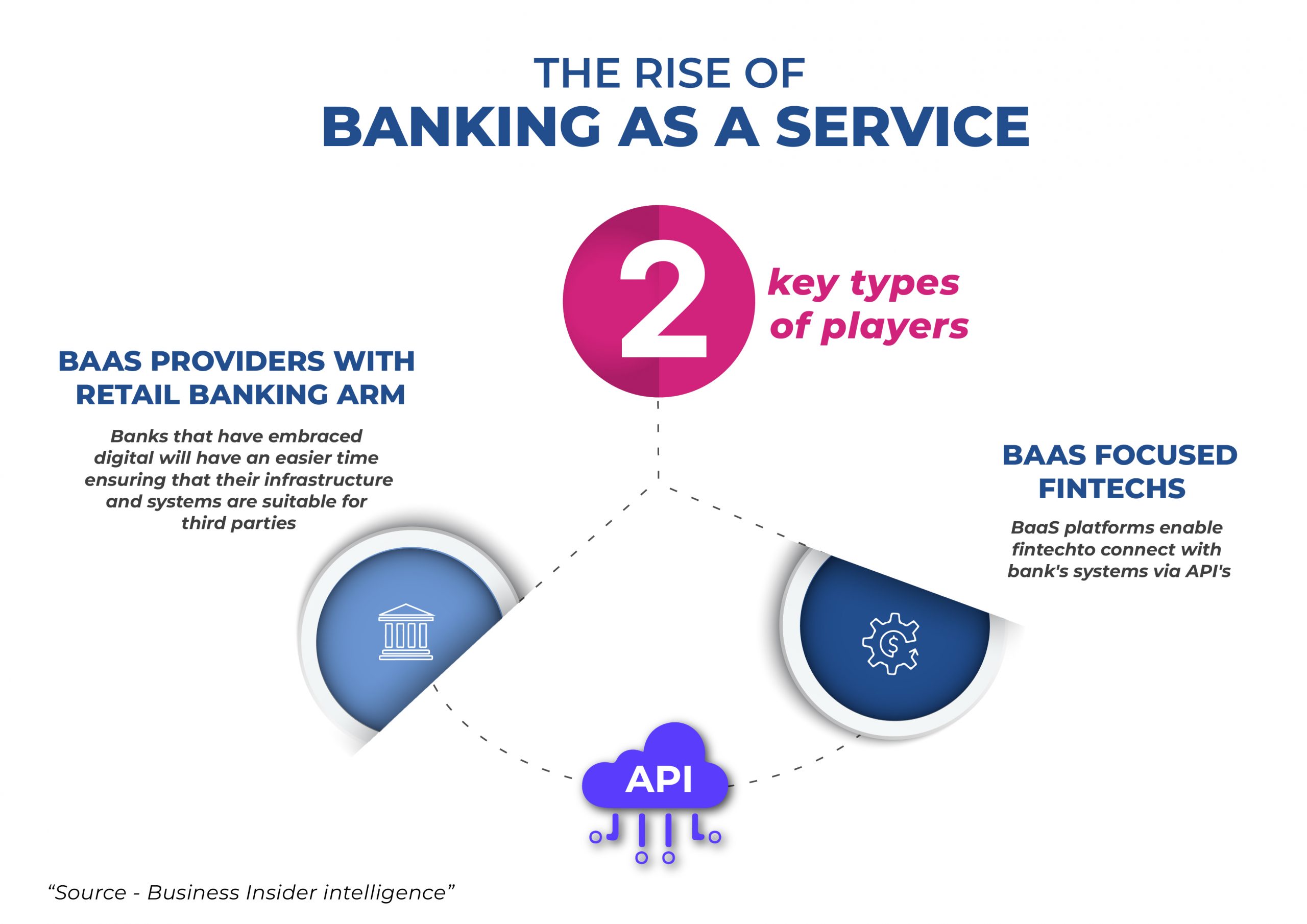
BaaS is a type of developer platform designed to empower fintech companies. The Bancorp Bank, BBVA Open Platform, and Green Dot have launched their own BaaS platforms.

To access the payments system and store money, Fintechs form banking partnerships. These partnerships are becoming the product themselves. As several banks enable digital disruptors and neo-banks to gain access to inexpensive deposits, they earn valuable fee income. Treasury Prime sells BaaS enablement software to multiple banks while SynapseFi and Cambr build API platforms for neo-banks. Along with SaaS Fintechs that offer cost reductions to banks, the BaaS ecosystem is poised for hyper-growth.

5.  Technology Players turning Fintechs – The Maze Multiplies. 

Fundamentally, Banks sit at the sweet spot of data and technology. One disruptive business model gaining strength is high-technology companies (Amazon, Google, and the like) entering the Fintech space. The two domains, banking and software development, share similar concepts – record-keeping, tracking transactions, and predictive modeling. Digital-first companies turn their eyes to banking – Apple’s credit card, WhatsApp payments, Instagram shopping, Google Pay, and Facebook’s foray into financial services – are all developments that point to a more serious future. Expect the resources and investments to multiply, and the partnerships that aim to scale growth will transform banking in ways we don’t fathom.

In sum, leading Banks are learning from the Fintech story. The banking space is poised for exciting developments by encouraging and incubating internal innovation, creating an agile enterprise, aggressively digitizing the customer experience, adopting an entrepreneurial mindset, and overhauling brand positioning to attract purpose-driven demographics.


View