


Of the four fault lines that stall banking transformation programs, trust debt is the least likely to appear on a project plan and the most likely to be the reason a program is still in review six months after it should have shipped. A capability that a bank cannot explain to a regulator, an auditor, or a customer does not simply proceed to production on schedule. It gets sent back sometimes repeatedly and every review cycle adds weeks or months that were never in the original timeline.
Trust Debt Is Different From the Other Three Fault Lines
Governance debt, capability debt, and data debt are all, in a sense, resourcing problems they can be addressed by bringing in the right function, the right specialist, or the right data foundation earlier. Trust debt is different: it is a design problem. A model architecture chosen for its predictive performance, without regard for whether its outputs can be explained, cannot be made explainable after the fact by adding process around it. The explainability has to be a property of the model and the system itself, decided at the point the architecture is chosen which means trust debt, more than the other three fault lines, is accumulated at decisions made very early in a program, often before anyone has framed the choice as a risk decision at all.
Why This Specifically Slows Delivery, Not Just Increases Risk
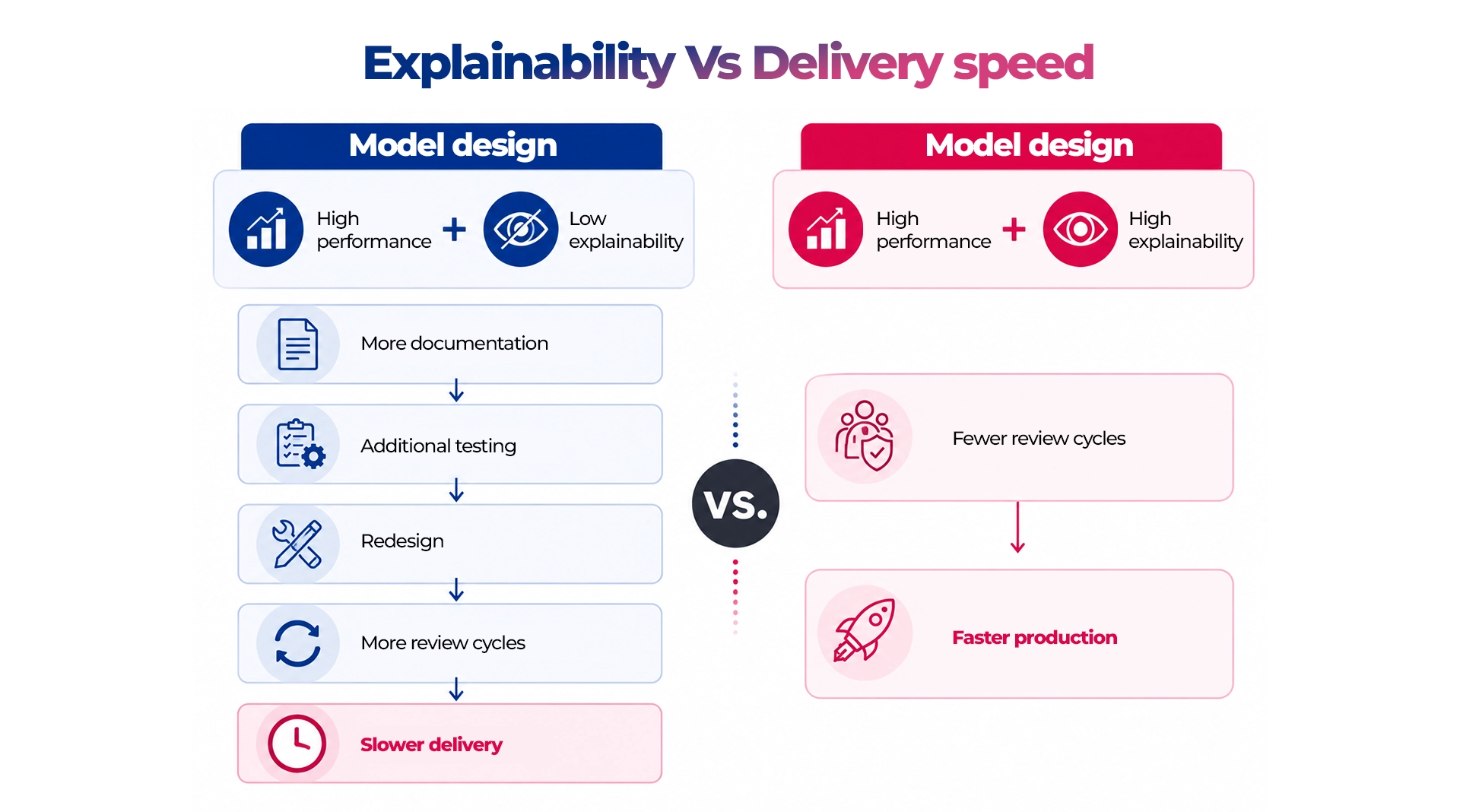
It is tempting to think of explainability primarily as a compliance nice-to-have, important for avoiding a fine, but not directly connected to whether a program ships on time. The data on how AI initiatives actually move through banking governance suggests the opposite: explainability is one of the most direct drivers of delivery speed, because it determines how many review cycles a capability needs before it is cleared for production.
A model that can show, in terms a reviewer can understand, why it produced a specific output a declined loan application, a flagged transaction, a risk score moves through a governance review as a single pass in most cases. A model that cannot produce that explanation typically triggers a request for more documentation, additional testing, or in some cases a redesign, each of which adds a full review cycle. Programs carrying significant trust debt do not fail outright as often as they simply take far longer than planned, cycling through reviews that a more explainable design would have cleared the first time.
The Explainability-Performance Trade-Off Executives Need to Plan For
There is a real, well-documented trade-off in model selection: the most powerful, highest-performing model architecture is not always the most explainable one. Some of the AI techniques capable of the highest predictive accuracy are also among the hardest to explain in terms a regulator or a customer-facing employee can use to justify a specific decision.
This trade-off does not have a single correct answer it has to be resolved deliberately, based on the stakes of the decision the model is making. For high-stakes, customer-facing decisions with direct regulatory exposure credit decisions, collections actions, account closures the evidence supports favoring interpretable architectures even at some cost to raw predictive performance, because the delivery-speed and regulatory-risk cost of an unexplainable model in this category consistently outweighs the performance gain. For lower-stakes, internally reviewed use cases where a human remains fully in the loop and the AI system’s role is to prioritize or assist rather than decide the balance can reasonably shift further toward performance, because the explainability bar a reviewer will apply is lower.
Programs that make this trade-off explicitly, as a deliberate design decision reviewed alongside performance benchmarks, accumulate far less trust debt than programs that select a model architecture purely for accuracy and address explainability as an afterthought once governance asks for it.
Trust Does not End at Deployment, It is a Lifecycle Commitment
Everything above concerns trust debt accumulated at the design stage, decisions made, or not made, before a model reaches production. But there is a second half to trust debt that shows up after go-live, and it is becoming the more consequential half as AI moves from experimentation into core banking processes. Unlike earlier generations of software, an AI system does not stay static once deployed, it continues to learn from data and adapt to changing conditions, which means a model judged safe and explainable at launch can drift away from that standard months later without anyone noticing, unless something is actively watching for it.
This reframes what “trust” has to mean operationally. It is no longer sufficient to ask whether a model was explainable at the point it was approved. The more complete question the one banking leadership increasingly has to be able to answer for a board, a customer, or a regulator is whether the system continues to be governed, audited, monitored, and corrected throughout its entire live operation, not just validated once before launch.
What Full-Lifecycle Trust Looks Like in Practice
A few concrete patterns from real AI deployments in banking illustrate what this looks like when it is built in deliberately rather than assumed. In one large-scale knowledge-management deployment inside a global consulting firm, quality was not measured once during testing and left alone the system used continuous, automated scoring to track answer faithfulness, contextual precision, and semantic accuracy in real time, on every response, for the life of the system. Guardrails enforced policy-aligned outputs at every single response, not just at the model-selection stage, and every answer cited its source documents directly, so a reviewer could trace any output back to the specific policy or SOP behind it without having to trust the model’s word for it.
A separate customer-service transformation at a tier-one bank applied the same discipline to a conversational AI system handling live customer interactions: rather than validating the model’s ground truth once before launch, the program automated ground-truth validation on an ongoing basis, using a second AI system as an evaluator to continuously assess the primary model’s live performance catching drift or degradation as it happened, not months later during a scheduled review. The same deployment built in automated PII redaction as a standing control on every interaction, not a one-time privacy review at design time.
Both examples share the same underlying architecture principle: trust is not a milestone the model passes once. It is a continuously monitored property of a live system, with the same rigor applied to what the model does in its hundredth day of production as what it did in testing.
What Trust Debt Looks Like Inside a Program
A handful of patterns recur across programs carrying significant trust debt. The model’s decision logic exists only inside the model itself, with no parallel documentation a non-technical reviewer can use to understand it. Explainability testing is scheduled after the model is already built and performing well, rather than as a design criterion evaluated alongside accuracy from the start. Bias and fairness testing is segmented only at an aggregate level, missing disparate impact on specific customer groups that a more granular review would catch before a regulator does. And perhaps most tellingly: the team building the model cannot describe, in plain language, why it produces the outputs it does only that it does, reliably, in testing.
Building Trust In, Rather Than Reviewing It In
The single highest-leverage change available to programs carrying trust debt is the same one that applies to governance debt more broadly: move the trust checkpoint earlier, into the design phase, rather than treating it as a gate the finished model has to pass through. Explainability requirements, human-oversight checkpoints, and segmented fairness testing, evaluated alongside performance from the point a model architecture is first selected, consistently produce systems that clear governance review faster not because the bar is lower, but because the system was built to meet it from the start, rather than retrofitted to meet it under review pressure. Increasingly, that same discipline has to extend past go-live: continuous quality scoring, automated ground-truth evaluation, and standing controls like PII redaction are what keep a model trustworthy on its hundredth day in production, not just its first.
For any institution running an AI initiative that has stalled in review longer than expected, the most useful diagnostic question is rarely whether the model performs well. It almost always does. The more useful question is whether anyone on the team can explain, in terms a regulator would accept, exactly why it produces the outputs it does and whether that explanation will still hold up after the model has been learning from live data for six months and if the honest answer to either is no, that gap, not the model’s accuracy, is very likely what is actually holding up the program.
Related reading:
- Why Most Banking Transformations Fail at Execution (pillar guide)
- Explainable AI in Banking: Why Black-Box Models Will Not Survive
- AI Governance in Banking: From Frameworks to Real Control
FAQ
1. How is trust debt different from governance, capability, or data debt?
The other three are largely resourcing problems, addressable by bringing in the right function or foundation earlier. Trust debt is a design problem: explainability has to be a property of the model architecture chosen, decided before anyone has typically framed the choice as a risk decision at all.
2. Does explainability always mean choosing a less accurate model?
Not universally. For high-stakes, customer-facing decisions with direct regulatory exposure, credit decisions, collections, account closures, the evidence supports favoring interpretable architectures even at some cost to raw performance. For lower-stakes, human-in-the-loop use cases, the balance can reasonably shift toward performance.
3. Does a model stay trustworthy once it clears governance review at launch?
Not automatically. An AI system continues to learn and adapt after deployment, so a model judged explainable at launch can drift months later without anyone noticing unless something is actively monitoring it. Full-lifecycle trust requires continuous quality scoring and ongoing ground-truth validation, not a one-time approval.