



A transformation program can be fully staffed by every measure a headcount report tracks, and still lack the specific capability it needs to deliver. This is one of the more counterintuitive findings running through the current data on banking transformation execution, and one of the most consequential, because it means the standard resourcing question executives ask do we have enough people is often the wrong question entirely.
The Real Constraint Is Specialist Depth, Not Headcount
Recent global workforce research spanning roughly 39,000 employers across 41 countries found that, for the first time, AI-related skills have become the single hardest capability category to hire for anywhere in the world overtaking traditional engineering and IT roles, which had held that position for years. Inside banking specifically, a 2026 survey of bank CEOs, chairs, and independent directors found 69% naming AI expertise as the capability their C-suite most urgently needs ranking above M&A integration skills and general digital transformation expertise combined.
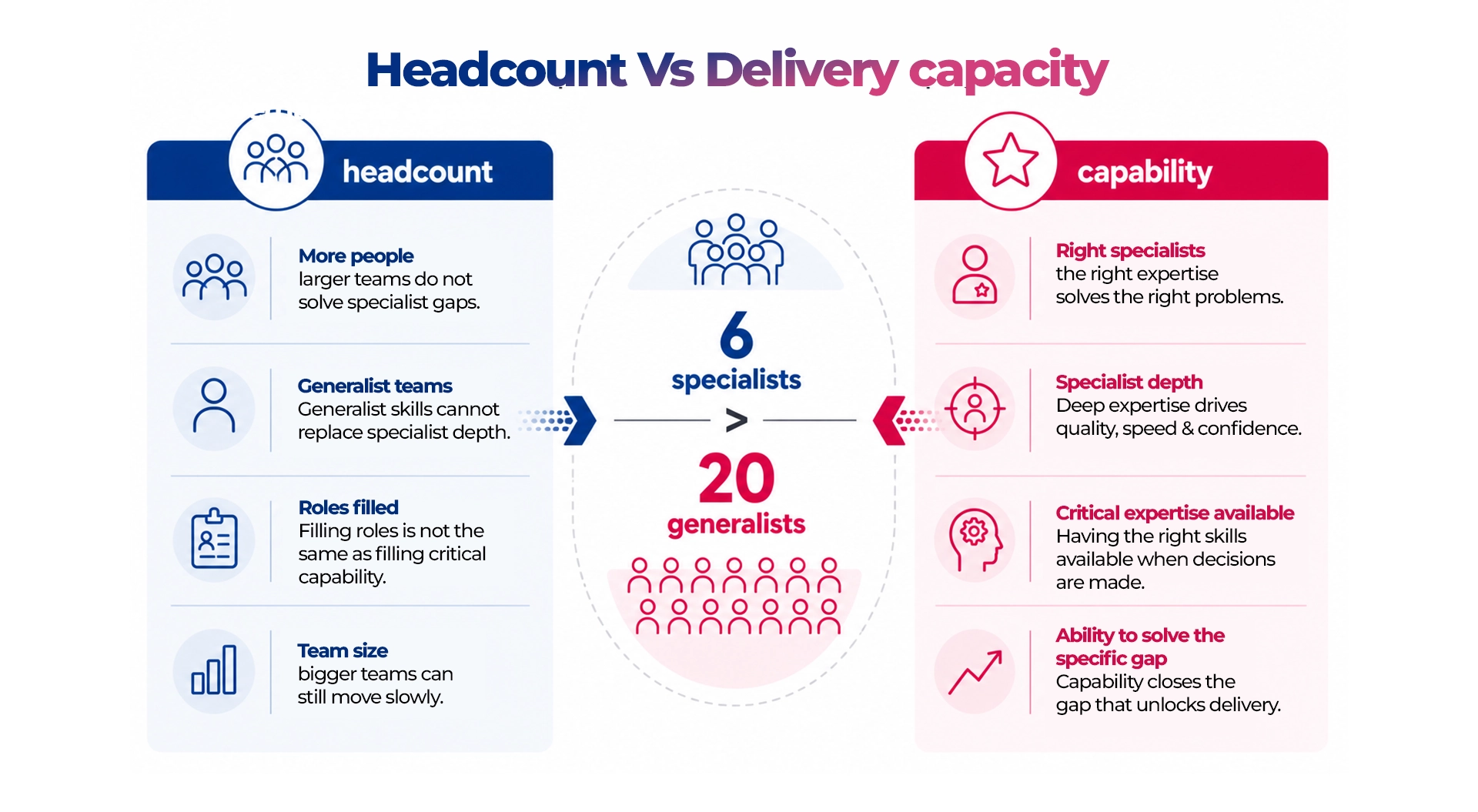
These findings point to a specific kind of shortage: not a general labor market tightness, but a scarcity concentrated in exactly the specialist roles a modern transformation program depends on most data engineers who can build a governed foundation for AI, model risk specialists who can validate an AI system before it reaches production, cloud architects who understand both the target state and the legacy banking infrastructure they are migrating from. A program can add ten generalist engineers and still be no closer to solving a gap that only three specific specialists could close.
Why This Shortage Compounds Specifically in Regulated Industries
The talent constraint is a global phenomenon, but it lands harder in banking than in most other sectors, for a structural reason: banking transformation requires a rarer combination of skills than most technology work deep domain knowledge of regulated financial services, alongside current technical expertise in cloud, AI, and data engineering. A specialist with only the technical skill set, but no banking domain context, tends to design solutions that do not survive contact with regulatory or operational reality. A specialist with only the domain knowledge, but dated technical skills, cannot execute the modern architecture the transformation actually requires. The talent that combines both is scarcer than either skill set alone, and every bank pursuing AI-first transformation right now is competing for the same narrow pool.
One industry hiring analysis put a specific number on the scale of this gap in the US market alone: a projected shortage of 350,000 digital workers that recruiting alone cannot close meaning the gap has to be addressed through a combination of upskilling existing staff, redesigning roles to need fewer of the scarcest specialists, and bringing in experienced delivery partners, not solely through external hiring.
How Capability Debt Shows Up Inside a Program
Capability debt is easy to miss on a resourcing dashboard because it hides behind aggregate numbers that look healthy. A few patterns are worth watching for specifically:
The same two or three people are load-bearing for every critical decision. If a program’s architecture, data strategy, and model validation all route through the same small group of specialists, the program’s actual delivery capacity is defined by that group’s bandwidth regardless of how large the broader team is.
Generalist roles are being asked to make specialist decisions. A general software engineer configuring a model’s training pipeline, or a generalist project manager making a data governance call, is a sign that specialist capacity is being substituted with generalist effort which often produces a plausible-looking result that does not hold up under later, more expert review.
Key roles stay open for months. Given a documented average time-to-fill of six to seven months for specialized AI roles in some analyses, a program that assumed those roles would be filled within a normal quarter is, in practice, running without the capability it planned around for most of a year.
A Structural Answer: Centralizing Scarce Expertise Instead of Spreading It Thin
The instinct in a capacity-constrained organization is often to distribute the few specialists available as advisors across every team that needs them. This tends to produce exactly the load-bearing bottleneck described above, the same two or three people stretched across too many concurrent decisions to give any of them real depth.
A more resilient pattern showing up across banks navigating this shortage is a hub-and-spoke structure, where a central AI Centre of Excellence concentrates the scarcest specialist expertise complex model evaluations, model risk assessment, cross-functional technical review in one place, while business units retain their own delivery teams for day-to-day build and deployment work. The hub is not a bottleneck in this model because it is not trying to touch every decision; it is reserved specifically for the evaluations that genuinely require the scarcest expertise, while spokes handle everything within their own team’s existing capability. This is a direct, structural version of the “concentrate scarce specialists on the highest-risk decisions” principle: rather than leaving each business unit to solve its own capability gap independently and competing internally for the same tiny pool of specialists – the organization pools that scarce capability once, centrally, and makes it available on demand.
Small, Deep Teams Consistently Outperform Large, Generalist Ones
The headcount-versus-capability distinction shows up clearly across real deployments. A global fintech company’s vendor management transformation building an end-to-end automated vendor reporting and communication platform, including an AI-driven query resolution system was delivered by a team of one AI architect and five engineers. A separate legacy modernization effort, translating decades-old GUI frameworks that few remaining engineers still know how to work with, used AI specifically to compensate for a skill that has become genuinely scarce in the market not by hiring more people who do not have it, but by using AI to extend what the specialists who remain can cover. In both cases, the deciding factor was not team size. It was whether the specific specialist depth the problem required was actually present, at whatever scale.
This is worth stating plainly for any executive reviewing a resourcing plan: a six-person team with the right specialist depth, concentrated on the highest-value decisions, will consistently outperform a twenty-person team assembled mostly from generalists stretched across too many concurrent workstreams. The resourcing question that predicts delivery success is not “how many people,” it is “which specific gap, and do we have someone who can actually close it.”
Closing Capability Debt Without Waiting for the Talent Market to Recover
The talent shortage described here is not something any single institution can solve unilaterally, which means the more useful question for executives is how to reduce a program’s exposure to it. A few approaches show up consistently among institutions executing well despite the same market-wide scarcity.
Concentrate scarce specialists on the highest-risk decisions, rather than spreading them thinly as advisors across every workstream the same principle showing up in how the most capability-constrained regions are sequencing their transformation programs successfully.
Invest directly in upskilling existing domain experts who already have the banking context but need current technical depth often a faster path to a genuinely dual-skilled specialist than hiring one externally in a market where that combination barely exists.
Bring in delivery partners for the specific specialist depth the internal team lacks rather than either overloading the two or three internal specialists already load-bearing for the program, or working around the gap with generalist effort that produces decisions requiring later rework.
None of these approaches make the underlying talent shortage disappear. What they do is prevent a program from discovering, midway through delivery, that its headcount was never the same thing as its actual capability to execute a distinction that, based on the pattern running through this research, is one of the clearest dividers between programs that scale and programs that stall.
Related Reading:
Why Most Banking Transformations Fail at Execution (pillar guide);
The Middle East Paradox: Why Unlimited Capital Still Cannot Buy Execution Speed.
The Execution Readiness Playbook (white paper).
Source
FAQ
1. Why can a fully staffed program still lack the capability it needs?
Headcount reports measure people, not specialist depth. A program can look fully resourced while the specific expertise the architecture actually requires, data engineering, model risk, core platform migration, is missing or concentrated in two or three overstretched individuals.
2. What is the most effective structural response to a specialist talent shortage?
Centralizing scarce expertise in a hub, such as an AI Centre of Excellence, rather than distributing a handful of specialists thinly as advisors across every team that wants them. This concentrates the scarcest expertise on the decisions that actually require it.
3. Is a large generalist team ever a substitute for specialist depth?
No. A six-person team with the right specialist depth, concentrated on the highest-value decisions, consistently outperforms a twenty-person team assembled mostly from generalists stretched across too many concurrent workstreams.