



A transformation program slips six months behind schedule. The steering committee convenes. Someone asks the obvious question: was this the wrong strategy? Within a quarter, there is a revised roadmap, a fresh set of slides, and a familiar cycle beginning again because in the vast majority of cases examined across banking transformation research, the strategy was never the problem. The bank just diagnosed itself incorrectly, and paid for that misdiagnosis twice.
This distinction between a transformation that fails because it aimed at the wrong outcome and one that fails because the organization could not deliver the right one is arguably the single highest-leverage judgment call an executive team makes when a program stalls. Get it wrong, and you do not just waste the sunk investment. You recommit the same capital to the same execution gap a second time.
Two Failure Modes, Two Different Diagnoses
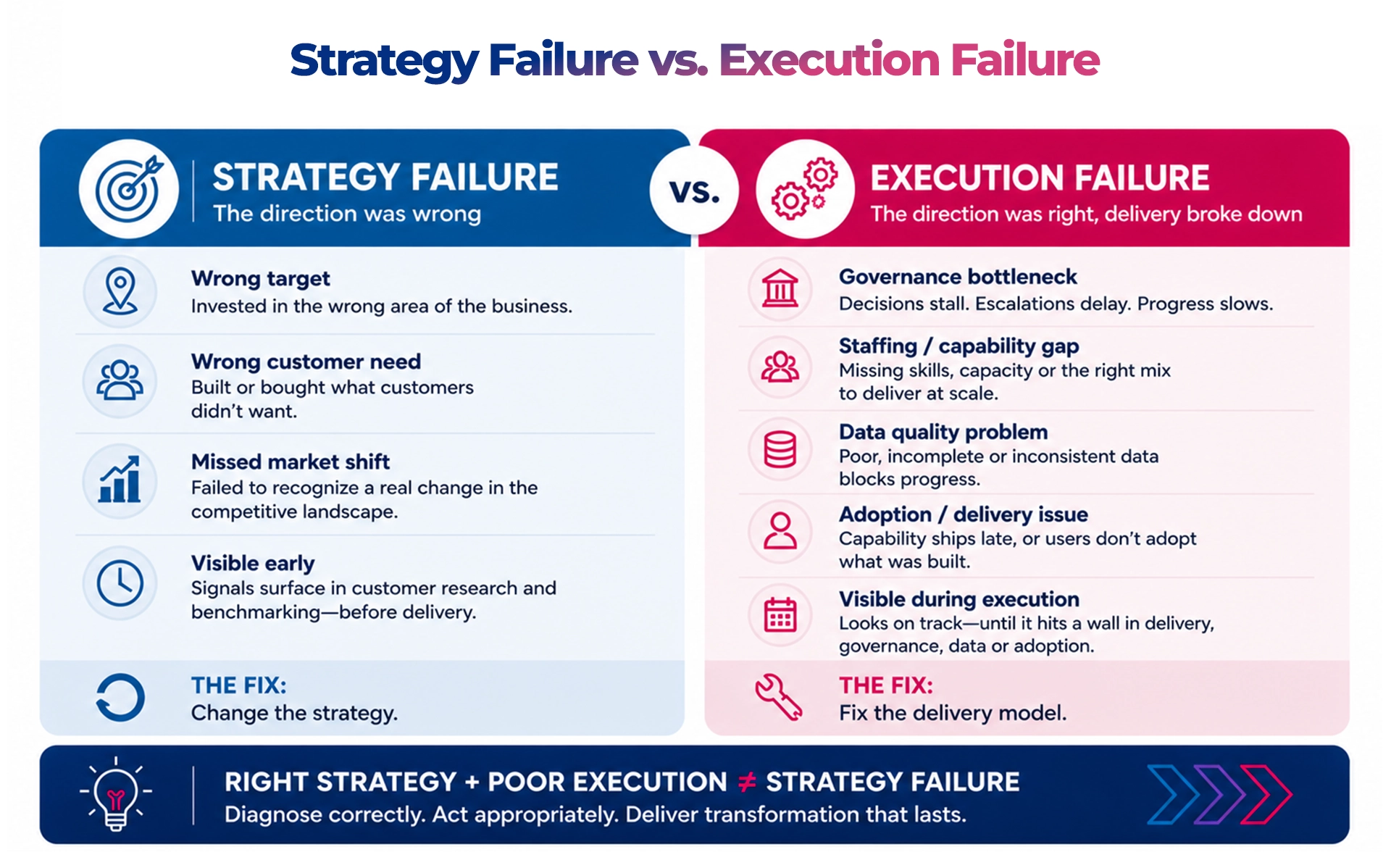
A strategy failure means the bank aimed at the wrong target: it modernized a system that was not actually the constraint, invested in a channel customers did not want, or missed a genuine shift in the competitive landscape. This does happen, but it is the less common failure mode, and it is usually visible early, in customer research and competitive benchmarking, well before a program reaches delivery.
An execution failure means the direction was right and the organization still could not turn it into a working, adopted, governed capability at the scale the business case assumed. This is what shows up, again and again, in the data on how banking transformation actually plays out. It is also much harder to see coming, because a program can look on track for months, milestones ticking, budget on pace, right up until it hits a governance review, a data quality wall, or an adoption problem it was never built to survive.
Why Banks Default to the Wrong Diagnosis
There is a structural reason executive teams reach for “wrong strategy” as the explanation even when the evidence points elsewhere: it is the more comfortable conclusion. A strategy failure is a planning problem, and planning problems have a familiar fix – commission new analysis, revisit the roadmap, present a refreshed vision to the board. An execution failure is a much less comfortable conversation, because it points at governance structures, staffing decisions, and delivery discipline that the same leadership team already built and already owns.
Research into what actually separates successful large-scale transformations from unsuccessful ones consistently finds organizational factors leadership clarity, change management, delivery capability ahead of strategic or even technological ones as the deciding variable. That finding holds specifically in banking, where nearly every institution pursuing transformation right now is chasing a strikingly similar strategic agenda: modernize the core, embed AI into customer and operational workflows, manage rising regulatory and cyber risk, and reduce cost-to-serve. When the destination is this consistent across an entire industry, and outcomes still vary enormously between institutions, the variable explaining that gap cannot be the strategy. It has to be everything that happens after the strategy is set.
A Simple Diagnostic Test
Executive teams do not need a consultant to run this test, it can be applied directly, using information most steering committees already have.
Look for a peer pursuing a near-identical strategy. If a competitor with a comparable digital and AI agenda is delivering faster, with fewer stalled workstreams and fewer governance escalations, the shared strategy cannot be what explains the gap between the two outcomes. Something organizational is different.
Check where the program actually stalled. A strategy failure typically surfaces as low adoption of something that did ship customers or employees using a new capability far less than projected, because it was not what they needed. An execution failure typically surfaces before that point: a capability that never reached production, or reached it eighteen months late, because of a governance bottleneck, a staffing gap, or a data problem discovered mid-build.
Ask who owns the decision to keep going. If no single executive can say, with authority, whether the program proceeds to its next phase, that is itself evidence of an execution gap shared or unclear ownership is one of the most consistently cited predictors of a stalling program, independent of what the strategy actually says.
Trace the delay to its root cause, not its symptom. “The vendor was late” or “the regulator pushed back” are almost always symptoms of an earlier execution gap, a decision that was made without the specialist input needed, or a governance conversation that should have happened months earlier and did not.
If the honest answers to these questions point at delivery, not direction, the response that actually works is not a new strategy. It is the same strategy, run through a delivery model built to close the specific gap – governance, capability, data, or trust that stalled it the first time.
The Cost of Getting the Diagnosis Wrong
Misdiagnosing an execution failure as a strategy failure is expensive in a way that does not always show up on the program budget line. The bank re-approves substantially the same direction, under a new name, with a new timeline and, absent a change to how it is delivered, runs into the same governance, capability, data, or trust gap the second time. Meanwhile, the organizational memory of the first attempt what actually went wrong, and why often gets buried under the narrative that the old strategy simply did not work, which makes the same mistake harder to catch the second time around, not easier.
The more useful discipline, for any executive team facing a stalled transformation, is to resist the pull toward a strategy review as the default response. Apply the diagnostic test first. In most cases, the plan on the table is still the right one. What has to change is the discipline behind delivering it starting with which of the specific fault lines, examined in depth across this series, is actually responsible for the stall.
Related reading:
- Why Most Banking Transformations Fail at Execution.
- What the Data Really Says About Digital Transformation Failure Rates.
Sources
FAQ
1. How can an executive team tell whether a stalled program is a strategy failure or an execution failure?
Check where the program actually stalled. A strategy failure typically shows up as low adoption of something that shipped. An execution failure typically shows up earlier, in a capability that never reached production or arrived far behind schedule because of a governance, staffing, or data gap.
2. Why do boards default to blaming strategy when a program slips?
It is the more comfortable diagnosis. A strategy failure points to a planning problem with a familiar fix: commission new analysis, revise the roadmap. An execution failure points at governance structures and staffing decisions the same leadership team already owns, which is a harder conversation to have.
3. What does it cost a bank to misdiagnose an execution failure as a strategy failure?
The bank re-approves substantially the same strategy under a new name and, without a change to how it is delivered, runs into the same governance, capability, data, or trust gap a second time, while losing the organizational memory of what actually went wrong the first time.