


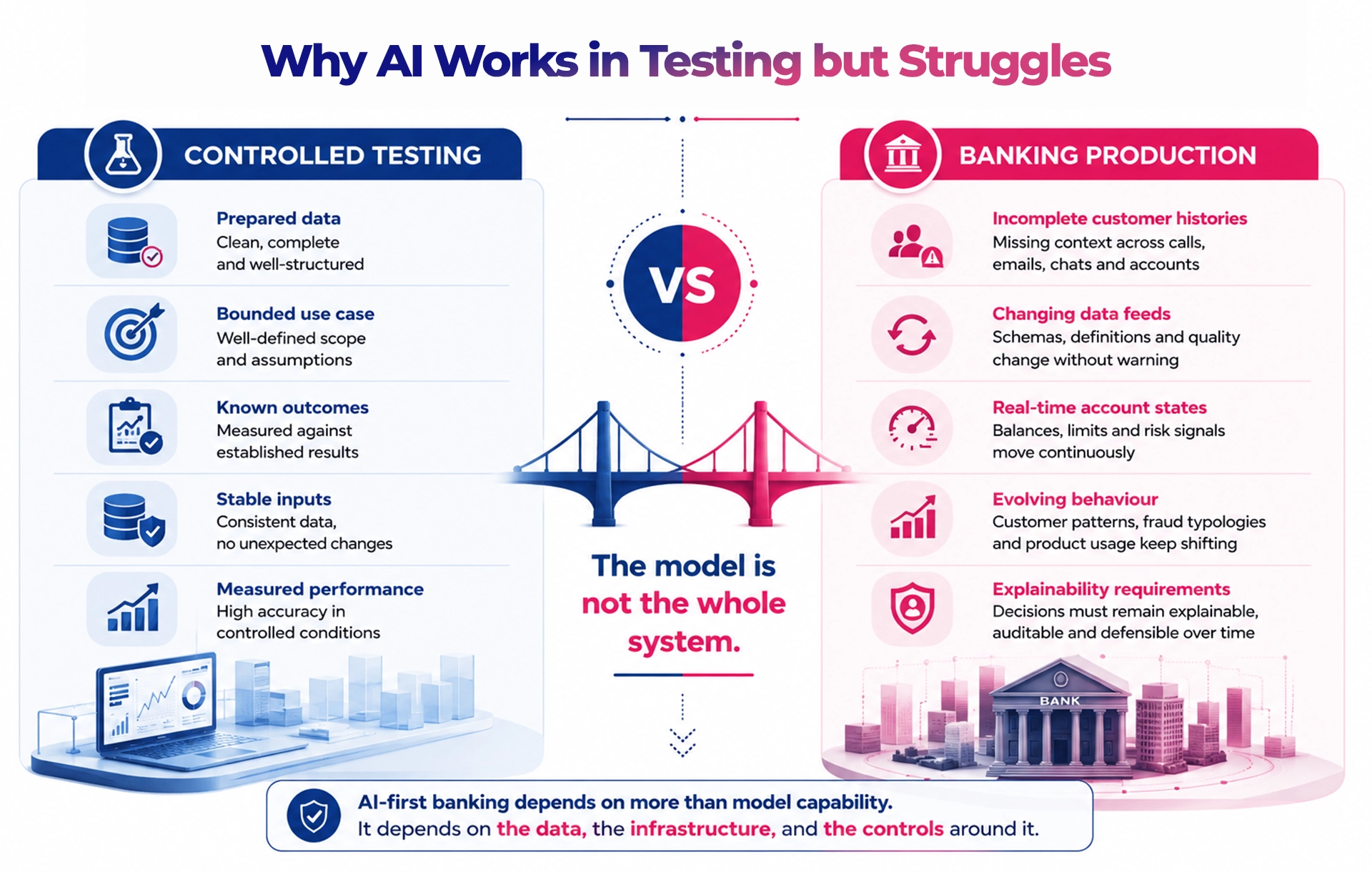
Banks rarely struggle to prove that an AI model can work. In controlled testing, data is prepared, the use case is bounded, and performance is measured against known outcomes. The real difficulty begins in production, where customer histories are incomplete, data feeds change, account states move in real time, and decisions must remain explainable long after they are made.
This is why AI-first banking depends on more than model capability. It depends on the operating infrastructure around the model: the information it can access, the standards applied to every feed, the speed at which data is updated, and the controls that test whether the system is still performing as intended.
The Model Can Only Reason Over What the Bank Makes Available
Consider customer service. An AI agent may have access to call dates, issue categories, product codes, and resolution outcomes stored in the CRM. Yet those fields do not capture what the customer actually said, the tone of the interaction, or the details buried in earlier call notes, emails, and chat transcripts.
Without this unstructured information, the model can recognise an interaction history but not fully understand it. First-call resolution may improve quickly and then plateau, especially for complex or cross-product enquiries. The constraint is not necessarily the model. It is the data surface the model can reason over.
The same principle applies across lending and fraud. A sophisticated credit model cannot compensate for an account status that has not been refreshed since the previous batch cycle. A fraud model cannot preserve per-entity precision if a transaction categorisation schema changes without warning.
Reliable data quality in banking is therefore not a supporting concern. It defines the limits of what production AI can know. Giving a model broader access is not enough either. Structured and unstructured information must be governed, complete, current, and available at the moment a decision is made.
Data Contracts and Real-Time Architecture Make Inputs Dependable
Production AI needs more than access to data. It needs an explicit agreement about what each input must provide. This is the role of data contracts.
A data contract establishes the freshness, completeness, consistency, and schema standards an upstream feed must meet. It also enables the bank to detect when those standards are breached. Without that discipline, an AI system may continue producing decisions after the meaning, structure, or timeliness of its inputs has changed.
The risk becomes especially visible in payments and financial crime. A sanctions update arriving late, a counterparty risk flag trapped in a batch process, or a fraud indicator that has not reached the payments layer can make an assessment technically correct based on the available data, but operationally wrong at the moment of execution.
For context-specific payment decisions, event-driven data architecture is not an enhancement. It is a prerequisite. Account-state changes, compliance signals, and counterparty updates must reach the decisioning layer when they occur. Effective data governance banking practices must therefore govern not only ownership and access, but also propagation speed and production dependencies.
Continuous Validation Keeps Automation Trustworthy
Even governed data and accurate models can deteriorate in production. Customer behaviour evolves. Fraud typologies adapt. Product structures change. New pipelines are introduced. A quarterly review may identify these issues eventually, but AI-led banking operations automation can produce thousands of decisions before a periodic control notices the drift.
Continuous validation closes this gap. It monitors whether feeds remain within contract, whether model performance changes across entity segments, and whether outcomes remain consistent with the operational and regulatory purpose of the automation.
The granularity of validation matters. Aggregate accuracy can appear stable while performance weakens for particular customer groups, account types, or transaction patterns. If a model operates at the level of an individual entity or instruction, governance must monitor at a comparable level.
Conclusion
For CIOs, the lesson is clear. Scaling AI is not simply a deployment challenge. Banks must engineer a governed information surface, bind upstream feeds through data contracts, replace critical batch dependencies with real-time propagation, and validate continuously at the speed of execution. In production, the model is only one part of the system. Trusted automation emerges when the entire decision environment remains current, observable, and defensible.
Download the whitepaper to know more about intelligent automation in AI-first banking.
FAQ
1. Why do banking AI models perform differently in production than in testing?
Testing environments usually use prepared, stable, and well-defined datasets. Production environments involve changing data feeds, incomplete histories, evolving customer behaviour, schema changes, and real-time account conditions that can affect the reliability of AI decisions.
2. Why is unstructured data important for AI in banking?
Unstructured data such as call transcripts, chat logs, emails, application documents, and customer notes contains context that structured fields cannot fully represent. Access to this information helps AI understand what occurred, rather than relying only on categories and metadata.
3. What is a data contract in banking AI?
A data contract defines the freshness, completeness, consistency, structure, and availability standards that an upstream data feed must meet before it is used by an AI system. It also enables monitoring when a feed breaches those standards.
4. Why does banking AI require real-time data?
Many banking decisions depend on the current state of an account, customer, counterparty, sanctions list, or transaction network. Delayed data can cause a model to make an accurate assessment of an outdated situation, producing an operationally incorrect outcome.
5. What is continuous validation in AI-led banking automation?
Continuous validation monitors data integrity, model performance, decision outcomes, and changes across customer or entity segments while the system is operating. It helps banks identify drift and production failures before they affect decisions at scale.