



Every AI governance conversation eventually reaches the same budget question: is this actually worth the spend, or is it insurance against a risk that might never materialise? It’s a fair question, and it deserves a real answer rather than a reassurance. The real answer is that the spend is rarely optional in practice – not because governance is free of trade-offs, but because the alternative to spending on it upfront is spending considerably more on it later, under worse conditions, with a regulator watching. This is not a rhetorical point. It is a pattern that recurs, in broadly the same shape, across every institution that has gone through it.
Why Remediation Costs More Than Prevention – Structurally, Not Just Anecdotally
Building monitoring and explainability infrastructure before a finding happens is engineering work, done on the institution’s own timeline, by teams who already understand the systems involved. Remediating after a regulatory finding is a fundamentally different exercise: it happens under an examiner-imposed deadline, frequently requires external counsel and consultants brought in to demonstrate independence, and has to reconstruct – after the fact – evidence and context that would have been generated automatically had the monitoring existed in the first place. Each of these differences compounds. That is the structural reason remediation programmes typically run five to ten times the cost of the prevention infrastructure that would have avoided them, not an exaggeration for effect.
Remediation is prevention, done later, under a deadline you don’t control, at a cost you didn’t budget for.
Where the Multiplier Actually Comes From
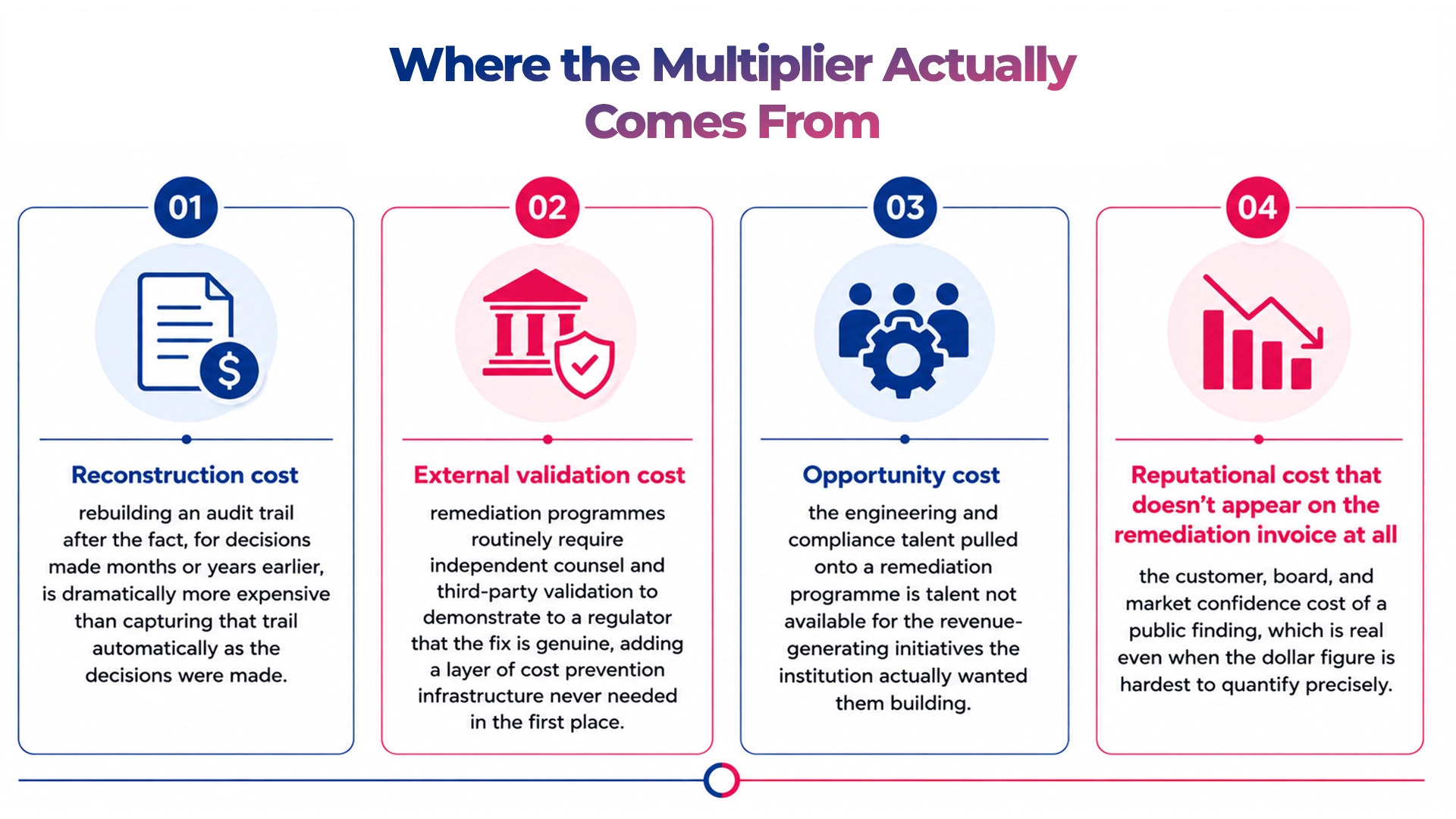
- Reconstruction cost – rebuilding an audit trail after the fact, for decisions made months or years earlier, is dramatically more expensive than capturing that trail automatically as the decisions were made.
- External validation cost – remediation programmes routinely require independent counsel and third-party validation to demonstrate to a regulator that the fix is genuine, adding a layer of cost prevention infrastructure never needed in the first place.
- Opportunity cost – the engineering and compliance talent pulled onto a remediation programme is talent not available for the revenue-generating initiatives the institution actually wanted them building.
- Reputational cost that doesn’t appear on the remediation invoice at all – the customer, board, and market confidence cost of a public finding, which is real even when the dollar figure is hardest to quantify precisely.
This Isn’t a Hypothetical – It’s the Pattern Across the Institutions This Series Has Documented
A credit decisioning model that passed every pre-deployment validation gate can still, months into production, quietly increase its decline rate for a specific customer segment – not because the model was built badly, but because the data it consumes shifted in a way no one was monitoring for. Left uncaught, that pattern doesn’t surface until a compliance review is triggered by a rise in customer complaints, at which point the institution is reconstructing seven months of decisions after the fact, under scrutiny, rather than having caught the drift in week one through monitoring that would have cost a fraction as much to build.
The Business Case This Actually Supports
None of this argues for unlimited governance spend regardless of return – that would be its own kind of poor capital allocation. It argues for treating AI governance infrastructure as what it actually is: a cost-avoidance investment with a calculable multiplier, not a compliance overhead evaluated purely on its own line-item cost. The business case that gets governance funded at the pace it needs to be funded is rarely “this reduces our regulatory risk” in the abstract. It is the specific comparison – what continuous monitoring costs to build this year, against what a remediation programme has cost peer institutions that didn’t build it, five to ten times over.
Boards and finance functions respond to that comparison in a way they don’t respond to risk framed in the abstract. It is the same argument that gets any other prevention-versus-cure investment funded – just rarely made with this specific a multiplier attached to it.
What Prevention Actually Costs, for Comparison
It’s worth being specific about the other side of this comparison, because a vague “prevention is cheaper” claim is exactly the kind of thing a finance function will push back on. Prevention infrastructure – continuous drift and bias monitoring, decision-level explainability tooling, an audit trail generated automatically rather than reconstructed – is a bounded, scoped engineering investment. It has a defined build timeline, a known team, and a cost that can be estimated with reasonable confidence before the work starts. Remediation, by contrast, is open-ended by nature: the scope isn’t known until the investigation is underway, the timeline is set by the examiner rather than the institution, and the final cost is rarely close to the initial estimate, because reconstructing months of decision history after the fact routinely surfaces more gaps than anyone anticipated at the outset.
That asymmetry – a knowable, bounded cost against an unknowable, open-ended one – is itself the argument, independent of the specific 5–10x figure. Finance functions are generally comfortable approving a bounded investment against an unbounded risk once the comparison is framed this way, even before anyone attaches a specific multiplier to it.
The full cost analysis – and the governance architecture built specifically to avoid this multiplier – is set out in Paper 5 of Maveric’s CIO Mandate Series:
AI Compliance and Regulatory Governance: A CIO & CRO Mandate for Global Banks