

Why This Article Matters
Every banking technology leader knows their institution has AI. What most cannot answer precisely is: where on the maturity spectrum does that AI actually sit? This article provides the diagnostic framework to answer that question honestly – not in a board presentation prepared for the purpose but based on what you actually know about your production AI estate right now. The three-stage model, the inflection point between adoption and outcome assurance, and five specific diagnostic questions that locate your institution with precision. If the answers make you uncomfortable, that is the point.
AI Maturity Is Not Measured by Volume of Deployment
The standard way of describing AI transformation progress focuses on adoption: how many use cases are live, how many models are in production, what percentage of decisions are AI-driven. These are legitimate measures of deployment activity. They are not measures of AI maturity.
AI maturity in banking is measured by how reliably an institution’s AI can be trusted to perform – consistently, under scrutiny, at production scale, over time. That shift in measurement changes the map completely.
An institution with thirty AI models in production, twelve of which exhibit unmonitored drift, and eight of which cannot produce decision-level explainability, is not a more mature AI institution than one with fifteen models that are fully validated, continuously monitored, and defensible under regulatory examination. It is a more exposed one.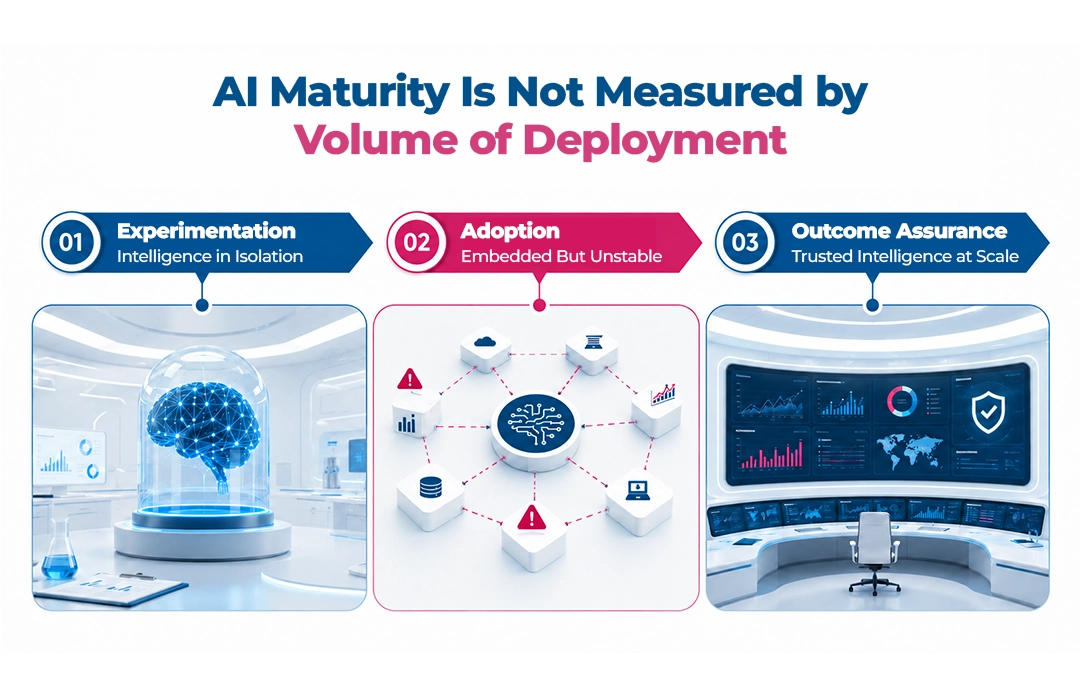
Stage 1: Experimentation – Intelligence in Isolation
At this stage, AI exists in controlled environments. Pilots are running. Use cases are being validated. The technology is demonstrating its capability under conditions specifically designed to support it – curated data sets, limited scope, high human oversight, and success metrics that measure model accuracy rather than production reliability.
The failure mode at the experimentation stage is not the AI itself. It is the assumptions being built about the AI. Models that perform with 94% accuracy on curated data are being presented as models that will perform with 94% accuracy in production. Pilots graduate to production carrying unresolved data governance gaps, unexplained decision logic, and unvalidated edge case behaviour – each one a future production incident waiting for the right conditions to surface.
The Signal
AI projects consistently succeed in pilots and fail to industrialise. The gap between ‘this works in testing’ and ‘this works in production’ is wide and recurring. Each new pilot starts without addressing the governance gaps that caused the previous one to stall.
Stage 2: Adoption – Embedded But Unstable
At this stage, AI has moved into production. Real decisions. Real customers. Real regulatory obligations. The organisation is delivering the efficiency gains and capability improvements that justified the investment.
Below the surface, a different dynamic is developing. Data pipelines were designed with less rigour than the production environment demands. Models that were validated for accuracy at deployment have not been continuously monitored, and several have begun to drift. Compliance and governance frameworks that cleared the models for deployment were not designed to travel at the speed of the delivery pipeline – so updates are reaching production with less rigorous governance review than the initial deployment received.
A personalisation engine is producing offers. Response rates are reasonable. But the underlying customer data is inconsistently synchronised across the CRM, the core banking system, and the digital channel event stream. The same customer receives different product recommendations on different channels on the same day – because each channel’s AI system is working from a different representation of the same customer.
A credit decisioning model has been live for seven months. It passed all pre-deployment validation gates. No one has reviewed its production behaviour since launch, because the monitoring infrastructure was not built into the delivery pipeline. The model has gradually increased its decline rate for a specific geographic customer segment – not because the model was wrong at deployment, but because the data it is consuming has been subtly altered by an upstream system change that no one flagged as model-relevant.
The Signal
AI is in production and delivering some value – but with a persistent and unresolved tail of production incidents, compliance challenges, and cross-functional friction between engineering teams that are accelerating deployment and governance teams that are discovering gaps after the fact.
Stage 3: Outcome Assurance – Trusted Intelligence at Scale
The defining characteristic of Stage 3 is not that nothing goes wrong. It is that when something goes wrong, the institution finds out immediately, contains it quickly, understands exactly why it happened, and can demonstrate to every relevant stakeholder – including regulators – that it was identified, managed, and corrected with appropriate governance.
AI systems are operating as genuine infrastructure – not experiments under observation, but core operational capabilities that the business relies on with genuine confidence. Data trust is enforced through data contracts monitored continuously. Model trust is maintained through drift detection that surfaces anomalies before they propagate into material decision errors. System trust is provided by validation infrastructure embedded in the delivery pipeline. Outcome trust is demonstrated through compliance monitoring that operates continuously – and through audit readiness that is a permanent operational state.
When a regulator examines this institution’s AI governance, the examination is not a stress event. It is an operational review – because the documentation, the monitoring, and the governance that the examination requires are operational artefacts, not emergency productions.
The Signal
Speed and trust compound together. Each validated release builds institutional evidence. Each clean regulatory interaction builds the relationship capital that makes future AI approvals faster. The delivery pipeline accelerates because the confidence infrastructure beneath it makes acceleration safe.
The Inflection Point – Where Most Banks Are Right Now
The honest assessment: the majority of banking institutions are at Stage 2, aware that Stage 3 exists, and experiencing the specific friction that defines the transition between them.
The inflection point separates two distinctly different institutional states. Below it, AI is present – functioning, delivering some value, but the institution cannot fully account for its behaviour, cannot confidently predict how it will perform as the environment evolves, and cannot demonstrate to regulators the continuous governance they increasingly require.
Above the inflection point, AI is trusted. The institution can demonstrate, continuously and on demand, that its AI systems are performing within validated parameters, that their decisions are explainable, that their data foundations are sound, and that their governance is operating at the speed of their delivery pipeline.
Five Diagnostic Questions – Where Is Your Institution?
Answer these based on what you know about your production AI estate right now – not what a board presentation would say.
- Question 1: How do you know when a production AI model is drifting? If the answer is ‘we review model performance monthly’ or ‘the business team flags it’ – Stage 2. Stage 3 means continuous, automated drift detection surfacing anomalies before they are visible at the business layer.
- Question 2: If a regulator asks today to explain a specific credit decision made last Tuesday, how long does that take – and what does the answer look like? If the answer involves reconstruction and general model description – not Stage 3 explainability.
- Question 3: When you release a new model version, what specifically validates that it will behave in production the way it behaved in testing? If there is no continuous post-deployment validation – system trust does not exist.
- Question 4: What is the governance process for a model that fails a compliance review after it has already been deployed? If the answer is unclear or has never been invoked – the governance framework was designed for pre-deployment review, not ongoing accountability.
- Question 5: Do your engineering, data, and compliance teams share a single definition of what ‘production-ready’ means for an AI model? If each function has its own definition – you are experiencing the organisational misalignment that is the most persistent structural feature of Stage 2.
The question that defines AI-first banking leadership is not ‘How many AI use cases do we have in production?’ It is: ‘How many of those decisions can we trust – and can we prove it?’
The AI Maturity Spectrum maps directly onto the Four-Layer Trust Architecture. The full research report shows exactly what building from Stage 2 to Stage 3 requires – capability by capability, layer by layer, across the full complexity of an AI-first banking enterprise.
Download the Full Research Report: Engineering Trust in AI-First Banking
What to Read Next
PREVIOUS: What Trust Means in AI-First Banking: The Four-Layer Trust Architecture
NEXT: Generative AI in Banking: Opportunity Without Control Is Risk – why GenAI is a different risk class
This article is part of the Engineering Trust in AI-First Banking series, examining the framework that separates institutions that scale AI from those that stall.
FAQ
1. What is the AI Maturity Spectrum and what does it tell a bank about its current position?
The AI Maturity Spectrum is a diagnostic framework that maps an institution’s AI capability against its trust and governance infrastructure – from early experimentation through isolated deployment and managed scale, to the inflection point where AI becomes genuinely enterprise-trusted. Where a bank sits on the spectrum determines not just what it can do with AI today, but what its ceiling for trusted AI at scale actually is. Most large institutions sit in the “deployment without confidence” zone – broad adoption, but governance maturity that cannot yet sustain it.
2. What is the inflection point on the AI Maturity Spectrum, and what does crossing it require?
The inflection point is where AI programmes transition from generating isolated efficiency gains to delivering reliable, scalable business value across the enterprise. Crossing it requires four things to be simultaneously true: data governance is mature enough to sustain AI inputs across all production use cases; continuous validation is embedded in the delivery pipeline rather than applied at deployment gates; explainability infrastructure is operational, not planned; and governance accountability is integrated across engineering, data, and compliance – not siloed in a separate risk function.
3. How can a CIO or CDO use the AI Maturity Spectrum practically in their transformation planning?
The five diagnostic questions in the framework allow an institution to self-assess across each maturity dimension – data governance coverage, model monitoring depth, explainability readiness, governance integration, and outcome measurement maturity. The resulting profile identifies which dimensions are constraining the institution’s ceiling, and sequences investment accordingly. Institutions that skip this assessment typically invest in the most visible capability gaps rather than the foundational gaps that are actually limiting their progression.
4. Why do banks often overestimate their own position on the AI Maturity Spectrum?
Because maturity is typically self-assessed using deployment metrics – models in production, use cases activated, automation rates – which measure capability breadth, not governance depth. An institution with fifteen AI models in production and no continuous monitoring infrastructure is not more mature than one with five models and robust validation pipelines; it is more exposed. The spectrum reorients assessment toward the governance and confidence dimensions that actually determine whether AI transformation will sustain.
5. What separates institutions that move from deployment to outcome assurance from those that plateau?
The institutions that progress are those that treat trust infrastructure as a strategic investment rather than a compliance cost. They make architectural decisions – data contracts, continuous validation, explainability by design – early, before scale makes them expensive to retrofit. They measure AI programme success using reliability and governance KPIs, not just go-live dates and automation rates. And critically, they have cross-functional accountability structures that prevent the engineering, data, and compliance functions from optimising independently.