

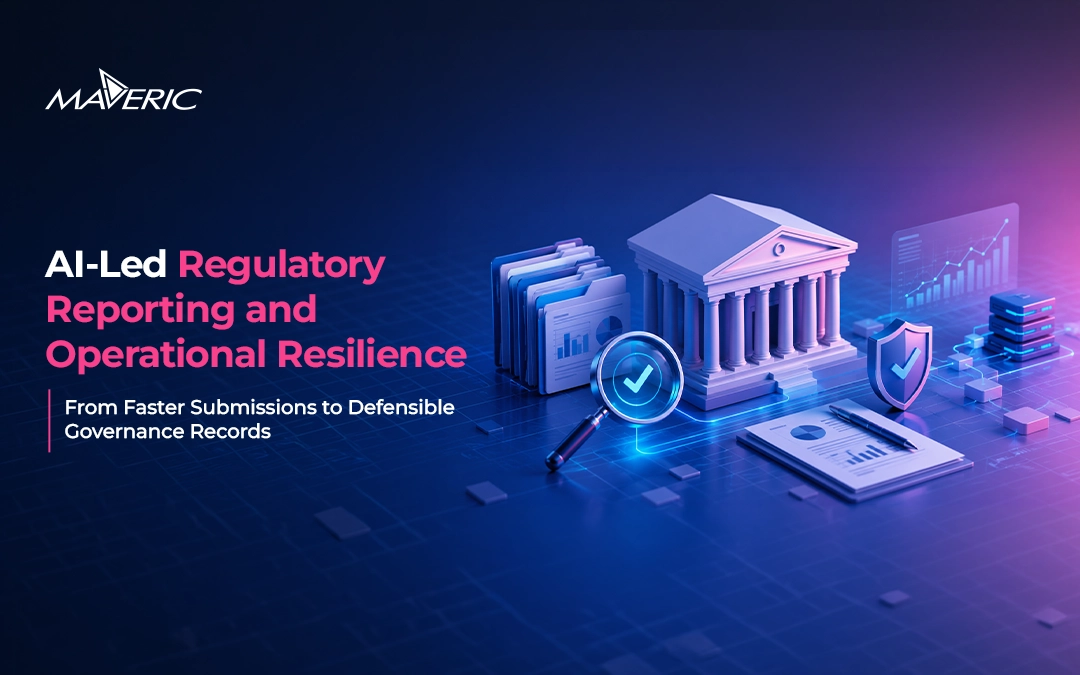
AI is changing the economics of regulatory reporting. What once required days of manual data aggregation, validation, reconciliation, review, and submission can now be accelerated through intelligent automation. For banks, the appeal is obvious: faster reporting cycles, reduced manual effort, lower cost per submission, and greater consistency across recurring regulatory obligations. But in regulatory reporting, speed is not the final measure of maturity. Defensibility is.
Challenges of trusting AI-generated regulatory reports
An AI-generated report is not valuable simply because it is produced faster. It is valuable when every figure in that report can be traced, validated, explained, and reconstructed when a regulator asks how it was produced. This is where the conversation around regulatory reporting data banking must move beyond automation and into governance-grade assurance.
The whitepaper makes the failure mode clear. AI-led regulatory reporting can deliver genuine efficiency gains, but risk emerges when the underlying data is not governed to the standard the submission claims to reflect. An automated report built from inconsistently governed data does not produce uncertainty slowly. It produces it quickly. The institution often discovers the gap only when an examiner asks for evidence behind a specific figure, and the bank cannot provide the lineage documentation required to prove that the number is right.
This is a critical CIO issue. Regulatory reporting cannot be treated as a downstream documentation exercise. The report is only as defensible as the data, validation logic, transformation path, and governance record that sit behind it. In an AI-first environment, the intelligence layer that generates the report must also generate the evidence trail that makes the report auditable.
The data traceability layer that enables better governance, yet quicker reporting
That is why report data lineage becomes central. The whitepaper defines this as the ability to trace every figure in a regulatory submission back to the data source that produced it, the transformation steps applied to it, the validation logic that governed it, and, where relevant, the specific regulatory or internal policy passage that the validation reflects. In other words, data governance banking cannot stop at source system control. It must extend into the logic of how regulatory figures are created, validated, and justified.
This also reframes the value of AI-led reporting. The benefit is not only faster submission. It is the ability to create a permanent operational record that is available on demand, without examination-time reconstruction. That is a very different standard from assembling supporting documentation after a supervisory request arrives. It moves the bank toward audit readiness as a permanent state.
The whitepaper also points to a related governance challenge: shadow AI in regulatory reporting. Compliance teams under deadline pressure may use accessible AI tools to draft, summarize, or prepare parts of regulatory submissions. The issue is not that AI is being used. The issue is whether its outputs are governed, validated against the underlying data, and approved by qualified people before submission. The institution remains accountable for every figure and statement in the submission, regardless of which tool helped create the first draft.
Pivotal role of the predict function in preventing compliance failures
This is where AI compliance banking must connect with operational resilience. The whitepaper’s five-stage framework of predict, prevent, mitigate, recover, and restore gives CIOs a useful operating model for AI-first compliance. In a traditional rules-based environment, resilience operated largely at the programme level. In an AI-first environment, it must operate at the model level and increasingly at the individual decision or output level.
The predict function means monitoring model behaviour, upstream data quality, and distributional shifts before they create compliance failures. The prevent function means embedding governance controls into the output pipeline so that unsupported figures, unexplained determinations, or unvalidated AI-generated content do not move forward. Mitigation requires knowing exactly which model, decision, report figure, or regulatory obligation is affected. Recovery and restoration require the ability to reconstruct what happened, identify scope, demonstrate control, and strengthen governance records.
Conclusion
For CIOs, the mandate is clear. AI-led reporting must not become a faster route to weaker evidence. It must become a stronger route to defensible governance records. The future of trusted AI in banking will depend not only on intelligent automation, but on whether every automated output can carry the lineage, validation, and resilience evidence needed to stand up in a regulatory examination.
In AI-first banking, the report is not the end product. The defensible record behind the report is. Download the whitepaper to know more compliance governance in AI-first banking.
FAQ
1. Why is speed not enough in AI-led regulatory reporting?
Speed is useful, but a regulatory report must also be defensible. Banks need to prove where every figure came from, how it was transformed, what validation logic was applied, and which regulatory or policy requirement governed that logic.
2. What is report data lineage in regulatory reporting?
Report data lineage is the ability to trace every figure in a regulatory submission back to its source data, transformation steps, validation rules, and relevant regulatory or internal policy references.
3. How does AI create risk in regulatory reporting?
AI can generate reports, summaries, or submission content quickly, but risk emerges if the outputs are not validated against governed data or reviewed within an approved compliance framework.
4. What is shadow AI in regulatory reporting?
Shadow AI refers to the use of unsanctioned or unmanaged AI tools by compliance teams for regulated activities such as drafting submissions, summarizing guidance, or preparing regulatory content without formal governance oversight.
5. How does operational resilience apply to AI compliance?
Operational resilience in AI compliance means being able to predict, prevent, mitigate, recover, and restore at the level of specific models, decisions, report figures, and regulatory obligations, not just at the overall compliance programme level.