

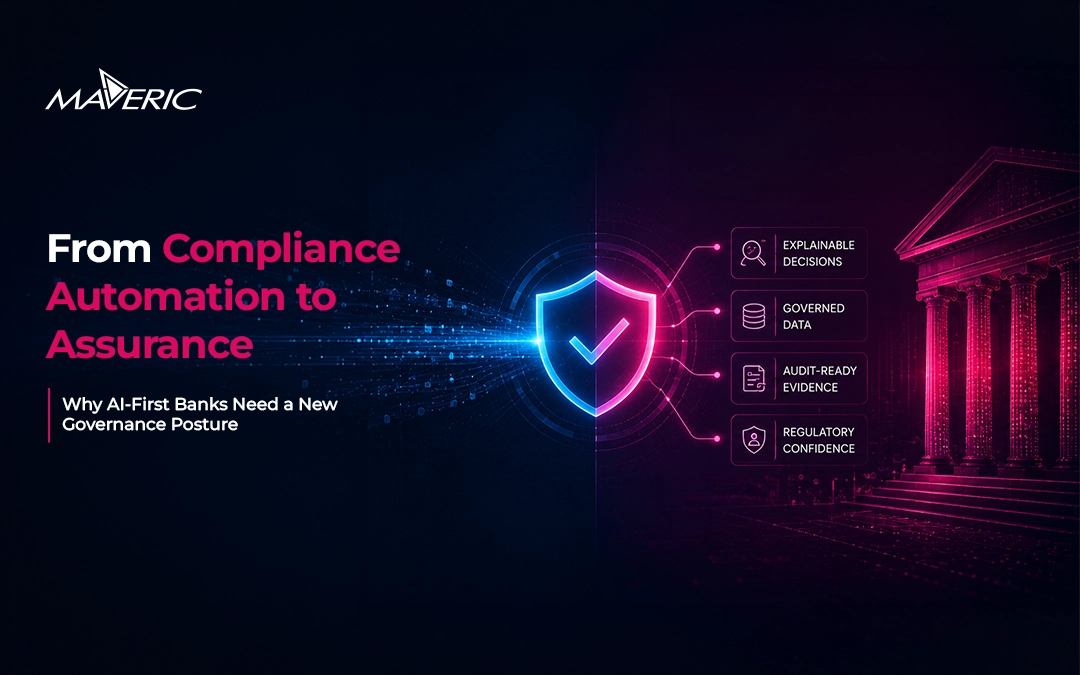
Banks have spent years automating compliance. Transaction monitoring systems process huge volumes of activity. Credit decisioning engines assess applications faster. Regulatory reporting tools aggregate data, validate fields, and reduce manual effort. On paper, this looks like progress. But in an AI-first bank, automation is no longer the real test. Assurance is.
The governance posture gap faced by institutions
The distinction matters because compliance automation banking solves only part of the problem. It helps banks move faster and handle scale. But regulators do not examine speed alone. They ask whether a bank can demonstrate why a decision was made, whether the data behind it was governed, whether the model behaved within approved parameters, and whether the institution can reconstruct the outcome using production evidence. As the whitepaper argues, this is not a technology gap. It is a governance posture gap between institutions that have automated compliance volume and those that have built the assurance infrastructure required to defend AI in regulated contexts.
This shift changes the CIO mandate. In traditional compliance governance, reviews were periodic. Model validation happened annually. Risk assessments were quarterly. Documentation was often assembled when an examination or supervisory request arrived. That operating model was built for a slower environment, where compliance failures were usually investigated after the event. AI changes the cadence. It introduces decisions that happen continuously, at scale, and often at the level of the individual customer, transaction, or report figure.
Why governance must be engineered into the AI compliance framework
That is why AI compliance banking needs to move from periodic governance to continuous assurance. The whitepaper frames this clearly: monitoring must evolve from periodic reviews to real-time oversight of model behaviour, data quality, and decision consistency. Explainability must move from model-level documentation to decision-level explanation. Regulatory readiness must shift from examination-time preparation to an audit-ready operational state where lineage, validation records, and decision reconstruction are available on demand.
For CIOs, this is a profound architectural shift. Governance can no longer sit outside the system as a layer of policy, documentation, and retrospective control. It must be engineered into the operating fabric of compliance AI. Every AI-generated alert, adverse credit decision, regulatory report figure, or compliance output must carry its own explainability, lineage, validation evidence, and audit trail.
Consider AML. A rules-based system was explainable almost by default. If a transaction crossed a threshold or matched a watchlist rule, the rule became the explanation. AI-driven AML monitoring is different. The model may detect suspicious behaviour through a combination of transaction value, frequency, counterparty behaviour, geography, timing, account history, and even narrative content. The output may be more intelligent, but it is not automatically defensible. Without determination-level explainability, the bank has automated alert generation without solving the accountability problem.
Engineering decision-level explainability in compliance mechanisms
The same logic applies to credit compliance. A highly accurate AI credit model is still a regulatory exposure if it cannot explain why a specific customer received a specific outcome. The whitepaper’s point is direct: accuracy without explainability is not compliance. It is accuracy plus exposure. Decision-level explainability is therefore not a reporting feature. It is a core engineering requirement for trusted AI in banking.
Regulatory reporting adds another dimension. AI can generate submissions faster, but speed becomes risky if the bank cannot trace every figure back to its source data, transformation steps, validation logic, and the regulatory or policy requirement behind that logic. An automated report built on weak lineage does not fail slowly. It produces uncertainty quickly.
This is where the governance posture must change. CIOs need to treat audit readiness as a permanent operating state, not an examination response. Continuous monitoring, determination-level explainability, report data lineage, and decision reconstruction must be built before the regulator asks. The cost of building this assurance architecture proactively is far lower than the cost of discovering its absence during an examination.
Conclusion
In the AI-first bank, compliance is not a back-office control function. It is the proving ground for every claim the institution makes about trust, accountability, and resilience. The banks that understand this will not simply automate compliance work. They will engineer assurance into the decisions, systems, and records that regulators, customers, and leaders depend on.
Download the whitepaper to know more compliance governance in AI-first banking.
FAQs
1. What is the difference between compliance automation and compliance assurance in banking?
Compliance automation focuses on making compliance processes faster and more scalable. Compliance assurance goes further by ensuring that AI-driven decisions can be explained, monitored, reconstructed, and defended with production evidence during regulatory scrutiny.
2. Why is periodic compliance governance not enough for AI-first banks?
Periodic governance was designed around annual validations, quarterly reviews, and examination-time documentation. AI-first banking requires continuous monitoring because models make decisions at scale and their behaviour, data quality, and decision consistency can change in production.
3. Why does AI-driven AML need determination-level explainability?
AI-driven AML models may flag transactions based on complex combinations of behavioural, geographic, historical, and narrative signals. Determination-level explainability ensures that each alert includes a structured explanation of why that specific transaction was escalated.
4. Why is model documentation not enough for AI compliance?
Model documentation explains how a model works in general. AI compliance requires decision-level explainability, which shows why a specific decision was made for a specific customer, transaction, or report figure at a specific moment.
5. What should CIOs prioritize for AI compliance and regulatory governance?
CIOs should prioritize continuous monitoring, decision-level explainability, report data lineage, audit-ready records, and governance controls embedded directly into AI decision pipelines.