


Something shifted in US banking technology strategy over the past year, and the data behind it is worth sitting with. A 2026 survey of 200 senior US banking executives found that 71% now agree their organizations need to modernize their platforms to bring new products to market faster up sharply from 46% making the same statement just one year earlier. That is not a gradual trend line. That is a jump of 25 percentage points in twelve months, in an industry not known for rapid sentiment shifts.
The obvious question is what changed. The more useful question, for any executive currently running a modernization program, is what that jump actually predicts for delivery and the honest answer is that rising urgency, on its own, tends to widen the execution gap rather than close it.
Why Urgency and Delivery Capacity Move at Different Speeds
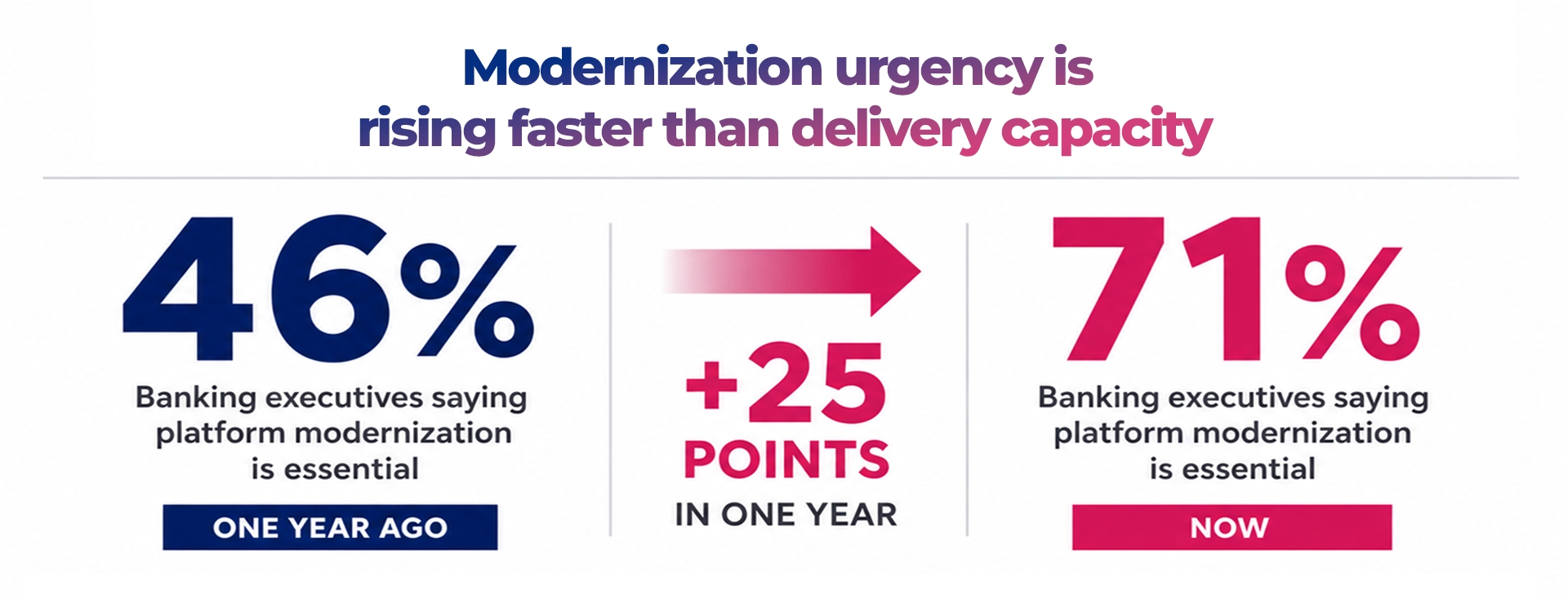
Executive conviction can shift in a single strategy offsite. Delivery capacity, the specialist engineering talent, the governed data foundation, the mature vendor relationships, the tested migration playbooks, all these take years to build, and does not respond to a change in sentiment on the same timeline. When urgency jumps 25 points in a year and delivery capacity grows at its normal, much slower pace, the gap between what leadership wants delivered and what the organization can actually deliver gets wider, not narrower, even though every individual in the organization may be working harder and faster than before.
This is precisely the condition under which execution failures multiply. Programs get greenlit with compressed timelines because the urgency is real and the pressure from the board is real, but the underlying capability to hit that timeline has not caught up. The result, visible across the broader research on transformation outcomes, is not usually outright cancellation. It is partial delivery, schedule slippage, and capabilities that ship but do not get fully adopted because they were rushed past the governance and testing rigor a calmer timeline would have allowed.
The Investment Is Following the Urgency
The same urgency shift is showing up in spend in the US and globally. Finastra’s 2026 State of the Nation survey of 1,509 banking and financial-services executives across eleven countries, including the US, found that 87% now plan to invest in modernization over the next 12 months, and expect security investment specifically to rise by an average of 40% over the same period. The same research found AI adoption has become close to universal, only 2% of institutions report no AI use at all, and 43% now naming AI their single biggest lever for innovation.
Technology investment intentions across the sector have risen sharply alongside the modernization sentiment, with the substantial majority of surveyed institutions planning to increase spend rather than hold flat. When 87% of institutions worldwide are increasing technology investment at the same time, the market for the specialist delivery talent that investment depends on gets more competitive everywhere at once, not just in the US. In practice, a rapid increase in budget without a matched increase in specialist delivery capacity tends to produce a specific and recognizable failure pattern more concurrent workstreams, each with less dedicated senior engineering and architecture talent than it needs, competing for the same limited pool of people who actually understand both the legacy estate and the target architecture.
What This Means for How Modernization Programs Should Be Sequenced
The instinct, when urgency spikes this sharply, is to launch more initiatives in parallel to show visible progress against the new mandate. The data suggests the opposite discipline pays off better. Institutions that sequence modernization deliberately fully resourcing a smaller number of priority workstreams with genuine specialist depth, rather than spreading the same increased budget thinly across a longer list of initiatives are far more likely to convert the current urgency into delivered capability rather than into a longer list of half-finished programs.
There is a specific trap worth naming directly: treating the survey finding itself as validation to move faster on every front simultaneously. The 71% figure describes a shift in conviction about the need for modernization. It says nothing about whether the organization’s delivery capacity has grown to match and for most institutions, in the current talent market, it almost certainly has not.
The Capability Question Underneath the Urgency Number
This is where the North American data connects directly to a broader pattern showing up across every region in banking transformation right now: the constraint on execution speed is rarely strategic conviction, and increasingly consistently, it is specialist delivery capacity. US banks are not short on urgency, board mandate, or budget approval for modernization. What separates the institutions converting that urgency into shipped, adopted capability from the ones still building the business case a year from now is whether they matched the spending increase with a genuine increase in the specific engineering, data, and architecture depth the target modernization actually requires not just more generalist headcount absorbed into an already-stretched delivery organization.
For any executive team reading the 71% figure as license to accelerate, the more useful response is to first ask a narrower question: does our delivery capacity, specifically, support the timeline our urgency is now demanding? If the honest answer is no, closing that specific gap before adding more parallel workstreams is what will determine whether this year’s investment surge shows up as delivered capability twelve months from now, or as next year’s stalled-program conversation.
Related reading:
- Why Most Banking Transformations Fail at Execution
- Capability Debt: Why Headcount Is not the Same as Delivery Capacity.
Sources
- KPMG 2026 Banking Technology Survey of 200 US banking executives – KPMG.
- ManpowerGroup 2026 Global Talent Shortage Survey – AI-related skills hardest capability category to hire for – ManpowerGroup.
- Finastra’s 2026 State of the Nation survey
FAQ
1. Why does rising urgency around modernization tend to widen the execution gap rather than close it?
Executive conviction can shift in a single strategy offsite. Delivery capacity, specialist engineering talent, governed data, mature vendor relationships, and tested migration playbooks take years to build and do not move on the same timeline, so a fast jump in urgency outpaces what the organization can actually deliver.
2. Should a bank launch more modernization initiatives in parallel when urgency spikes?
The data points the other way. Institutions that sequence deliberately, fully resourcing a smaller number of priority workstreams with genuine specialist depth, convert urgency into delivered capability more reliably than institutions that spread the same budget thinly across a longer list of initiatives.
3. What is the first question a US bank CIO should ask before adding new modernization workstreams?
Whether delivery capacity, specifically, supports the timeline the current urgency is demanding. If the honest answer is no, closing that capacity gap has to come before adding parallel workstreams, or the investment shows up as next year’s stalled-program conversation instead of delivered capability.