



Ask any banking executive how many digital transformations fail, and you will likely hear a number: 70%. Push a little further and you might hear higher – 88%, even 93%. These figures circulate constantly, in conference keynotes, vendor decks, and LinkedIn posts, almost always presented as settled fact. Very few people citing them have traced where they actually come from. We did. The results are worth knowing before you let any of these numbers shape a board conversation.
Tracing the $2.3 Trillion Claim
One of the most widely repeated statistics in this space is that $2.3 trillion is wasted globally every year on failed digital transformation programs. It appears in blog posts, LinkedIn articles, and consulting pitch decks, almost always attributed vaguely to “research” or, incorrectly, to Gartner.
Tracing the figure back to its source tells a different story. The number originates from a 2024 press release tied to the publication of a single author’s book on transformation methodology, distributed through commercial press-release wire services. It is not the output of a named research institution, and no underlying study, sample size, or methodology accompanies it. That has not stopped it from being repeated, often confidently attributed to “Gartner” or “industry research,” across hundreds of secondary blog posts in the two years since a case study in how an unsourced number becomes conventional wisdom simply through repetition.
Where the “70% Fail” Figure Actually Comes From
The 70% figure has a more legitimate misapplied lineage. It traces most credibly to McKinsey’s long-running research into organizational transformation, which defines success strictly: a transformation succeeds only if it improves performance and that improvement is sustained over time, not just achieved briefly. Under that demanding definition, McKinsey’s research does consistently find that a majority of large-scale transformations often cited around 70%, fail to meet the bar.
The problem is not that this number is fabricated. The problem is how it gets used. It measures a specific, strict definition of full and sustained success across all types of organizational transformation, not a binary pass/fail on digital or AI initiatives specifically, and it says nothing about partial value. When the figure is stripped of that context and applied as “70% of digital transformations are failures,” it becomes a much blunter and more misleading claim than the underlying research supports.
What the More Careful Research Actually Shows
The primary research that does hold up, when traced to its source, tells a more nuanced and arguably more useful story than either of the numbers above.
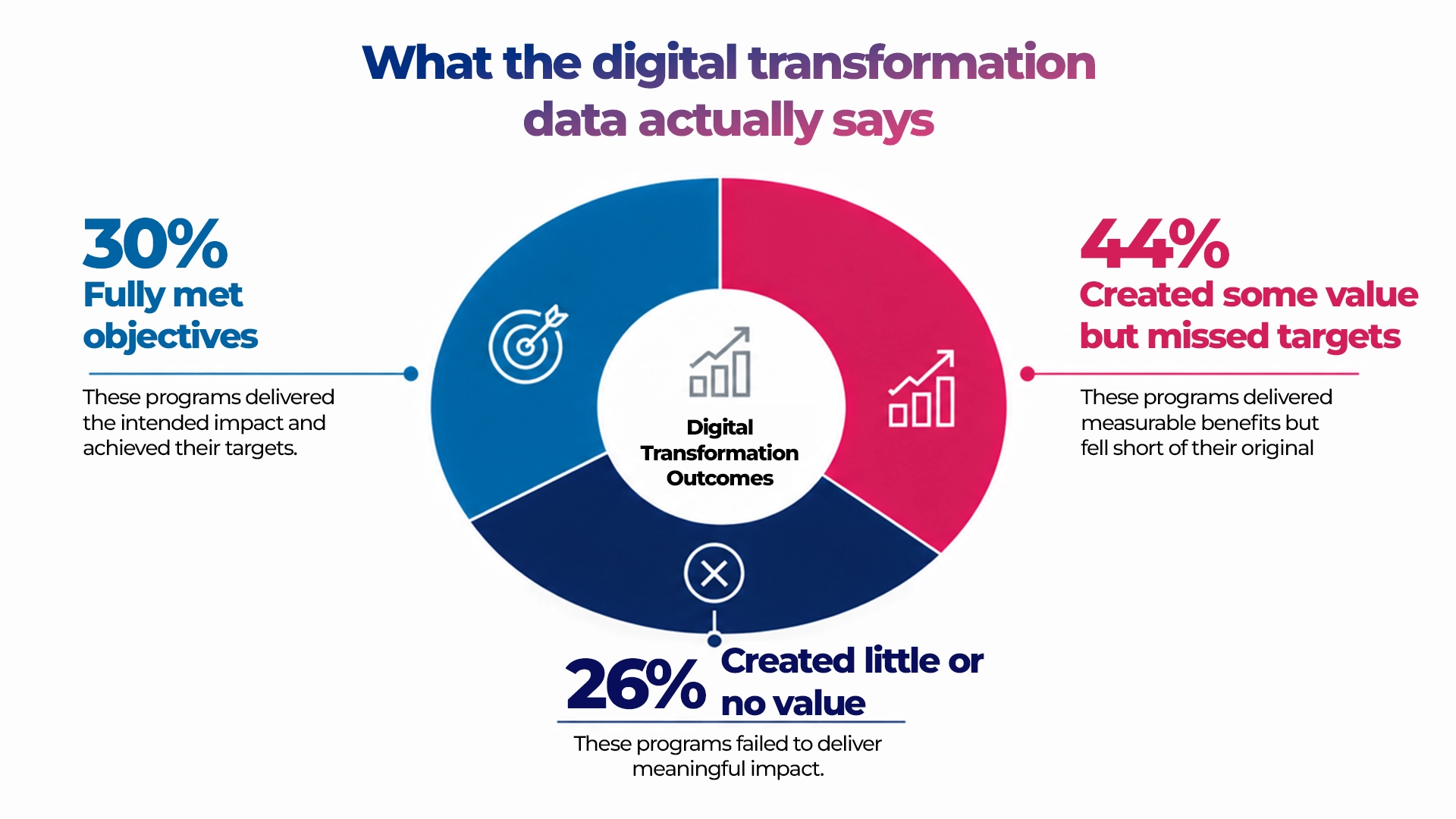
Boston Consulting Group’s widely cited analysis of digital transformation programs found roughly 30% fully met their objectives, 44% created some value but missed their targets, and the remainder created little or nothing. Read carefully, that is not a story of 70% catastrophic failure. It is a story where a large majority of programs produce partial value, and a much smaller minority produce nothing at all. That distinction matters enormously for how an executive team should respond: a program producing 60% of its intended value has a very different diagnosis and fix than a program producing none.
Gartner’s own published research on project and initiative success, not the disputed $2.3 trillion figure sometimes wrongly attributed to it puts the share of projects fully meeting or exceeding their targets at around 48%. That is a meaningfully less dire picture than “70% fail,” and it aligns with the pattern BCG found: not total collapse, but a wide gap between full success and everything else.
Inside banking specifically, one 2026 industry survey found 93% of financial institutions are not fully achieving their digital transformation goals, but the same research also found 57% of institutions still naming digital experience as a top strategic priority, and a notable share simultaneously continuing to expand physical branch networks. That combination, high stated priority, continued investment in the old model, and missed digital goals is not evidence of the wrong strategy. It is close to a textbook description of an execution gap – the ambition is real, the follow-through is inconsistent.
Why This Distinction Matters More in Banking Than Almost Anywhere Else
In most industries, an inflated failure statistic is a minor irritant. It makes for a dramatic conference slide and not much else. In banking, it has real consequences for how boards and risk committees respond to transformation programs. A board that believes 70–90% of transformations fail outright is primed to treat any program encountering difficulty as evidence of a doomed strategy, rather than diagnosing whether the actual problem is fixable execution debt. That primes exactly the wrong response: abandoning or re-planning programs that would have succeeded with better delivery discipline, rather than fixing the delivery discipline itself.
The more defensible numbers, a meaningful minority achieving full success, a large share achieving partial value, and a much smaller share failing completely point toward a different, more actionable conclusion – most banking transformation programs are not doomed by strategy. They are underperforming their potential because of specific, identifiable execution gaps, most of which are addressable without starting over.
The Right Number to Actually Track
Rather than importing an industry-wide statistic of uncertain provenance into a board discussion, the more useful exercise for any executive team is to apply the same rigor to their own program: what percentage of the original business case has actually been realized, and is the gap between the business case and the realized value concentrated in a specific, identifiable cause. Is Governance, capability, data, or trust spread evenly across everything? That answer, unlike any of the numbers examined here, is one your own institution can actually verify, and act on.
Related reading:
- Why Most Banking Transformations Fail at Execution (pillar guide)
- Strategy Failure vs. Execution Failure: Why Banks Keep Misdiagnosing Their Own Transformation Problems.
Sources
- Boston Consulting Group digital transformation success-rate research (30% / 44% / 26% split) – BCG / PR Newswire.
- McKinsey research defining transformation success as improved and sustained performance, finding fewer than a third of transformations meet that bar – McKinsey & Company.
FAQ
1. Is it true that 70% of digital transformations fail?
Not in the way the statistic is usually used. The 70% figure traces most credibly to McKinsey research that defines success strictly as performance improvement sustained over time across all types of organizational transformation, not a pass/fail verdict on digital or AI initiatives specifically. Applied that way, it substantially overstates outright failure.
2. Where does the $2.3 trillion global transformation waste figure come from?
It traces back to a 2024 press release tied to a single author’s book on transformation methodology, distributed through a commercial wire service, not a named research institution with a disclosed methodology. It is frequently, and incorrectly, attributed to Gartner.
3. What is a more useful number for a bank to track than an industry-wide failure statistic?
What percentage of the original business case has actually been realized on the bank’s own program, and whether the shortfall is concentrated in a specific, identifiable cause, governance, capability, data, or trust. That answer is verifiable and actionable in a way a borrowed industry statistic is not.