

From Execution Engines to Inference Engines
Banking CIOs have led their organizations through three major technology waves: core banking modernization, the internet, and the mobile revolution. Each demanded heavy capital investment, structural rewiring, and the willingness to cannibalize systems that still functioned. The overarching objective in every cycle was the same – build faster, cheaper execution engines that automate explicitly defined processes and reduce cost per transaction.
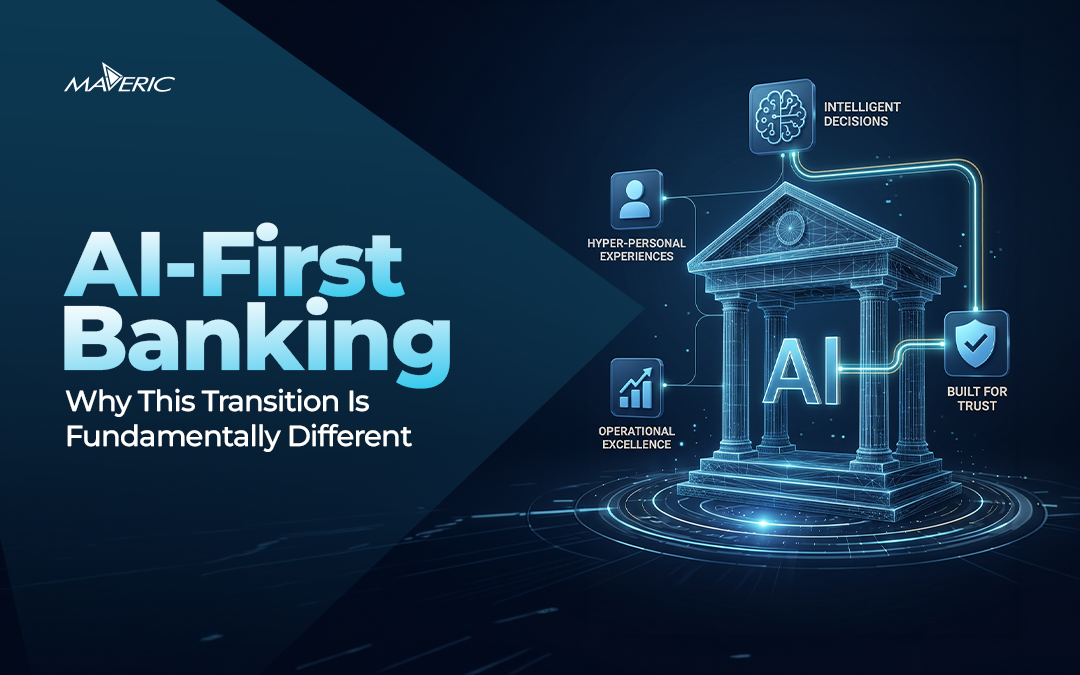
The shift to AI-first banking breaks that pattern. It is not a new channel. It is not a faster interface. AI in banking transforms the fundamental axis of banking technology from passive execution to active inference and orchestration.
Where digital technologies required humans to define rules, structure data, and anticipate every query in advance-AI can autonomously conceptualize an objective, harness unstructured data dynamically, and interpret context to make real-time decisions.
That is not an incremental upgrade. It is a structural redesign of how banking intelligence operates, and it demands a fundamentally different CIO agenda.
Three Architecture Shifts That Define AI-First Banking
Understanding the AI transformation in banking requires examining it across three core capability dimensions: data sourcing, processing, and customer engagement. The contrast with digital-first architecture is precise and consequential.
Data Sourcing: Static Lakes vs. Dynamic Context
Digital-first banks-built data lakes engineered for foreseen queries. Schemas were pre-structured for anticipated use cases. If a new fraud pattern emerged or a new customer segment needed to be modelled, the lake required re-engineering – introducing delay and cost every time the business changed its questions.
An AI-first architecture eliminates this bottleneck. Rather than relying on pre-structured data lakes, the system dynamically pulls contextual information from internal and external sources simultaneously: CRM records, government registries, third-party providers, transaction history, and behavioral signals – processed in a single inference pass without waiting for a schema to be updated.
Processing: Rule-Driven vs. Context-Driven
Rule-based workflow engines – the backbone of digital banking – require humans to define every decision pathway in advance. If the scenario was not anticipated, the system cannot process it. This constraint is particularly costly in fraud detection, credit decisioning, and compliance monitoring, where the edge cases are precisely the cases that matter most.
AI replaces static decision models with context-driven stratification and continuous pattern validation. The system does not need a human to write the rule; it infers the decision from the pattern. This is the mechanism behind the AI in financial services shift from predictive analytics to autonomous, real-time decisioning.
Customer Engagement: Channels vs. Multimodal Intelligence
Digital banking provided customers with multiple self-service channels – mobile, web, IVR. AI gives banks a single multimodal intelligence layer capable of seamlessly processing and pivoting between text, voice, image, and video within one interaction. This is not a UX enhancement. It is a structural redesign of how customer intent is understood and how resolutions are orchestrated – in real time, without pre-programmed scripts.
What the AI-First Mandate Means for Banking CIOs
For North American banking leaders, the AI transformation in banking carries three immediate strategic imperatives.
Retire the foreseen-query assumption:
Data architectures must evolve from static lakes designed for known rules into dynamic foundations that unify domain, digital, data, and quality engineering competencies. The infrastructure must be capable of serving questions that have not yet been asked.
Redefine the performance scorecard:
Digital-era metrics channel adoption, transaction throughput, uptime – remain necessary but are insufficient for the AI era. AI-first banking demands a three-dimensional KPI framework: operational KPIs (turnaround time, cost per process); business KPIs (revenue productivity, fraud loss reduction); and trust KPIs (model explainability, fairness, auditability). The inclusion of trust KPIs is not cosmetic it is the foundation on which responsible AI in banking is built.
Position AI as an orchestration layer, not a feature:
Institutions extracting measurable value from AI transformation are not those that have deployed a chatbot or a single ML model. They are those that have embedded AI as the operating intelligence of the bank spanning onboarding, compliance, personalization, and software delivery with governance and explainability designed in from the start.
Banking has always been built on trust and efficiency. In the AI-first era, that trust is engineered not by how fast a customer can click through a form but by how intelligently the bank anticipates their needs and orchestrates the solution.
The digital era asked banking CIOs to be fast and multi-channel. The AI era asks them to be predictive, contextual, and trusted. That is a different mandate – and it requires a different operating model. The strategic framework for leading this transition is documented in full in the whitepaper – From Digital-First to AI-First: The Mandate Reshaping the Banking CIO Agenda.
Frequently Asked Questions
What is AI-first banking?
AI-first banking is an operating model where artificial intelligence functions as the primary intelligence layer across core banking operations – from customer onboarding and fraud detection to product development and compliance monitoring. Unlike digital-first banking, which automates pre-defined rules, AI-first banking enables systems to infer, orchestrate, and adapt in real time without requiring humans to define every decision pathway in advance.
How is AI-first banking different from digital banking?
Digital banking created faster execution engines for pre-defined processes. AI-first banking introduces active inference – the ability to interpret unstructured data, identify patterns, and make autonomous decisions without a pre-written ruleset. The shift is from transaction automation to contextual intelligence that operates across data sourcing, processing, and customer engagement simultaneously.
Why is responsible AI important in banking?
Responsible AI in banking ensures that AI-driven decisions are explainable, fair, and auditable – conditions that are both regulatory requirements and foundations of customer trust. As AI becomes embedded in credit decisioning, compliance, and fraud detection, banks must build explainability and governance into system architecture from the outset, not as retroactive additions.
What should banking CIOs prioritize in an AI-first transition?
CIOs should focus on three areas: evolving data architectures from static lakes to dynamic foundations; embedding multimodal AI across customer servicing; and deploying agentic workflows that span the full software development lifecycle. Equally critical is redefining performance metrics to include trust KPIs – model explainability, fairness, and compliance auditability – alongside operational and business outcomes.