

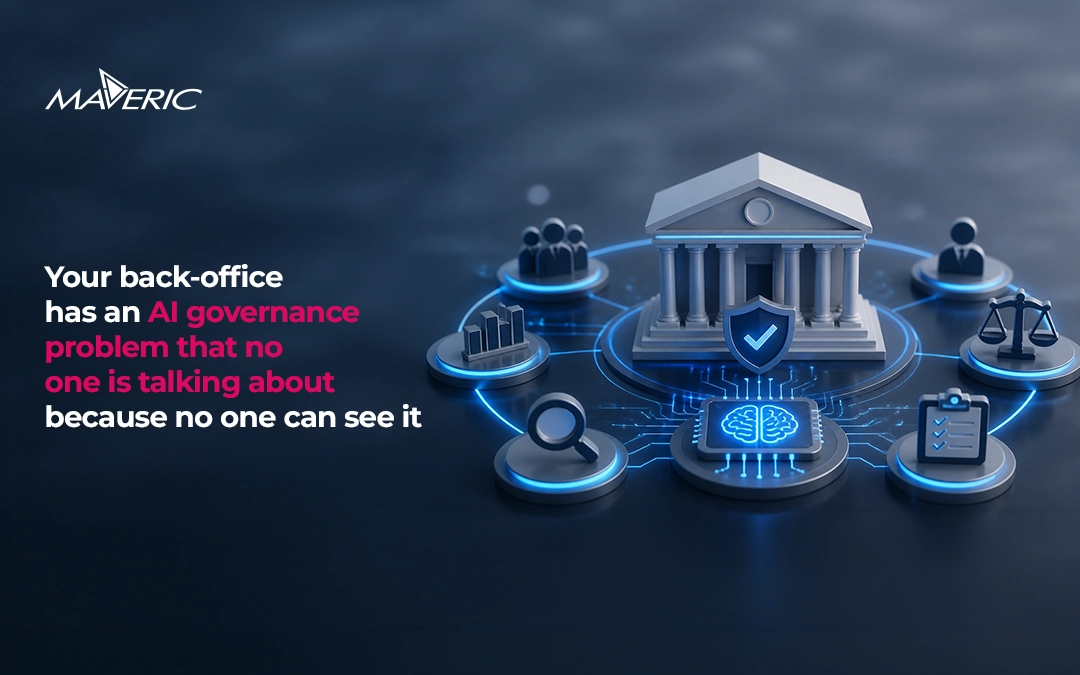
There is a question worth asking of any banking technology leader who oversees operational AI governance: how many AI tools are in use across your back-office functions right now – not on the approved technology list, not through a formal deployment, not assessed for accuracy or regulatory compliance?
Most honest answers to this question are larger than the governance team knows. And most governance programmes addressing shadow AI in banking focus on the first-order problem: identify the tools, assess them, approve or remove them. This is necessary. It is not sufficient.
The deeper governance gap in back-office shadow automation is not the presence of unsanctioned tools. It is the lineage problem those tools create. And lineage is the governance dimension that most shadow AI frameworks have not yet reached.
Why Back-Office Automation Failures Are Invisible Until They Are Not
Customer-facing automated decisions that produce wrong outcomes generate immediate signals. A customer who was incorrectly declined calls to complain. A payment that was wrongly blocked is reversed with an apology. The failure is visible within hours.
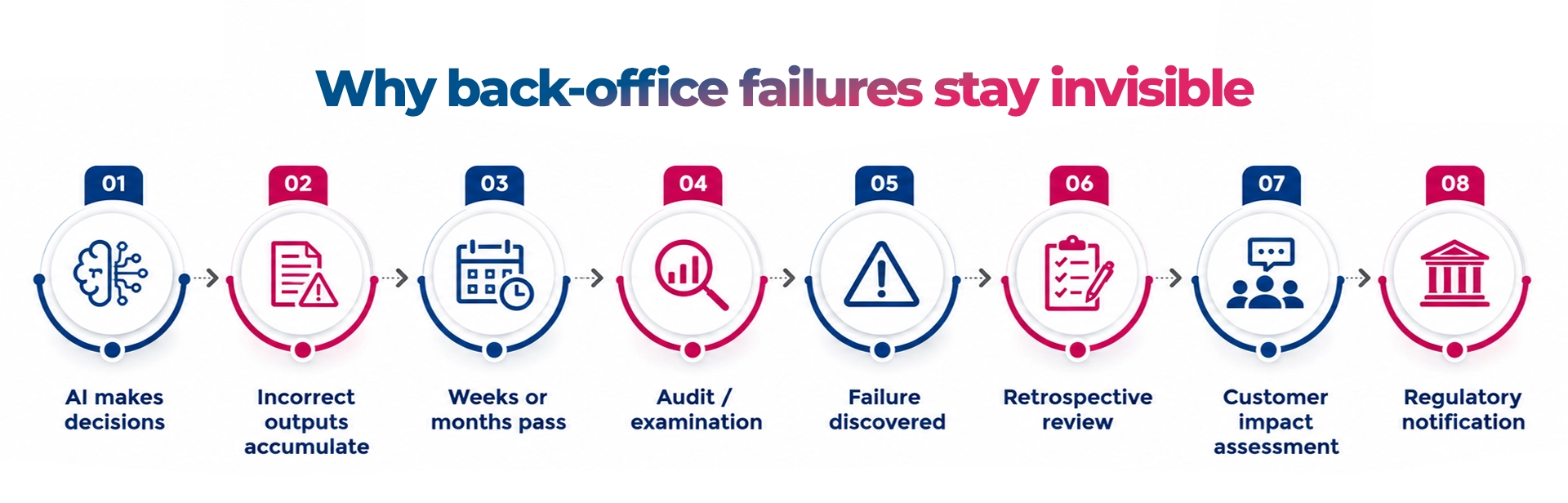
Back-office automation failures have a different temporal signature. Reconciliation processes that have been clearing incorrect matches. Exception management workflows that have been routing cases to the wrong resolution path. Regulatory data preparation that has been aggregating figures from an inconsistently governed source. None of these generate an immediate visible signal. They generate a pattern – a pattern that becomes visible only when a downstream audit, a regulatory examination, or a calculation error downstream reveals the accumulation of what the automation has been doing for weeks or months.
By the point of discovery, the remediation scope is not one decision. It is every decision the process has made since the failure mode began. The retrospective review, the customer impact assessment, the regulatory notification, the governance reconstruction – these are the costs that make back-office automation failures disproportionately expensive relative to the volume of individual decisions involved.
THE PATTERN THAT REPEATS
A regional bank’s operational risk team identified during examination preparation that approximately 340 exception items processed over six months had been assessed using an AI-assisted matching tool adopted independently by one team member. The tool was not on the approved technology list, had not been assessed for accuracy, and produced no audit trail of its matching logic. The exceptions had been signed off by team members who had no way of knowing the matching assessments were AI-generated rather than human-reviewed. The examination finding was a governance failure in the exception management process – requiring full retrospective review of all exceptions in the period. The retrospective review cost substantially more than a governed AI adoption programme would have required.
The Two Versions of the Shadow Automation Problem
Most governance responses to shadow automation focus on Version 1: unsanctioned tools that need to be brought into governance or removed. This is the version that technology audits find – a team member using an AI summarisation tool for regulatory guidance, a reconciliation function using an AI matching tool outside the approved list, a risk team using AI-generated analysis in board briefings.
Version 2 is less commonly addressed and more consequential: the lineage gap that shadow automation creates. Every automated decision produced by a governed programme has a lineage record – the data it consumed, the model version that processed it, the logic it applied at the time it ran. This lineage is what makes the decision reconstructable under examination. The institution can answer the question: why did this automated process produce this output on this date?
An automated decision produced by a shadow tool has no lineage. There is no record of what data the tool was operating on at the time the decision was made. No record of the model version – or whether the tool has a concept of model versioning at all. No record of the specific logic applied. When an examiner asks to reconstruct the decision, the institution cannot reconstruct what it cannot trace. The problem is not that the tool was unsanctioned. The problem is that its outputs are unaccountable.
This distinction matters because the regulatory consequence of Version 2 is different from the consequence of Version 1. An unsanctioned tool that has been used is a governance process failure – addressable through remediation of the approval process. An unaccountable output that cannot be reconstructed is an evidential failure – where the institution cannot demonstrate that the regulatory obligation attached to that output was met. These carry different examination classifications and different remediation requirements.
Why the Problem Is Larger Than Most Governance Programmes Have Found
Back-office functions are uniquely vulnerable to shadow AI adoption for three reasons that governance programmes frequently underestimate.
First, the pressure to adopt. Back-office teams operate under volume and deadline pressure that is constant and structural. The regulatory data preparation cycle that must complete by a defined date. The reconciliation that must close before month-end. The exception queue that cannot be allowed to grow. When an accessible AI tool reduces the time required to meet these obligations, adoption follows – not because the team is circumventing governance, but because the governance process has not moved at the speed the operational reality demands.
Second, the invisibility of the outputs. Customer-facing AI outputs are reviewed before they reach the customer. Back-office AI outputs are often reviewed by the same person who generated them – which means the review is not genuinely independent, and an AI-generated output that looks plausible to the person who generated it will pass review even if it is wrong.
Third, the normalisation of productivity tools. The line between a productivity tool (acceptable) and an AI tool requiring governance (requiring assessment) is not clearly drawn in most banking organisations. A team member using an AI writing assistant to draft the narrative in a regulatory exception report does not necessarily understand that the output carries regulatory accountability and therefore requires the same governance as any other AI-assisted regulatory output.
What Genuine Lineage Governance Requires
The governance response to the shadow automation problem at both levels – the tool and the lineage – requires an automation register that goes beyond a technology approval list.
An approval list records which tools have been assessed and approved. An automation register records, for every AI-driven process in the operational estate – sanctioned and unsanctioned – what data it consumed, what obligation its output fulfils, what human review touchpoints exist in the process, and what lineage record exists for each output it has produced. The automation register is not a one-time governance exercise. It is a continuously maintained operational record that is updated with every new deployment, every tool adoption, and every process change – including unsanctioned adoptions brought into governance through the discovery process.
Building this register begins with the discovery process: a systematic inventory of what AI is actually being used across back-office functions, conducted with enough operational depth to surface the tools that have been adopted outside formal governance channels. For most institutions, this inventory will produce a larger list than the governance team expects. The gap between what has been formally approved and what is operationally in use is the shadow automation estate. It is almost certainly larger than any programme review has found.
You cannot govern what you cannot see. And you cannot account for what you cannot trace. The shadow automation estate is not a future risk. It is a current lineage gap, accumulating with every output that cannot be reconstructed under examination.
The Automation Register – its specific requirements, the discovery process for bringing shadow automation into governance, the lineage record architecture, and the 90-day action checklist for operational AI governance – is set out in full in CIO Mandate Series Paper 3.
Download: Engineering Trusted Automation in AI-First Banking Operations