Your compliance function probably cleared more alerts this year than ever before. Could it explain any single one of those decisions to an examiner, with the model, the data and the reviewer behind it?
Banks are already moving. In American Banker’s 2025 Data-Driven Bank survey1 of 130 bank and credit union leaders, 59% said they were integrating and testing new AI-powered tools for risk and compliance.
Numbers like these make compliance automation in banking an easy case to approve. They also hide a risk. Automating compliance work raises its volume and speed. Whether it raises the bank’s ability to defend each outcome is a separate question, and it is the one examiners ask.
Where Volume and Assurance Diverge
Engineering Trust in AI Compliance and Regulatory Governance describes the gap between automated compliance volume and compliance assurance. A bank can screen more transactions, check more documents and generate more reports with AI, and still be less able to explain an individual determination than it was when a person made it.
The gap opens for a structural reason. When a person made a compliance decision, the explanation lived with them: an analyst could say why a match was cleared or an alert closed. When a model makes or shapes the decision, the explanation has to be captured deliberately, at the moment of the decision, or it is lost. Much compliance tooling records outcomes more reliably than it records reasons.
The gap matters most where an automated output becomes a regulatory fact: a suspicious activity report, an adverse action notice, a regulatory filing. For those, the whitepaper argues for determination-level explainability, the ability to show how each individual outcome was reached, and warns of the adverse action trap, in which exposure comes from undocumented reasons as much as from wrong decisions.
Two Groups of Compliance Use Cases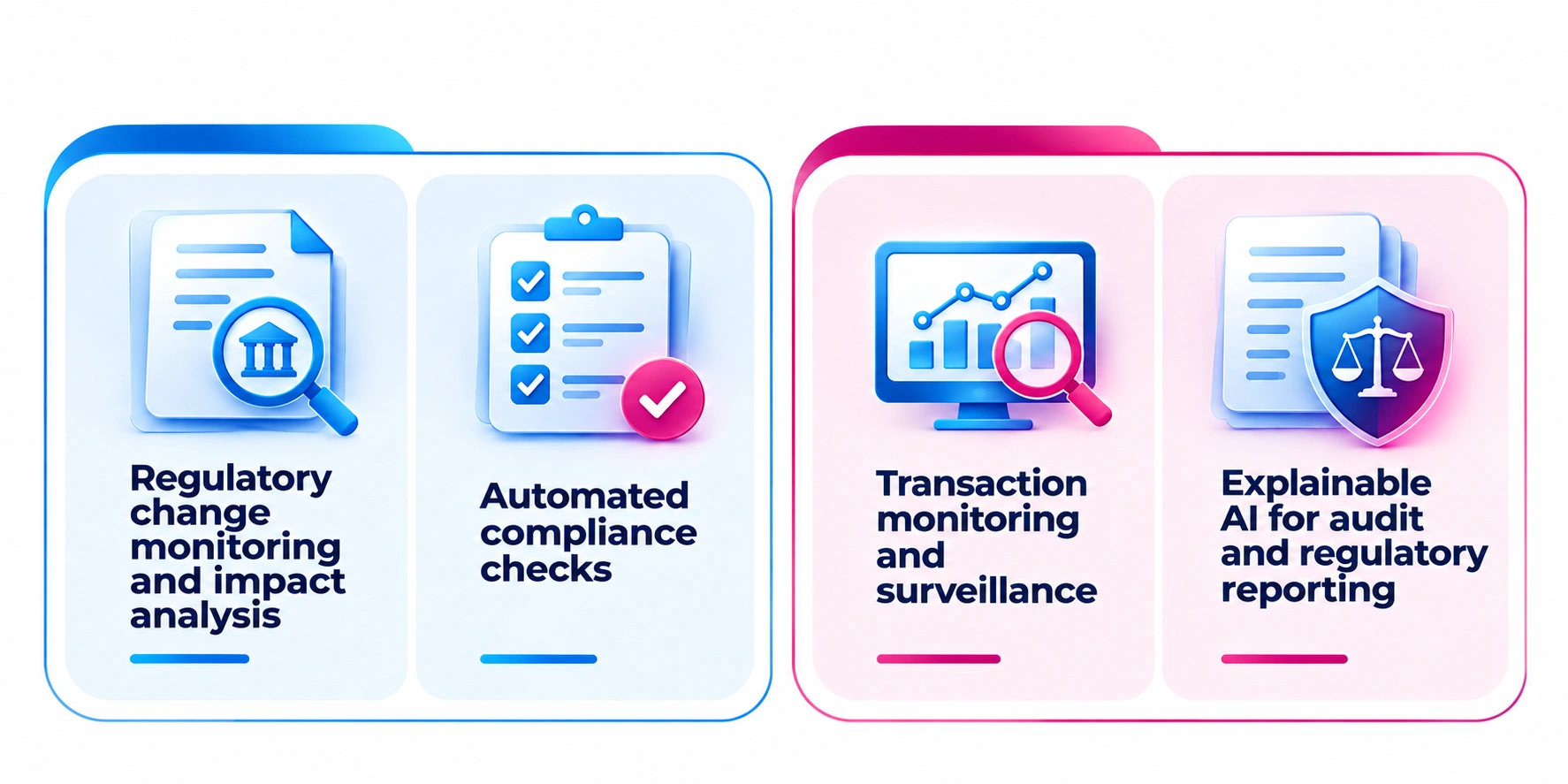
The AI in banking prioritization framework rates each use case on value, data, judgment, controls and measurability. The four compliance use cases split into two groups.
Regulatory change monitoring and impact analysis supports compliance officers who still interpret the rule. The review point is clear and the outcome measurable: time from publication to impact assessment, and the number of obligations mapped to owners. For a regional bank with a small compliance team tracking federal and state changes, it usually lands in the first wave.
Automated compliance checks apply known rules faster and more consistently. They score well where the rules are explicit, such as disclosure timing or document completeness, and less well where the check requires judgment the model cannot document.
Transaction monitoring and surveillance has high value and sits inside model risk management, so validation, tuning and drift monitoring decide its readiness. Its outputs feed SAR decisions, so the explanation standard is high.
Explainable AI for audit and regulatory reporting is different from the other three. It is a control in its own right, and it often has to be in place before the rest of the portfolio can scale. Banks that score it low tend to find that several other use cases are quietly waiting on it.
The Regulatory Clock Has Changed
Two developments make the assurance question more pressing in 2026. SR 26-2, the revised interagency model risk guidance issued by the Federal Reserve, FDIC and OCC in April 2026, replaces SR 11-7 and is expected to be most relevant to banks with over $30 billion in total assets. Monitoring and screening models at those banks sit inside the revised framework. Generative AI used to draft narratives or summarize regulation sits outside it, so the bank’s own controls carry the full weight.
For credit unions, the gap is wider. The US Government Accountability Office reported in May 20253 that the NCUA’s model risk guidance is limited in scope and detail and that the NCUA cannot examine technology service providers, where much credit union compliance technology runs. A credit union automating compliance with vendor tools therefore needs to set and evidence its own standard.
From Periodic Validation to Continuous Assurance
Traditional compliance assurance runs on a calendar: annual model validation, periodic testing, scheduled audits. AI models change faster than that cycle, through retraining, data drift and vendor updates. A CIO and CRO Mandate for Global Banks: AI Compliance and Regulatory Governance describes the response as a move toward continuous assurance, built on its Enterprise AI Accountability Architecture: policy and risk framework, lifecycle governance, continuous monitoring, and accountability and audit.
For a regional bank, the change can happen without a large new function. Each automated compliance use case ships with three things: monitoring that runs as often as the model changes, a record of each determination it supported, and a named owner who reviews exceptions. The first use case that adopts this pattern becomes the template for the rest.
Name an Owner for Each Explanation
Compliance automation sits across four owners, and each tends to assume another holds the explanation. The Chief Compliance Officer owns the obligation and the determination. The CIO owns the platform and the logs. Model risk owns validation for the models inside its scope. The business line owns the customer and the process the check sits in. When an automated decision is questioned, the evidence has to come from all four, usually in a hurry.
Naming one owner for the end-to-end evidence trail of each automated compliance use case, from model output to recorded determination, removes that scramble. It also makes the controls question in the prioritization framework easy to score: if nobody can be named, the use case is not ready.
The Cost of Getting It Wrong
Compliance automation that cannot be explained tends to surface in an examination, often months after the decisions were made, and the remediation usually means re-reviewing work the automation was meant to save. The savings case for automation assumes the output is accepted; the real cost includes the chance that it is not. Scoring controls honestly before launch is the cheapest insurance against that outcome.
What to Ask of Compliance Technology Solutions
When evaluating compliance technology solutions for banking, ask the vendor or internal team to demonstrate, for a single sample case:
- Which model version produced the output, and when it was last validated.
- What data it used, and where that data came from.
- How the output would be explained to an examiner in plain language.
- Who reviewed it, and how exceptions are escalated.
- How drift or degraded performance would be detected and reported.
Ask for the answers on a single case first. If they are hard to produce for one case, they will be harder to produce for thousands.
Bring Explainability Forward
The AI in Banking Scorecard from Maveric Systems includes the four compliance use cases in this article alongside KYC, lending and operations. Scoring explainable AI for audit next to the use cases it supports shows how much of the portfolio is waiting on that one control.
Of the compliance decisions your bank automated this year, how many could you explain individually to an examiner, with the model version, the data and the reviewer?
Compliance Automation in Banking Key Questions
What is compliance automation in banking?
Compliance automation uses rules engines and AI to perform compliance work such as screening, transaction monitoring, regulatory change tracking, policy checks and reporting. AI extends it to unstructured work, such as reading regulatory text or drafting narratives, which makes explainability and review more important.
Can AI reduce compliance costs in banking?
It can reduce the labor in high-volume work such as screening, document review and regulatory change analysis. The savings hold when each automated outcome can be explained and reviewed; otherwise the cost moves into remediation and examination findings.
What makes AI compliance in banking defensible?
A defensible AI compliance process can show, for any individual outcome, the model version, the data used, the reasoning in plain language, the reviewer and the monitoring results at the time. Building those records in from the start costs less than reconstructing them later.
Do credit unions face different AI compliance expectations?
Credit unions are supervised by the NCUA, not by the interagency SR 26-2 guidance. GAO’s May 2025 report found NCUA model risk guidance limited and noted the NCUA cannot examine technology service providers, so credit unions using vendor AI need their own documented standard.
Sources
- American Banker, “Bankers Continue to Deploy AI but Worry About Data Accuracy” (2025 Data-Driven Bank survey).
- OCC Bulletin 2026-13, Model Risk Management: Revised Interagency Supervisory Guidance (SR 26-2 at the Federal Reserve), 17 April 2026.
- US Government Accountability Office, Artificial Intelligence: Use and Oversight in Financial Services, GAO-25-107197, May 2025.