



Technological revolutions often follow a predictable rhythm of hype, adoption, and consolidation. The dot com bubble of the late 1990s serves as a cautionary tale: between 1995 and 2000, internet optimism drove NASDAQ from under 1,000 to 5,048, only for trillions of dollars in market value to evaporate within two years.
Today, artificial intelligence especially generative AI is evoking similar excitement. Companies with limited revenues command extraordinary valuations. Hyperscaler capital expenditures have reached unprecedented levels. Yet, unlike 2000, enterprises, investors, and regulators are approaching AI with lessons learned from the past. For C-suite leaders, this is an opportunity to navigate hype with discipline and position their organizations for long-term value creation.
The Dot Com Era: Lessons in Hype and Risk
The late 1990s saw venture capital inflows skyrocket from $8 billion to over $100 billion, with nearly 40% directed to internet ventures. IPOs surged, and companies like Pets.com captured headlines despite minimal revenue.
The ensuing crash in 2000-2002 obliterated valuations. Webvan, Boo.com, and other high-profile failures burned through hundreds of millions in capital. Yet, the aftermath wasn’t solely destructive: nearly 50% of ventures survived five years, infrastructure companies like Cisco and Qualcomm rebounded, and Amazon ultimately emerged as a trillion-dollar giant.
Key lessons were absorbed across stakeholders:
- Enterprises realized that technology investments must be grounded in measurable business value. Digital transformations became phased, auditable, and ROI-driven.
- Technology providers learned the importance of sustainable unit economics and validated demand. The overbuilt internet infrastructure later enabled global broadband expansion.
- Investors adopted milestone-based funding, diversified portfolios, and a focus on capital efficiency.
- Regulators introduced stronger governance frameworks like Sarbanes-Oxley.
- Analysts emphasized organizational readiness, feasibility, and total cost of ownership.
This suggests that while a correction is likely, it will be more controlled than catastrophic.
Strategic Implications for Leaders
C-suite executives should consider four key priorities:
1. Measurable ROI:
AI programs must demonstrate payback within 12–18 months. Predictive maintenance and quality transformation initiatives are proving value, but only a fraction of AI projects scale.
2. Phased Scaling:
Adopt AI incrementally. Governments, for example, advance fewer than 10% of proposed initiatives, emphasizing proof-of-value over experimentation at scale.
3. Governance and Transparency:
AI assurance frameworks now mirror early 2000s corporate governance reforms, with regional variations influencing risk exposure.
4. Portfolio Discipline:
Focus on high-survival categories—compute platforms, chip manufacturers, and ROI-driven enterprise AI applications. Frontier LLMs and pure-play AI cyber tools remain vulnerable.
Looking Ahead: Controlled Consolidation
The AI market is likely to see a 30–50% correction—shallower than the dot com crash but more prolonged due to deep infrastructure integration. Strategic leaders who prioritize value, governance, and phased adoption will navigate this consolidation effectively. Ultimately, AI adoption today is not a replay of history—it is an opportunity to apply historical lessons, mitigate risk, and create durable value.
Read the full blog to understand which AI initiatives will endure and how your enterprise can position itself for sustainable growth.
FAQ
How is AI in 2025 similar to the dot com era?
AI in 2025 mirrors the dot com era in terms of rapid innovation, strong investor enthusiasm, and elevated valuations. Like the late 1990s, market narratives have accelerated faster than enterprise-wide adoption.
Why is AI not expected to collapse like the dot com bubble?
Unlike the dot com era, AI adoption today is shaped by stronger enterprise discipline, measurable ROI expectations, regulatory oversight, and mature digital infrastructure. These factors significantly reduce the likelihood of a sudden, systemic collapse.
What signals indicate an AI market correction is likely?
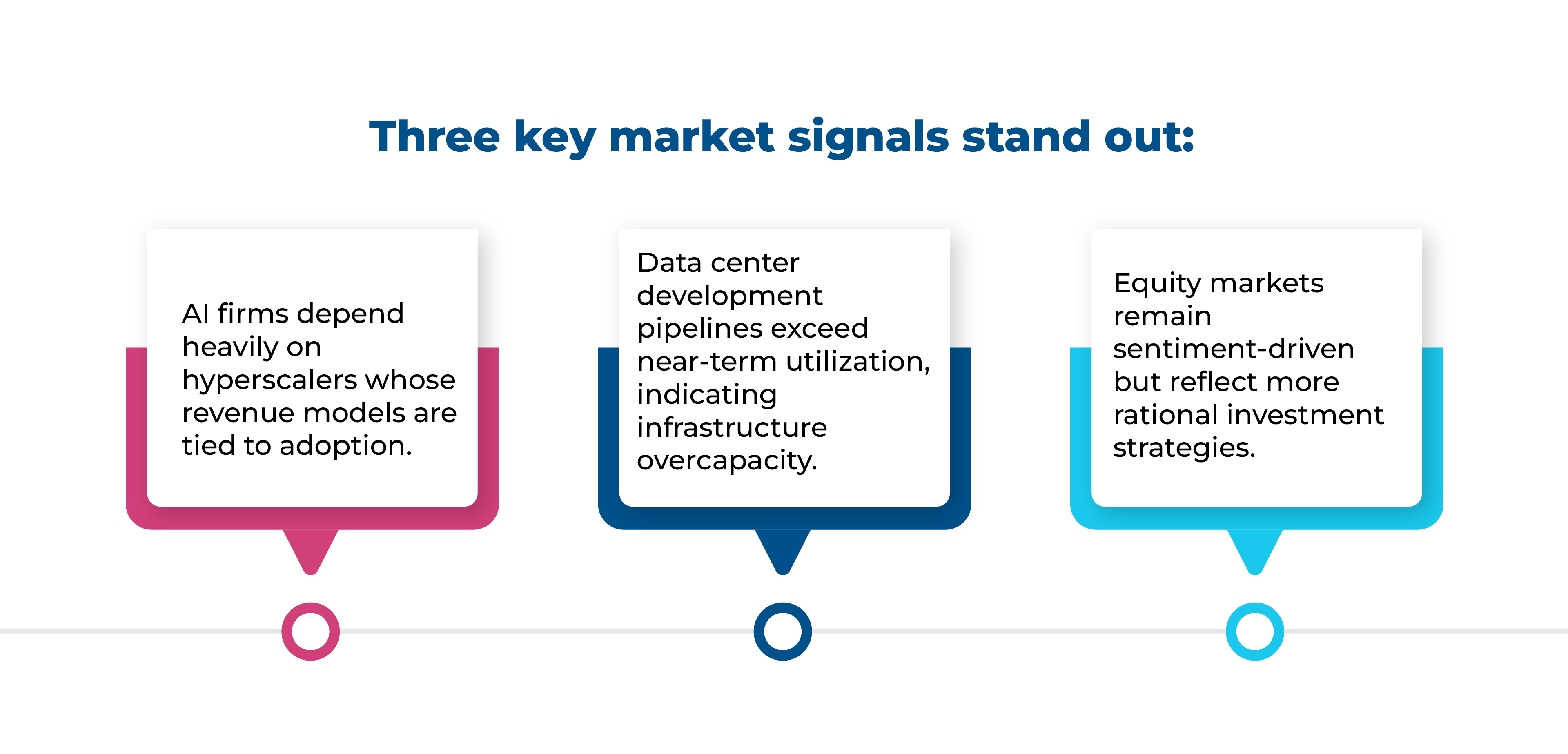
Three key signals suggest a market correction:
- AI companies’ dependence on hyperscalers for monetization
- Data center development pipelines exceeding near-term utilization
- Equity market sensitivity to AI-related sentiment
These indicators point to recalibration rather than collapse.
How severe will the AI market correction be?
The AI market is expected to experience a 30–50% correction, which is likely to be shallower than the dot com crash but more prolonged due to AI’s deep integration across enterprise systems and infrastructure.
Which AI investments offer the strongest enterprise value today?
Enterprise leaders see the strongest value from:
- Compute platforms and chip manufacturers
- ROI-driven AI use cases such as predictive maintenance and quality optimization
- Scalable enterprise AI applications aligned with operational outcomes
These areas align closely with measurable business priorities.
Which AI segments carry higher risk for enterprises?
Frontier large language model platforms and pure-play AI cybersecurity tools carry higher risk due to differentiation challenges, high integration dependencies, and unclear paths to sustainable profitability.
What should C-suite leaders prioritise in AI adoption?
C-suite leaders should prioritise:
- Clear 12–18 month ROI expectations
- Phased and auditable AI deployment
- Strong governance and transparency frameworks
- Portfolio discipline focused on high-survival AI categories
What is the key leadership takeaway from the dot com comparison?
The core lesson is that long-term value emerges when innovation is paired with discipline. Leaders who apply lessons from the dot com era—measurable ROI, phased scaling, and governance—will be best positioned to succeed in the AI consolidation phase.