

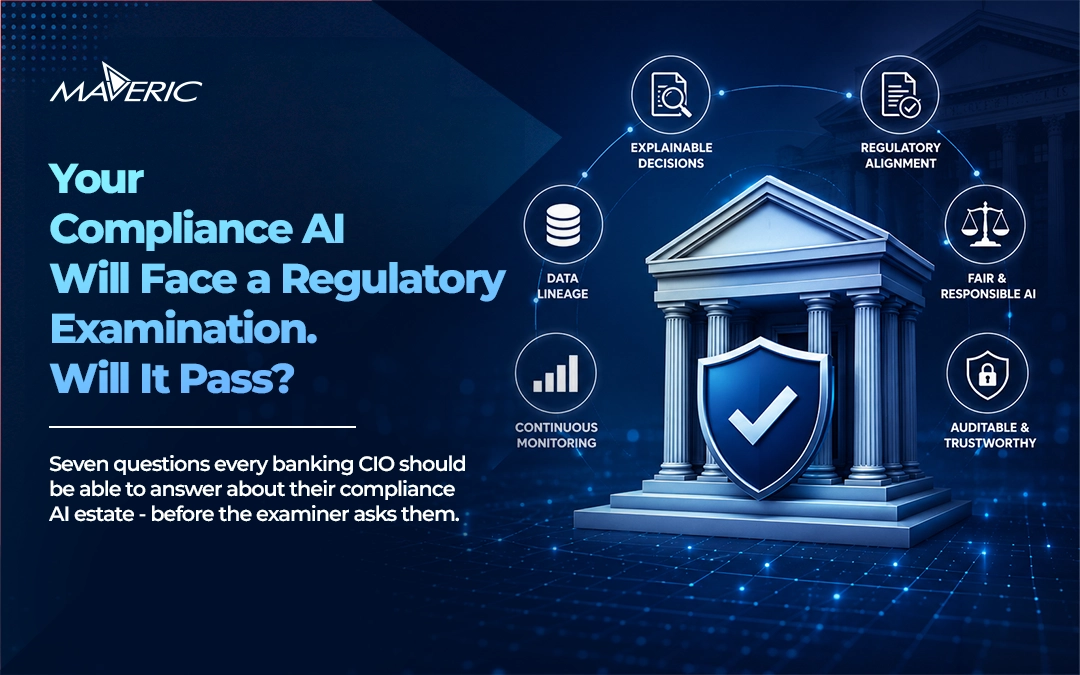
Seven questions every banking CIO should be able to answer about their compliance AI estate – before the examiner asks them.
There is a question that banking regulators increasingly ask when they examine an institution’s AI compliance programme. It is not the question most institutions are prepared for.
The question they are prepared for is: Do you have governance documentation? Model risk management policies, validation frameworks, approval records. Most institutions can produce these. The documentation exists.
The question regulators are now asking is different: Can you demonstrate, using production data, that your compliance AI is performing within its governance parameters today? Not on the day it was approved. Today.
That is a different standard. It requires operational infrastructure that documentation alone cannot substitute for – continuous monitoring, determination-level explainability, and data lineage that traces not just to a source system but to the specific passage in the governing regulatory standard that each validation reflects.
Most institutions do not have it. 80% of large financial institutions use AI in core compliance functions. Fewer than 12% have the governance infrastructure that doing so in a regulated context requires. The gap between those two figures is where the industry’s next wave of regulatory findings will originate.
The shift from compliance automation to compliance assurance is the defining governance challenge of AI-first banking. And it plays out across three specific battlegrounds where the consequences of getting it wrong are not measured in efficiency losses but in enforcement actions, consent orders, and the kind of remediation programmes that run for 18 months and cost multiples of what the governance infrastructure would have required.
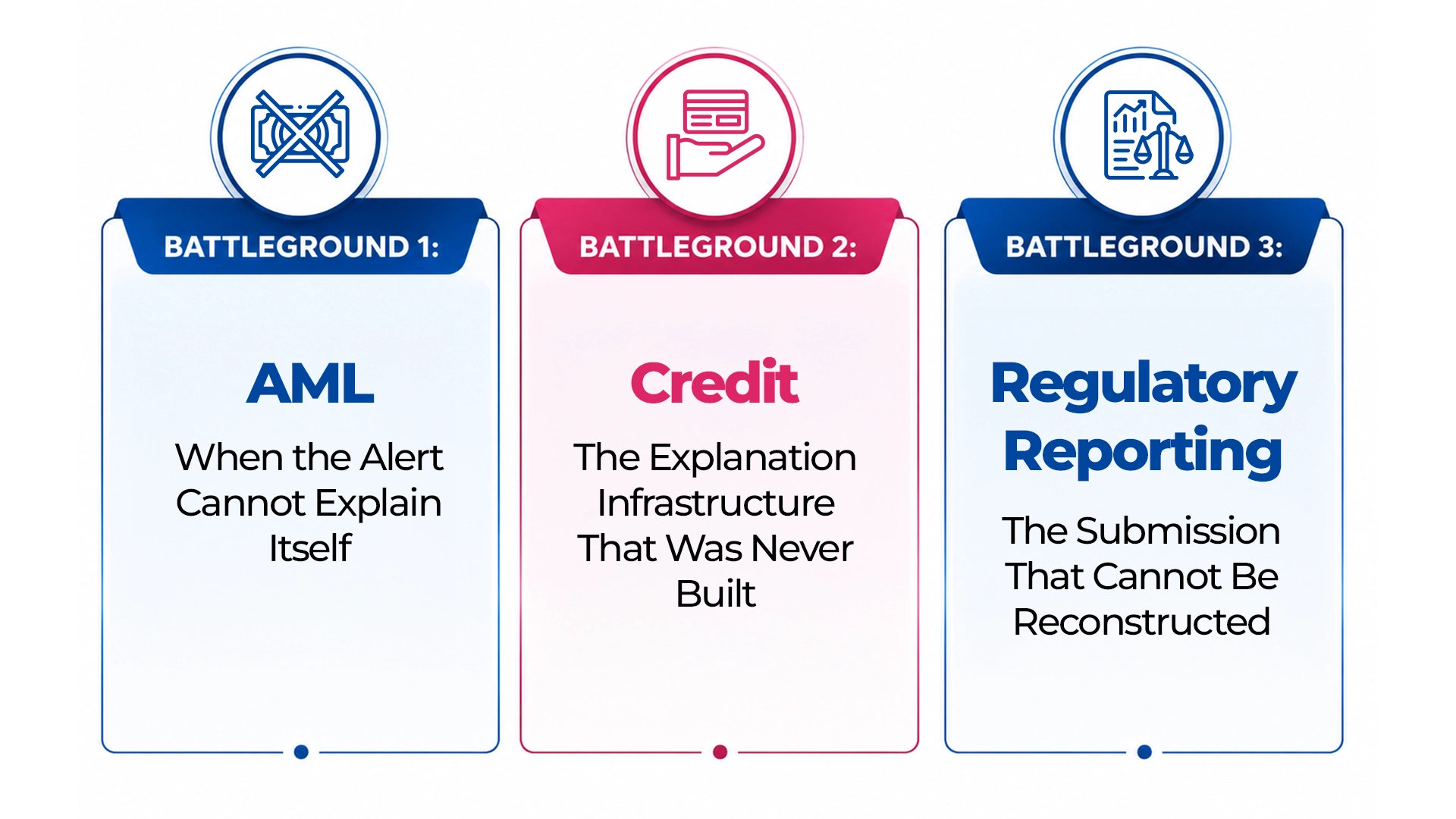
Battleground 1: AML – When the Alert Cannot Explain Itself
Rules-based AML monitoring was explainable by definition. The rule that triggered the alert was the explanation. Transaction amount exceeded threshold X. Counterparty appeared on list Y. The compliance analyst wrote the SAR narrative based on the rule that fired.
AI-driven AML monitoring works differently. The determination emerges from a combination of features – transaction value, frequency, counterparty patterns, geographic signals, timing, account history, and in an AI-first architecture, the semantic content of the transaction narrative itself. No single feature triggered it. The weight of the combination did.
This creates a specific accountability gap. When the compliance analyst sits down to write the SAR narrative, they need to explain why the transaction was suspicious. If the AI system was not designed to produce that explanation as a first-class output alongside the alert, the analyst is interpreting a confidence score – not exercising professional judgment on an explanation.
The institutions that have built this correctly embed determination-level explainability directly into the alert architecture. Every alert is accompanied by a structured, human-readable account of what the model assessed. The analyst validates the explanation. They do not reconstruct it.
This matters beyond the SAR narrative. When a third-party AML model is in use – which is common across Tier-1 and regional institutions – SR 11-7 places the governance obligation on the institution, not the vendor. An institution that cannot explain a determination because it does not understand the vendor’s model well enough has a model risk management gap, not a vendor problem.
Battleground 2: Credit – The Explanation Infrastructure That Was Never Built
Every institution that has faced enforcement action for algorithmic credit decisions has something in common. It was not penalised because its model produced incorrect outcomes. It was penalised because it could not explain why the model produced the outcomes it did.
ECOA and the FCRA require specific reasons for adverse credit decisions. The CFPB has been explicit: algorithmic complexity does not exempt a lender from this obligation. The FCA’s Consumer Duty extends the same standard in the UK. GDPR Article 22 applies it across the EU.
The explanation must be specific to the individual decision. Not a description of the model. Not a list of factors the model considers. A specific account of why this customer was declined, at this moment, drawing on these inputs.
This is a different engineering requirement from model documentation. Model documentation is produced once. Decision-level explainability is produced for every adverse decision, at the moment of the decision, in the format the regulation requires. The institutions that have the first and not the second are not compliant – regardless of how thorough their model governance documentation is.
And in an AI-first credit function that reasons over unstructured data – the text of application narratives, customer correspondence, document content – fair lending governance must extend to those unstructured inputs. Language patterns can carry demographic signals that structured features do not capture. A model that learns those patterns from training data can apply them at scale in ways that standard disparate impact testing, calibrated for structured features, will not detect.
Battleground 3: Regulatory Reporting – The Submission That Cannot Be Reconstructed
AI-led regulatory reporting is faster, more complete, and lower cost than manual reporting. It also introduces a failure mode that manual reporting did not have: a submission that appears complete but whose figures cannot be fully reconstructed because the AI that generated them did not produce the lineage documentation that reconstruction requires.
The report was automated. The auditability was not.
Shadow AI compounds this. Compliance analysts under deadline pressure use accessible AI tools to help draft submissions. The outputs are plausible. The institution has no visibility into whether the AI-generated content is accurate, consistent with the underlying data, or aligned with the regulatory standards the submission must meet. The institution is accountable for every figure in a regulatory submission regardless of which tool generated the first draft.
The governance architecture that closes this gap traces every figure in a regulatory submission back not just to its data source but to the validation logic applied to it – and where that validation logic reflects a regulatory requirement, to the specific passage in that requirement. Report data lineage at this level of granularity makes regulatory examination responses precise rather than reconstructed.
7-Questions to Ask About Your Compliance AI Estate Now
Before your next regulatory examination asks them:
- In your AML system, does determination-level explainability include reasoning over the semantic content of transaction narratives – not just structured features?
- Does your AML monitoring establish a behavioural baseline at the individual entity level – this specific customer, this specific account – or at the aggregate model level?
- Can your credit adverse action notice trace the validation logic to the specific passage in the credit policy that governed the decision – not just the data inputs?
- Does your fair lending bias assessment cover unstructured data inputs – application text, customer communications, document content – or structured features only?
- When your AI generates a regulatory submission, does the lineage for each figure trace to the specific passage in the governing regulatory standard that the validation reflects?
- Does your resilience framework’s predict function monitor at the context-specific level – this customer type, this transaction type, this market condition – or at the programme level?
- Do you have a complete inventory of AI tools in operational use across your compliance function – including tools your teams adopted without formal approval?
- If any of these questions produced hesitation, that hesitation is the gap. The regulatory examination that asks the same questions is not a future event. It is a current programme at your prudential supervisor.
The Standard Has Moved
The question is no longer whether your compliance AI is documented. It is whether it is demonstrably performing – with explainability at the individual decision level, lineage at the passage level, and monitoring at the entity level – in production, today, under the conditions the regulation requires.
The institutions building that infrastructure now are not just better prepared for the examination. They are operating AI-first compliance as it was intended: with the accountability that banking’s social contract has always required, engineered into technology that does not produce it automatically.
The full architecture – determination-level explainability, continuous AML monitoring, decision-level adverse action infrastructure, report data lineage, and the predict-prevent-mitigate-recover-restore framework for AI-first compliance – is examined in depth in CIO Mandate Series Paper 4: Engineering Trust in AI Compliance and Regulatory Governance