


Most digital account opening is a paper form on a screen. The customer still does the work, and the bank still checks everyone the same way.
Over the past decade, most banks moved account opening online. The forms became shorter, identity checks moved into the app, and e-signatures replaced the branch visit. Yet the structure underneath often stayed the same: the customer types in information the bank could have found, every applicant passes through the same checklist, and anything unusual stops in a queue until someone has time to look at it.
The cost of that structure is now visible. Fenergo’s 2025 survey1 of 600 senior decision-makers at banks, asset managers and fund administrators in the US, UK and Singapore found that 70% of firms lost clients in the past year to inefficient onboarding, up from 67% in 2024 and 48% in 2023. Abandonment averaged around 10%, and commercial and corporate banking carried the heaviest burden.
For digital onboarding in banking, the question has moved on from whether the journey is online to how much of the work the bank still hands to the customer, and how much of the risk work it still does the slow way
Why Onboarding Still Loses Customers
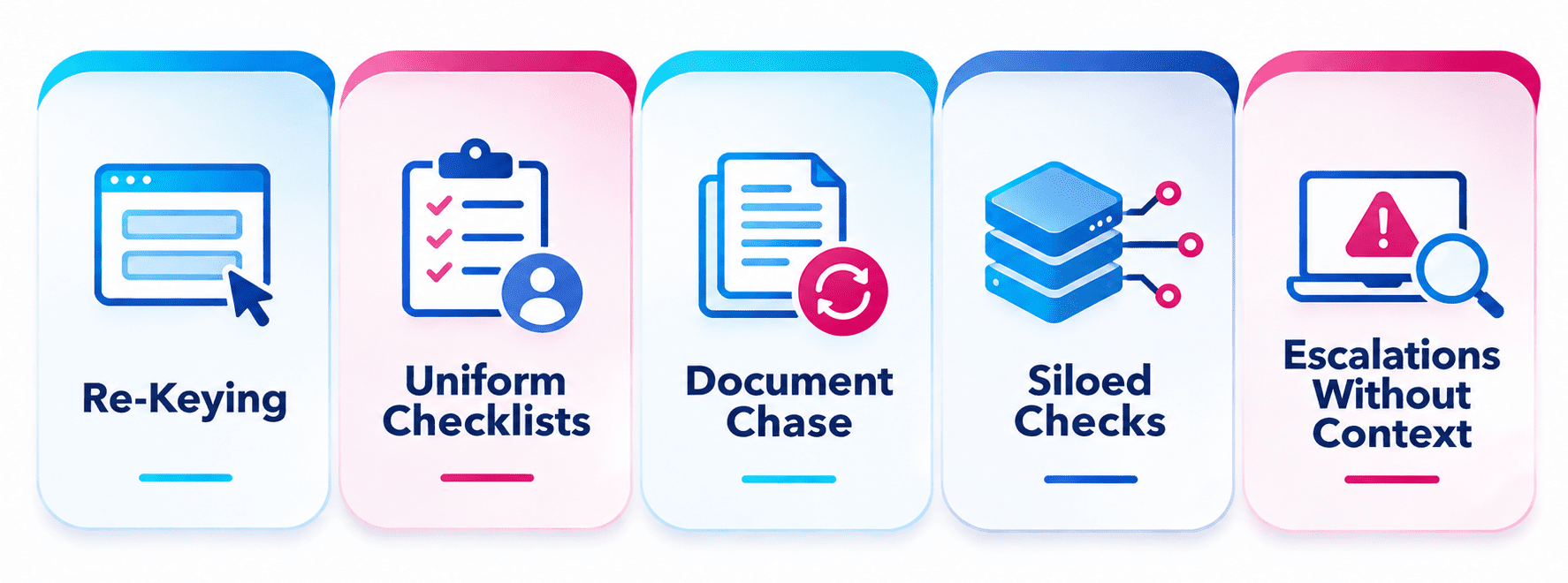
Applicants rarely abandon because of a single bad screen. They leave because of accumulated friction, and most of it has the same few sources.
Re-keying. The applicant is asked for information the bank already holds, such as an address on file for an existing customer, or that a trusted source could confirm. Every extra field is a chance to stop.
Uniform checklists. Rule-based onboarding applies the same checks to a low-risk applicant opening a savings account as to a complex business with overseas owners. The low-risk majority waits for controls designed for the high-risk minority.
The document chase. When something is missing or unclear, the process pauses while a person emails, calls or waits. For commercial applicants, a single chase can add days.
Siloed checks. KYC, AML screening and fraud checks often run in separate tools, each with its own data and its own false positives. One applicant can trigger the same question three times.
Escalations without context. When a case reaches a compliance analyst, it often arrives as a flag with no explanation. The analyst starts the investigation again from the beginning.
Each of these is a design choice inherited from the digital-first model, where the goal was to digitize the existing process. From Digital-First to AI-First describes the alternative as a move from self-service to zero-service
What Zero-Service Onboarding Looks Like
In the digital-first model, self-service meant that the customer typed in their own data instead of a teller doing it. Zero-service means the bank assembles what it can from its own records, registries, trusted third-party providers and the applicant’s digital footprint, and asks the applicant only to confirm and to supply what cannot be inferred.
The difference shows most clearly for existing customers. A customer who already holds a checking account and applies for a credit card or a business account should not be asked to prove their identity from scratch or to retype details the bank holds. For new customers, the gains come from pre-filling from verified sources and from reading documents automatically: identity documents, statements and business records are validated and cross-checked by AI instead of being reviewed line by line by an operations team.
Zero-service has a limit that matters for compliance. The bank still has to know who the customer is and still has to be able to show how it knows. Pulling data from more sources raises the importance of recording where each piece came from, when it was checked and how it was used. Banks that treat lineage as part of the onboarding design, and not as an afterthought, find zero-service much easier to defend.
Contextual Risk Stratification in Practice
The second shift replaces uniform checklists with an assessment of each applicant’s own risk profile. In practice, this usually means three paths:
- Straight through. Applicants whose identity, data and risk signals are consistent move through without manual review. This should be most retail applicants.
- Targeted review. Applicants with one specific question, such as an address mismatch or a missing document, are routed to resolve that question alone, often automatically.
- Full review. Genuine anomalies reach a compliance officer, with an AI-generated summary of what triggered the escalation, what has already been checked and what remains open.
The third path is where most of the analyst’s time goes, and the summary is what changes it. An analyst who receives a case with the reasons attached can make a decision in minutes. An analyst who receives a bare flag has to rebuild the picture first.
Stratification also has to be monitored. If the straight-through share rises sharply, it may mean the bank has become more efficient, or that a control has quietly loosened. A sample of straight-through decisions reviewed by compliance every month keeps the speed honest.
The Data Underneath: KYC, AML and Financial Crime on One Foundation
Many onboarding problems are KYC data issues in disguise. The same customer appears with different names, addresses or identifiers across onboarding, screening and core systems, and each tool reaches its own conclusion. The result is redundant checks for the customer and high false-positive rates for the bank.
The whitepaper argues for running KYC, AML and financial crime management on a converged data and risk infrastructure, so that structured and unstructured data are assessed together and the customer is recognized as one person across checks. For a regional bank that has grown through acquisition, this often means resolving identities across several inherited systems before any onboarding AI can perform well. It is unglamorous work. It is also the investment that lifts every later onboarding improvement, from stratification to escalation summaries.
Consumer and Commercial Onboarding Are Different Problems
Consumer onboarding is a volume and conversion problem. Most applicants are low risk, the journey is short, and every additional step costs completions. The biggest gains come from pre-filling, document intelligence and a high straight-through share.
Commercial onboarding is a complexity problem. Beneficial ownership, multiple signatories, entity documents and industry-specific risk make each case longer, and the relationship manager is often caught between the client and the compliance team. Fenergo’s finding that commercial and corporate banking carries the heaviest burden matches what most regional banks see. Here, the gains come from contextual escalation, from automated document collection and validation, and from giving the relationship manager visibility of where each case stands.
A bank that runs one onboarding program for both will usually optimize for the consumer flow and leave the commercial flow, where each lost client is worth far more, unchanged.
Onboarding Is Where Primacy Is Won
There is a commercial reason to look beyond completion rates. J.D. Power’s 2026 U.S. Retail Banking Satisfaction Study found that the average checking customer now holds deposit accounts at three different institutions, and that 20% had moved money away from their primary bank in the past three months.
When customers spread their money across banks, the first weeks of a relationship decide which bank becomes primary. Onboarding is the point where the bank has the customer’s attention and the most fresh information about them. Verifying identity is the minimum. The banks that win primacy also learn why the customer came, set up direct deposit and recurring payments with them, and pass that context to the teams who will serve them later.
What to Measure
Completion rate alone hides most of what matters. A useful onboarding measurement set covers:
- Abandonment by step, so the bank knows exactly where applicants leave.
- Time to open and time to fund, from first click to a usable, funded account.
- Straight-through share, together with a monthly compliance sample of straight-through decisions.
- Analyst time per escalated case, which shows whether escalation summaries are working.
- Early primacy signals in the first 90 days, such as direct deposit set up or a second product opened.
What to Fix First
For most regional banks, the sequence that pays back fastest is:
- Stop asking existing customers for what the bank already knows. It is the simplest form of zero-service and needs no new risk model.
- Attach context to every escalation. Analysts get faster, and the bank gets a record of why each case was reviewed.
- Introduce stratification on the retail flow, with monitoring. Start with clearly low-risk products and widen as the evidence builds.
- Resolve customer identity across KYC, AML and fraud data. This is the longest step, and it raises the ceiling for everything after it.
Score Your Onboarding Readiness
Intelligent onboarding and identity orchestration is the most heavily weighted dimension in the CX Readiness Assessment from Maveric Systems, alongside personalization. Its six onboarding capabilities, from zero-service data orchestration to unified KYC, AML and financial crime infrastructure, show where your journey still relies on the customer or the analyst to do the work. The customer experience in banking guide explains how onboarding fits with the other five dimensions.
Of the customers who opened an account with your bank last quarter, how many were asked for information you already held, and how many of them made you their primary bank?
Digital Onboarding in Banking Key Questions
What is digital onboarding in banking?
Digital onboarding is the process of opening a bank account or relationship through online or mobile channels, including identity verification, KYC and AML checks, document collection and account funding. AI-first onboarding extends it by pulling information from trusted sources, assessing each applicant’s risk individually and escalating only genuine anomalies.
Why do customers abandon bank account opening?
Customers usually abandon because of accumulated friction: re-entering information the bank already holds, uniform checks that slow low-risk applicants, waits for missing documents and repeated questions from separate compliance tools. Fenergo’s 2025 survey found abandonment averaged around 10% and that 70% of firms lost clients to inefficient onboarding.
What is zero-service onboarding?
Zero-service onboarding means the bank assembles what it can about an applicant from its own records, registries and trusted third parties, so the applicant confirms information instead of typing it. It goes beyond self-service, where the customer simply does the data entry a bank employee used to do.
How does AI improve KYC in onboarding?
AI reads and validates identity and business documents, matches applicants across data sources, assesses each applicant’s risk profile and summarizes the reasons for any escalation. Its effectiveness depends on resolving customer identity across KYC, AML and fraud systems, so that one customer is not treated as several.
Sources
- Fenergo, 2025 financial crime and KYC research, press release, October 2025.
- J.D. Power, 2026 U.S. Retail Banking Satisfaction Study, press release, 26 March 2026.