How much of the code in your last release was written with an AI assistant, and how much of that was tested by someone who knew what the change was supposed to do?
Few banks can answer either half of that question, and the gap is growing. In Stack Overflow’s 2025 Developer Survey of more than 49,000 developers, 84% said they use or plan to use AI tools in their development process, up from 76% a year earlier, while 46% said they do not trust the accuracy of those tools’ output, up from 31%. Forty-five percent named time-consuming debugging of AI-generated code as a key frustration.
For a bank, plausible but wrong code is the testing problem in a sentence. Coding assistants are among the first AI tools many banks put into daily use. Developers write and change code faster, pull requests arrive more often, and release trains carry more change than they did a year ago. Software testing in banking has to absorb all of it, usually with the same people, environments and regression suites, while the code itself is more likely to contain plausible errors that a quick review will miss.
Why Faster Development Raises the Testing Bar
Google’s 2025 DORA report, drawing on nearly 5,000 technology professionals, found that 90% of respondents use AI at work. The consequence is easy to picture in a regional bank. Code arrives faster, but the business rules, regulatory constraints and integration knowledge that tell a tester what to check still live in documents and people’s heads. Coverage that kept pace with a quarterly release cycle falls behind a weekly one.
Banking adds constraints most industries do not face. A change to a payments flow, a disclosure or a credit decision rule carries regulatory consequences if it breaks. Integrations with vendor cores, card processors and payment networks limit how much can be tested in isolation. And test environments rarely mirror production closely enough to catch timing and data issues that appear only under real load.
Your Developers Already Sped Up. Did QA? describes the result as a gap between development velocity and release confidence. It argues for moving from scripted testing to a quality engineering architecture built on four elements: connected knowledge, risk-aware testing, intelligent automation and human-governed AI.
What the Industry Data Shows
AI in testing is spreading faster than it is scaling. The World Quality Report 2025, published by OpenText with Capgemini and Sogeti from a survey of more than 2,000 senior executives across 22 countries and 10 sectors, found that 89% of organizations were piloting or deploying generative AI in quality engineering, but only 15% had achieved enterprise-wide implementation. The top barriers to scaling were data privacy risks (67%), integration complexity (64%) and hallucination and reliability concerns (60%), and 50% reported lacking AI and machine learning expertise.
Each barrier maps to a question in the AI in banking prioritization framework. Privacy risk is a controls question, especially for test data drawn from production. Integration complexity is a data question, because test generation needs access to requirements, code and defect history. Reliability and expertise decide the judgment score: who can review what the AI produces, and how confidently.
Where Each Testing Use Case Earns Its Score
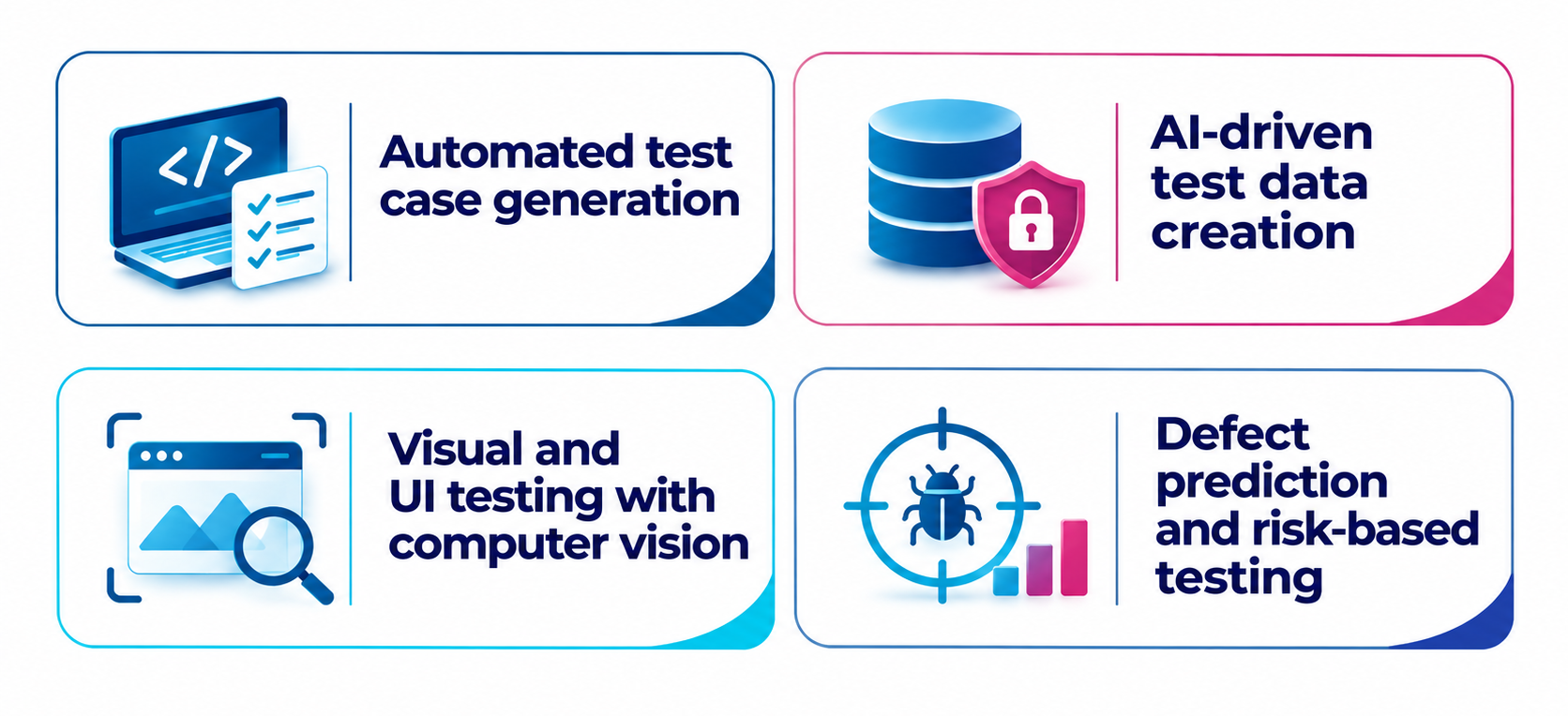
Automated test case generation usually scores high on value and measure, since coverage, cycle time and escaped defects are tracked. Its quality depends on the context the generator receives, which is why requirements and business rules matter as much as the model. A generator fed only code will test what the code does, which may differ from what the business intended.
AI-driven test data creation has high value in banking, where realistic data is scarce and production data is restricted, and the strongest controls requirement. Synthetic data must be shown not to reproduce or leak customer information, which is why the WQR’s top barrier applies here first.
Visual and UI testing with computer vision reduces brittle scripted checks on customer channels such as online banking and mobile apps. It supports a tester who reviews flagged differences, so the review point is clear.
Defect prediction and risk-based testing directs effort toward the changes most likely to break something. Its score depends on how well defect history, code changes and production incidents are linked, which in many banks they are not.
The Context Gap in AI-Assisted Delivery
The Context Continuum explains a problem that shows up in every one of these use cases: AI agents in the delivery pipeline do not inherit the business reasoning behind their instructions. A test generator that does not know a credit limit increase needs an affordability check will write tests that pass and still miss the requirement. The whitepaper proposes context contracts for each handoff, so that intent, constraints and evidence travel with the work from requirement to release.
That reframes where quality engineering effort should go in a bank adopting AI coding tools. Writing more automated tests helps less than making sure every test, human or generated, knows what the change is supposed to do.
Why Coverage Stalls
Breaking the 33% Ceiling adds the operating model view. Its argument is that test automation coverage stalls when automation is treated as a tooling project owned by a separate team, and moves when it is embedded in delivery, built from reusable assets, maintained with AI and executed inside the pipeline. It sets a target of 60% or more coverage.
The ownership point matters at regional banks, where quality engineering teams are often small and shared across many applications. When developers adopt AI tools but test ownership stays with a separate team, the gap between the two widens every sprint.
Measuring Release Confidence
Coverage percentages alone say little about whether a bank can release safely at AI speed. A more useful set tracks outcomes the business feels:
- Change failure rate, the share of releases that cause an incident or need a fix.
- Escaped defects on critical journeys such as payments, account opening and lending decisions.
- Time to restore service when a release goes wrong.
- Coverage of critical journeys, measured against business rules and regulatory requirements instead of lines of code.
- Review rate for AI-generated tests and code, the share checked by a person before release.
Each should be baselined before AI testing use cases go live, so their effect can be shown with evidence. The last measure matters most in the first year, because it shows whether human-governed AI is a practice or only a principle.
The measures also need an owner. In many regional banks, developers now own AI coding tools, a central quality team owns the regression suite, and operations owns production incidents. Release confidence falls between them. Assigning it to one owner, usually the head of engineering or quality engineering, with the five measures above as the scorecard, gives the bank a single answer to the question every CIO is asked after a bad release: how did this get through?
The Cost of Leaving Testing Behind
The cost of a testing gap rarely shows up in the testing budget. It shows up as production incidents, delayed releases while regression is completed by hand, and change freezes before regulatory deadlines. As AI-assisted development increases the volume of change, each of those costs rises unless test automation in banking rises with it. Testing is also where a bank can build AI governance habits, review points, evidence trails and monitoring, with low customer exposure before applying them to customer-facing use cases.
Score Testing First, Then Build On It
The AI in Banking Scorecard from Maveric Systems includes the four testing use cases in this article alongside the bank’s customer-facing candidates. Testing often ranks high because its risk is contained, which makes it a practical first wave while the bank builds the governance customer-facing use cases need. For banks that want to go further, Maveric’s PULSEAI platform applies continuous quality intelligence to the delivery pipeline.
If your release volume doubled next quarter, which part of your test suite would you trust, and which part would you only hope works?
Test Automation in Banking Key Questions
How is AI used in software testing in banking?
Banks use AI to generate test cases from requirements, create synthetic test data, run visual checks on customer channels and predict where defects are most likely. The strongest use cases support a tester who reviews the output and draw on connected requirements, code and defect history.
Why does test automation in banking matter more with AI coding tools?
AI coding tools increase the volume and speed of change, and in Stack Overflow’s 2025 survey 46% of developers said they do not trust the accuracy of AI output. Test coverage and release confidence therefore have to rise with development speed.
Is AI-generated test data safe to use in banking?
It can be, if the bank can show that synthetic data does not reproduce or leak real customer information, and if the generation process is governed like any other data use. Data privacy was the most cited barrier to scaling AI in quality engineering in the World Quality Report 2025.
What is quality engineering in banking?
Quality engineering treats quality as part of delivery instead of a separate test phase. It combines connected requirements, risk-based testing, automation embedded in the pipeline and human review of AI output, so release confidence keeps pace with development speed.
Sources
- Stack Overflow, 2025 Developer Survey press release, 2025.
- Google Cloud, “Announcing the 2025 DORA Report”, 2025.
- OpenText, Capgemini and Sogeti, World Quality Report 2025, press release, November 2025.