


If an applicant your bank declined last Tuesday asked why, could your team give the specific reasons the model used, in plain language, within the time the law allows?
Explainable AI in banking is often discussed as a model property: feature importance charts, interpretable architectures, validation reports. In lending it is something narrower and harder. It is the ability to explain one decision, about one customer, on demand, and to show that the same model does not treat groups of applicants unfairly.
US creditors have long had to tell declined applicants the principal reasons for adverse action under Regulation B, which implements the Equal Credit Opportunity Act. The rule is explicit: the statement of reasons “must be specific and indicate the principal reason(s) for the adverse action,” and generally has to reach the applicant within 30 days of a completed application. A model that lifts approval rates but cannot produce those reasons for an individual decision is a liability in production, however strong its accuracy.
The Case That Made It Concrete
In July 2025, the Massachusetts Attorney General announced a $2.5 million settlement with student lender Earnest Operations. The Attorney General alleged that Earnest used algorithmic models to make lending decisions, failed to test those models for disparate impact, and sent inaccurate adverse action notices that prevented applicants from understanding their own creditworthiness. The settlement requires a detailed corporate governance structure and written policies for its AI models.
Three things about the case matter for a regional bank. It was brought by a state, using existing consumer protection and fair lending law, with no AI-specific rule involved. The failures alleged were governance failures, testing and documentation, more than modeling failures. And the remedy was a governance structure, which is precisely what a bank can build before an examiner or an attorney general asks.
Why Lending Is the Hardest Test
Lending combines three conditions that most AI use cases face only one or two of. The decision affects a customer directly. It carries fair lending obligations, so the bank must be able to show its models do not discriminate, including through proxies hidden in new data sources. And the model usually sits inside formal model risk management.
That last point changed shape in 2026. The revised interagency guidance on model risk management issued by the Federal Reserve, FDIC and OCC in April 2026 (SR 26-2) replaces SR 11-7 and also rescinds the OCC’s 1997 examination guidance on credit scoring models. Its principles “apply to traditional statistical and quantitative models and non-generative, non-agentic AI models,” which covers most credit scoring and underwriting models in use today. Generative and agentic AI are outside its scope. The guidance is expected to be most relevant to banks with over $30 billion in total assets, and may also be relevant to smaller banks with significant model risk exposure.
Credit unions face a different picture. They are supervised by the NCUA, and the US Government Accountability Office reported in May 2025 that the NCUA’s model risk guidance is limited in scope and detail, recommending that it be updated to cover a broader range of models. For a credit union lending with a vendor-supplied scoring model, that leaves more of the explainability standard for the institution to set itself.
Where Each Lending Use Case Lands
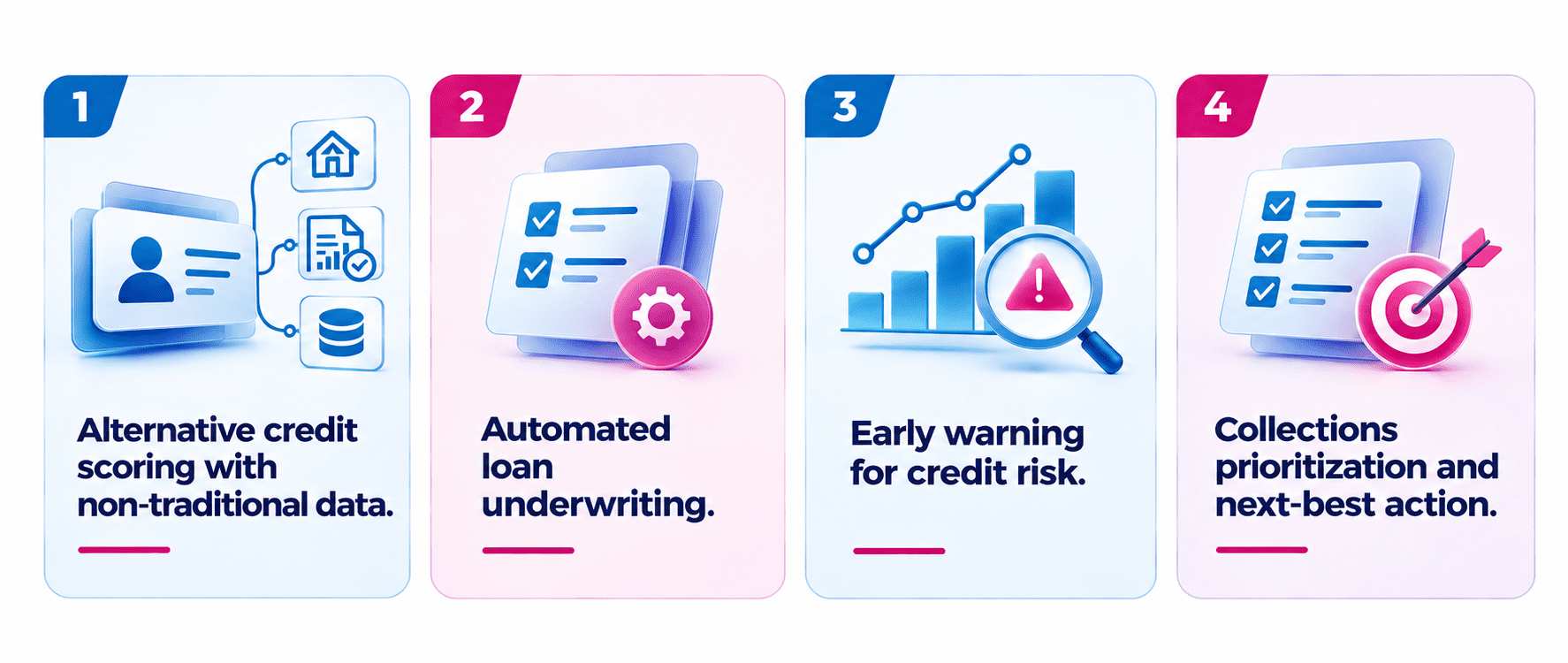
The AI in banking prioritization framework scores each use case on value, data, judgment, controls and measurability. In lending, judgment and controls do most of the work.
Alternative credit scoring with non-traditional data. High value for thin-file applicants, and the most demanding on explainability. Cash-flow data, rent and utility history or education variables can each act as a proxy for a protected characteristic, which is the kind of issue the Earnest case turned on. Every reason code has to make sense to a customer and survive a fair lending review.
Automated loan underwriting. The model makes or shapes the decision, so the review point and the adverse action reasons must be designed before launch. It usually lands in the second wave, after the bank has proven its explainability tooling on simpler use cases.
Early warning for credit risk. The model flags accounts; a relationship manager or credit officer decides what to do. A clear review point makes this one of the more ready lending use cases, especially in commercial portfolios.
Collections prioritization and next-best action. Also decision support, with measurable outcomes in cure rates and roll rates. Treatment of customers still needs review for fairness and consistency, but the explainability burden is lighter than for an approval decision.
Consumer and Commercial Lending Score Differently
Consumer lending carries the heaviest adverse action burden and the most visible fair lending exposure, because decisions are high volume, largely automated and individually reportable. Commercial lending relies more on credit officers and relationship managers, so AI typically informs a person instead of deciding. That difference changes the order. A regional bank with a large commercial book can often start with early warning and covenant monitoring, where explainability supports an officer’s judgment, and reach automated consumer underwriting later.
Small business lending sits between the two. Decisions are faster and more automated than commercial credit, yet adverse action obligations still apply, which makes it a common place for explainability gaps to appear first.
What Explainability Means in Practice
For a lending model, explainability is a set of records the bank can produce for any decision:
- The model version that produced the score, and when it was last validated.
- The inputs used for this applicant, with their source.
- The principal reasons that drove the outcome, in language a customer can understand.
- The person who reviewed or approved the decision, where review applies.
- The monitoring results for the model at the time, including drift and disparate impact testing.
Engineering Trust in AI Compliance and Regulatory Governance calls the failure to keep these records the adverse action trap, in which exposure comes from reasons that were never documented as much as from wrong decisions. It argues for determination-level explainability: explaining each individual outcome, in addition to the model in general.
The Ownership Seam
Explainability in lending fails most often between teams. The data science or vendor team owns the model and its reason codes. Model risk owns validation. Compliance owns fair lending testing and the adverse action process. The lending business owns the decision and the customer. When each team assumes another has checked the reasons customers actually receive, nobody has. Naming one owner for the end-to-end explanation, from model output to customer letter, closes the seam that the Earnest allegations describe.
How to Sequence Lending AI
Start with early warning and collections, where a person decides and outcomes are already measured. Use them to build the reason codes, monitoring, disparate impact testing and evidence trail the bank will need. Move to automated underwriting once that tooling is proven, and treat alternative data scoring as the use case that needs the most fair lending work before launch.
The same tooling pays off beyond lending. The Architecture of Trust in AI-Driven Banking treats explainability as one of the properties to design in from the start, alongside fairness, reliability, privacy and compliance, so it supports every later use case instead of being rebuilt for each one. That is also the practical meaning of AI compliance in banking: controls built once and reused across the portfolio.
Score the Lending Use Cases Side by Side
The AI in Banking Scorecard from Maveric Systems includes the four lending use cases in this article alongside fraud, KYC, operations and compliance. Scoring them side by side shows whether explainability is a lending gap alone, or a control gap the whole portfolio shares.
For the last ten credit decisions your models influenced, could your team produce the reasons, the model version, the fairness testing and the reviewer for each one before the end of the day?
Explainable AI in Banking: Key Questions
What is explainable AI in banking?
Explainable AI in banking is the ability to show how an AI model reached a specific decision, in terms a customer, an auditor or an examiner can understand. In lending, that means producing the principal reasons for an individual decision, the model version, the inputs, the reviewer and evidence of fairness testing.
Why does explainability matter most in lending?
Lending decisions affect customers directly, carry fair lending obligations and require specific reasons when credit is denied. Most credit models also sit inside formal model risk management, so explainability is both a customer obligation and a supervisory expectation.
What did the Earnest settlement involve?
In July 2025 the Massachusetts Attorney General announced a $2.5 million settlement with Earnest Operations over allegations that its algorithmic lending models were not tested for disparate impact and produced inaccurate adverse action notices. The settlement requires a governance structure and written AI policies.
Does SR 26-2 apply to credit scoring models?
Yes. The guidance states that its principles apply to traditional statistical and quantitative models and non-generative, non-agentic AI models, which includes most credit scoring and underwriting models at banks. Credit unions are supervised separately by the NCUA.
Source
- 12 CFR 1002.9, Regulation B, Notifications (Cornell Legal Information Institute).
- Massachusetts Attorney General, “AG Campbell Announces $2.5 Million Settlement With Student Loan Lender”, July 2025.
- OCC Bulletin 2026-13, Model Risk Management: Revised Interagency Supervisory Guidance (SR 26-2 at the Federal Reserve), 17 April 2026.
- US Government Accountability Office, Artificial Intelligence: Use and Oversight in Financial Services, GAO-25-107197, May 2025.