



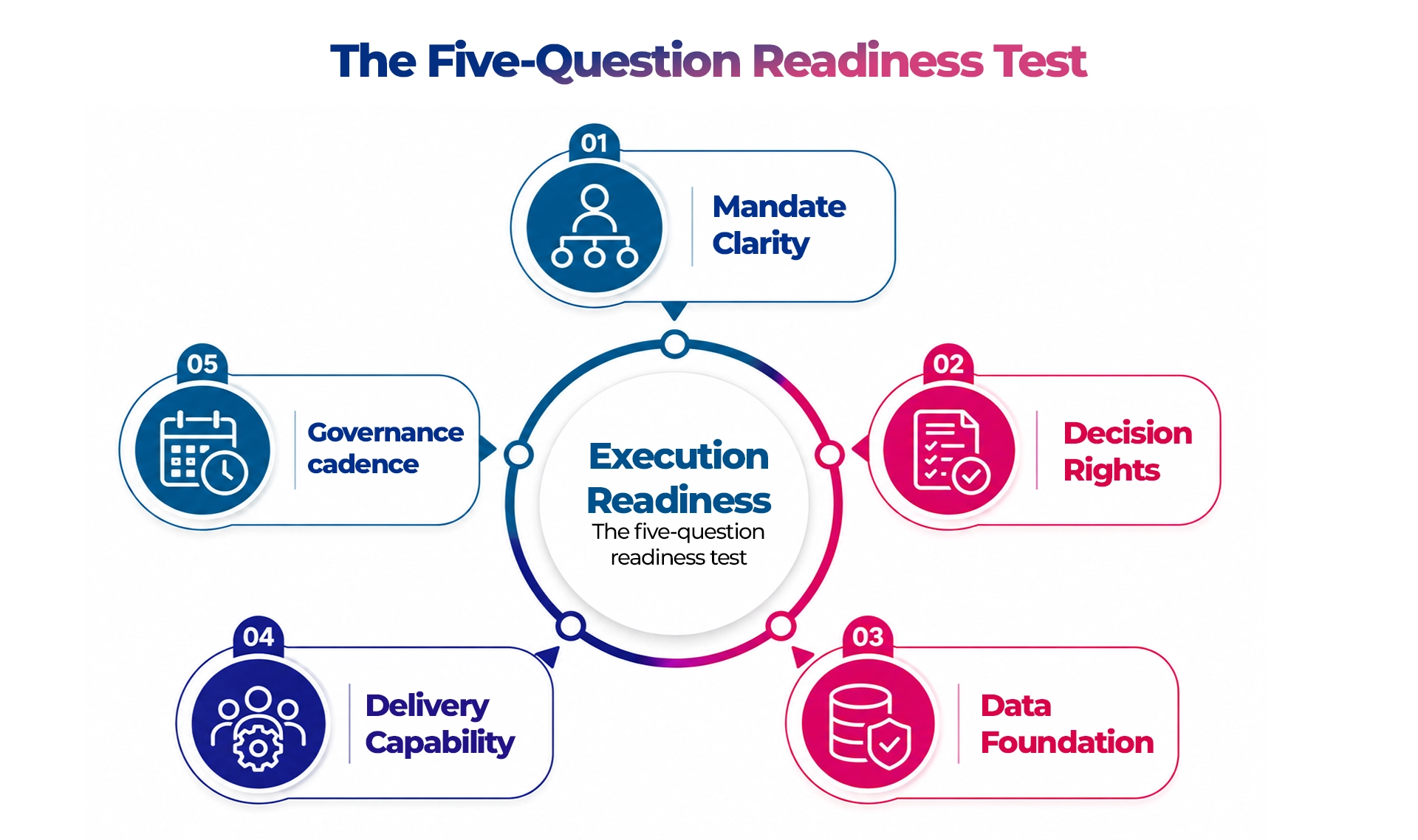
Most banks can describe their transformation strategy clearly. Far fewer have a structured, repeatable way to assess whether a specific program is actually ready to execute it which means readiness gets judged informally, inconsistently, and often only after a program has already stalled and the question becomes unavoidable. The framework below is built to close that gap: five dimensions, each with a direct question an executive team can put to any program before committing the next round of capital.
Why Readiness Deserves the Same Rigor as a Business Case
Transformation programs in banking are almost never short on business case scrutiny the expected value, the cost model, the competitive rationale all get real diligence before funding is approved. Execution readiness rarely receives the same structured review, despite the data consistently showing that readiness gaps, not business case flaws, are what actually derail most programs. A program with a flawless business case and weak readiness across governance, capability, data, and trust is, in practice, a worse bet than a more modest program that is genuinely ready to execute and most funding processes have no mechanism to catch that difference before capital is committed.
The Five Dimensions
1. Mandate clarity.
Is there one named executive accountable for this outcome, with real authority across every function the program touches? Programs with multiple sponsors, or a sponsor without cross-functional authority, consistently show more decision paralysis and slower escalation resolution than programs with a single accountable owner regardless of how strong the underlying strategy is.
2. Decision rights.
Can the program make and reverse meaningful decisions without escalating every one to a steering committee? A program where every material choice waits for a monthly governance meeting accumulates delay multiplicatively each dependent decision waiting on the one before it, compounding across the timeline in a way that a status report measuring only milestones will not show until the cumulative delay is already large.
3. Data foundation.
Is the data this program depends on governed, reconciled, and lineage-tracked today, not scheduled to be ready “by the time we need it”? This is the dimension most frequently assumed rather than verified. A program that discovers its data foundation is not ready mid-build has, in effect, been running on an unverified assumption since day one.
4. Delivery capability.
Does the team actually building this have the specific specialist depth the target architecture requires not just adequate headcount, but the particular combination of banking domain knowledge and current technical expertise the program needs? A program can be fully staffed by headcount and still critically under-resourced on this dimension.
5. Governance cadence.
Is risk, compliance, and audit reviewing the program continuously, as decisions are made, or only at scheduled gates? Continuous review catches a problematic assumption while it is still a single decision, cheap to reverse. Gate-based review catches the same problem after months of work have been built on top of it.
Why Mandate Clarity Is Usually the First Dimension to Break
A pattern worth naming explicitly, because it shows up so often in practice: many AI initiatives in banking have historically been funded and run as experiments, with success measured in what the organization learned rather than in business impact delivered. Learning is a legitimate outcome for an early pilot. It is not, on its own, a legitimate outcome for a program requesting its next round of funding and initiatives that never make that transition, from “what did we learn” to “what did we deliver,” are exactly the ones that fail the mandate-clarity test above. If nobody can state, in specific outcome terms, what this program’s next phase is meant to achieve, that ambiguity is itself the readiness gap, regardless of how promising the underlying technology looks.
The programs that make this transition successfully tend to share a specific trait: at some point, a phased, well-governed pilot converts into sustained, production-scale deployment not a single triumphant launch, but a track record of successive releases, each one clearing governance and each one demonstrably adding measurable value, rather than restarting the “learning” conversation from zero each time. That accumulating track record is itself strong evidence of mandate clarity and decision-rights health; a program still debating what success means, three phases in, has a readiness problem no amount of additional technical investment will fix on its own.
How to Run the Assessment
The framework is designed to be applied directly by an executive team, without requiring external facilitation for a first pass. For each dimension, score the program on a simple scale clearly strong, partially in place, or a clear gap and, critically, require a specific example as evidence for any “strong” rating, not just a confident assertion. A program claiming strong governance cadence should be able to point to a specific decision that was reviewed and adjusted mid-design, not just describe a governance process that exists on paper.
Programs strong across all five dimensions in the underlying research consistently outperform programs strong in only one or two even when the strategy and business case are functionally identical. This is worth sitting with directly: the data does not suggest that any single dimension, done exceptionally well, can compensate for weakness in the others. A program with excellent governance cadence but a critical capability gap is still likely to stall just later, and more expensively, than a program with early warning signs across multiple dimensions simultaneously.
What to Do With a Weak Score
A program that scores poorly on this assessment is not, by that fact alone, a program that should be cancelled or re-strategized that response, as the broader research on execution failure makes clear, usually just recommits the same capital to the same unaddressed gap. The more productive response is targeted: identify which specific dimension is weakest, and address that dimension directly before scaling the program further.
A program weak specifically on mandate clarity needs a single accountable owner named before the next phase, not a full governance overhaul. A program weak specifically on data foundation needs a data readiness assessment completed before further build work proceeds, not a pause on the entire initiative. Treating the five dimensions as independently diagnosable and independently fixable rather than as a single aggregate “readiness score” is what makes this framework actionable rather than just descriptive.
Applying the Framework Across a Portfolio, Not Just One Program
or institutions running multiple concurrent transformation initiatives, the highest-value use of this framework is comparative: running the same five-question assessment across every active program reveals which specific initiatives are genuinely ready to scale and which need remediation before more capital is committed a much sharper prioritization tool than the milestone-and-budget status reports most portfolios are currently governed by. Institutions doing this consistently are able to reallocate specialist capacity and governance attention toward the programs most likely to convert investment into delivered capability, rather than distributing both evenly across a portfolio where readiness varies enormously beneath the surface.
A more detailed version of this framework including a weighted scoring rubric, a facilitator’s guide for running it as a structured cross-functional workshop, and a decision-rights model for who owns remediation of each gap is available in the companion white paper for readers ready to apply it formally across a program portfolio.
Related reading:
- Why Most Banking Transformations Fail at Execution (pillar guide)
- The Execution Readiness Playbook” (white paper)
- From Milestones to Trust: Rethinking How Banks Measure Transformation Progress.
FAQ
1. What are the five dimensions of the Execution Readiness Framework?
Mandate clarity, decision rights, data foundation, delivery capability, and governance cadence. Programs strong across all five consistently outperform programs strong in only one or two, even when the underlying strategy is identical.
2. How should an executive team score a program on each dimension?
Score each dimension as clearly strong, partially in place, or a clear gap, and require a specific example as evidence for any ‘strong’ rating. A program claiming strong governance cadence should point to a specific decision that was reviewed and adjusted mid-design, not just describe a process that exists on paper.
3. Why is mandate clarity usually the first dimension to break?
Many AI initiatives in banking have historically been funded as experiments, with success measured in learning rather than business impact. Programs that never transition from ‘what did we learn’ to ‘what did we deliver’ fail the mandate-clarity test regardless of how promising the underlying technology looks.