


Every stalled transformation program has a moment its team can point to in hindsight: the review where months of completed work suddenly needed to be reworked, because risk, compliance, or audit raised a concern that could have been addressed at the design stage, if anyone had asked them to weigh in that early. This is governance debt, and it is one of the most consistent, most quietly destructive patterns in banking transformation precisely because, unlike a budget overrun or a missed deadline, it does not show up in a status report until it is already expensive.
Why Governance Debt Is Invisible Until It Is Not
Governance debt accumulates whenever a program makes architecture, data, or delivery decisions without the governance function that will eventually need to approve them. Meaning, every one of those decisions is, in effect, provisional, even though the team building on top of them treats it as final. A program can look completely on track under this condition: milestones are hit, sprints close on schedule, demos go well. The debt is invisible precisely because nothing has yet forced a confrontation between what was built and what governance will actually require.
The confrontation eventually arrives at a formal risk review, an audit, or in Europe and increasingly elsewhere, a regulatory examination, and it arrives all at once. Work that was built on an assumption governance does not accept has to be redesigned, sometimes substantially, and the redesign consumes far more time than the original governance conversation would have. This is the defining feature of governance debt: it does not cost a little bit continuously. It costs nothing for months, and then it costs a lot, all at once, usually at the worst possible moment in a program’s timeline.
The Structural Reason This Keeps Happening
Governance debt is not usually the result of a program deliberately ignoring risk and compliance. It is usually the result of a sequencing decision that seemed reasonable at the time: get the technical design moving quickly, and bring governance in once there is something concrete to review. This sequencing feels efficient in the short term. It avoids slowing down early momentum with a function that, fairly or not, is often perceived as adding friction rather than value. It is, in the data on transformation execution, one of the most reliable predictors of a program that eventually stalls.
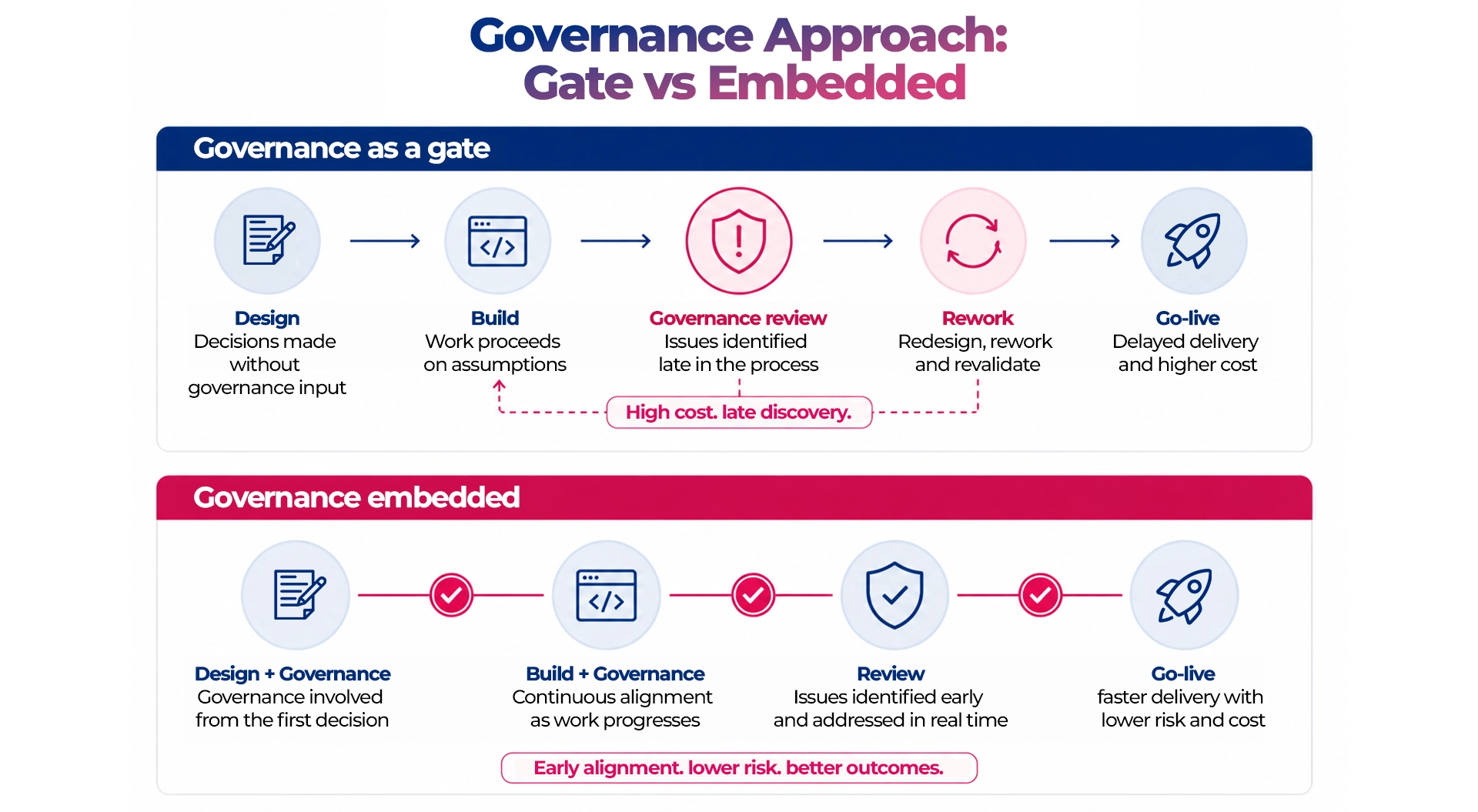
The deeper issue is that governance and delivery are frequently treated as sequential rather than parallel functions – design first, govern second, when the programs that avoid this debt treat them as running continuously, side by side, from the first architecture decision onward. This is not simply a preference for one project management style over another. It reflects a real difference in how risk gets caught: continuous governance catches a problematic assumption when it is a single design decision, cheap to reverse. End-stage governance catches the same problem after it is been built on top of dozens of times, expensive to unwind.
What Governance Debt Looks Like in Practice
A few recognizable patterns show up consistently across banking transformation programs carrying significant governance debt: Decisions get made by the delivery team that governance later reverses. A data flow, an AI model’s training approach, or a third-party integration gets built based on the delivery team’s best understanding of what will be acceptable, and governance, reviewing it for the first time months later, requires a different approach entirely.
Governance reviews are scheduled as gates, not as an ongoing cadence. The program has a “governance checkpoint” at specific milestones, rather than governance participation embedded in the working team’s regular decision-making. Everything between checkpoints accumulates risk that is not caught until the next scheduled review.
Documentation is assembled retroactively. When a review or audit is announced, the team scrambles to produce evidence of controls and decision rationale that should have existed contemporaneously. This is a strong indicator that governance was never actually part of the delivery process, only an external check on it.
No one on the delivery team can explain why a decision was made, only what was decided. This is a subtler but important signal. Decisions made with governance genuinely embedded tend to come with a documented rationale connecting them to specific risk, compliance, or regulatory requirements. Decisions made without that involvement often have no such rationale to produce when asked.
The Structural Fix: A Hub-and-Spoke Governance Model
As explored in a recent industry research on AI-first banking operating models, Governance debt is often framed as a discipline problem. Teams that simply need to involve governance earlier. In practice, it is frequently a structural problem: there is no single function actually positioned to set enterprise-wide policy fast enough to keep pace with a growing number of concurrent AI and transformation initiatives running across different business units.
An operating model gaining traction across banking addresses this directly with a hub-and-spoke structure. The hub, typically an AI Centre of Excellence, owns enterprise-wide policy: approved technology platforms, model risk management standards, ethical and regulatory guidelines, shared data infrastructure, and monitoring tools. The spokes, retail banking, wealth management, operations, and other business units, own use case identification, prioritization, and delivery, and remain accountable for the business outcome. Governance is not a gate the spokes wait for; it is a standing function the hub maintains continuously, so every business unit is building against the same current policy rather than discovering it retroactively at review.
This directly addresses the pattern behind most governance debt: uncoordinated, bespoke AI initiatives springing up independently across business units, each making its own assumptions about what governance will eventually require. A hub that maintains policy centrally, and spokes that build against it from day one, collapses the gap between what the business is building and what governance will approve – the same gap that, left open, is what turns a routine review into a rework cycle.
What Governance Embedded by Design Actually Looks Like
The distinction between governance as a gate and governance as a built-in property of the system is easiest to see in a concrete example. At one bank, validating documents such as facility agreements and loan contracts against regulatory and internal compliance checklists had been a manual process – slow, inconsistent, and prone to the kind of subjective judgment calls that make an audit trail hard to defend later. Rather than automating the document review and treating compliance as a separate check applied afterward, the bank built a validation engine where the compliance checklist itself was the mechanism driving the review: each document was assessed directly against a dynamically configurable checklist, tailored to the specific regulatory framework and institution, with every output including source references and confidence levels a reviewer or auditor could trace directly.
This is governance embedded by construction rather than governance as an external check: the compliance requirement is not something a separate function verifies after the work is done it is the structure the work is built around from the start. Programs that adopt this pattern, whether through a checklist-driven engine like this one or a hub-and-spoke policy model, consistently spend less time in rework because there is very little daylight between what was built and what governance requires the two were never separated in the first place.
Closing the Gap Without Slowing the Program Down
The instinct to treat governance as a separate, sequential phase usually comes from a reasonable fear: that involving risk and compliance earlier will slow delivery down. The evidence points to close to the opposite conclusion. Programs that embed governance continuously, from the first design decisions onward, consistently move through formal reviews faster than programs that treat governance as an end-stage gate because there is far less to catch, and far less rework required, when governance has already validated each major decision as it was made.
The practical shift this requires is not adding more governance overall, but changing its timing and cadence: a governance representative genuinely embedded in the working team’s regular decision-making, rather than a governance committee reviewing completed work in batches. This is a structural change to how a program is run, not an additional layer bolted on top of the existing plan and it is, based on the pattern showing up across the transformation research examined for this series, one of the highest-leverage changes an executive team can make to reduce the risk of a program stalling months into delivery.
Related Reading:
- Why Most Banking Transformations Fail at Execution (pillar guide).
- The Execution Readiness Framework: A Five-Question Test Before You Fund the Next Phase.
- “The Execution Readiness Playbook” (white paper).
FAQ
1. Why is governance debt harder to spot than a budget overrun?
It does not cost anything continuously. Milestones can be hit and demos can go well for months while a program builds on assumptions governance has not yet reviewed, until a formal risk review, audit, or examination forces the confrontation all at once.
2. What is the structural fix for governance debt, beyond involving governance earlier?
A hub-and-spoke operating model, where a central function such as an AI Centre of Excellence owns enterprise-wide policy continuously, while business units retain accountability for use case delivery. Governance becomes a standing function the hub maintains, not a gate the spokes wait for.
3. What is a reliable warning sign that a program is accumulating governance debt?
No one on the delivery team can explain why a decision was made, only what was decided. Decisions made with governance genuinely embedded come with a documented rationale tied to specific risk or regulatory requirements. Decisions made without that involvement usually do not.