


A global data review of the execution gap in banking transformation, and what separates the institutions that close it.
Every bank pursuing transformation today is chasing roughly the same strategy: modernize the core, become AI-first, put the customer at the center, and do it without inviting a regulatory problem. That convergence is itself revealing. When nearly every institution in every region is aiming at the same target, strategy stops being the variable that separates winners from laggards. Execution becomes the variable. This guide looks at what the current data, across North America, Europe, Asia-Pacific, and the Middle East, actually says about where banking transformation programs break, and the disciplines that separate institutions that convert strategy into working capability from those stuck restating it in next year’s plan.
EXECUTIVE TAKEAWAY, The one idea to take away
Banks rarely fail at transformation because they chose the wrong strategy. They fail because governance arrives too late, capability is underfunded relative to ambition, data is not ready for what the strategy assumes, and nothing in the delivery model earns the trust needed to keep a program moving through review after review. Execution, not ambition, is the differentiator now.
Execution Failure vs. Strategy Failure: A Definition Worth Getting Right
A transformation fails at strategy when the bank aimed at the wrong outcome, invested in a channel customers did not want, modernized a system that was not the constraint, or missed a shift in the competitive landscape entirely. A transformation fails at execution when the strategic direction was sound and the organization still could not turn it into a working, adopted, governed capability at the scale the business case assumed.
This distinction matters because the two failure modes call for opposite responses. A strategy failure calls for a new plan. An execution failure calls for different disciplines applied to the same plan: clearer decision rights, funded capability, governed data, and a delivery cadence that earns trust with risk, compliance, and the board as it goes, not just at the end. Most of the current evidence, across every region examined for this guide, points to execution as the dominant failure mode in banking transformation today.
EXECUTIVE TAKEAWAY, Definition
Execution failure: a transformation program with a sound strategic direction that stalls, is delayed, or fails to scale because of governance, capability, data, or trust gaps in delivery, not because the underlying strategic bet was wrong.
This is not a semantic distinction. Boards and investment committees routinely respond to a stalled transformation by revisiting the strategy, commissioning a new roadmap, benchmarking competitors again, restating the vision with more urgency. If the actual cause was execution, none of that changes the outcome. The bank re-approves substantially the same plan, funds it again, and runs into the same governance, capability, data, or trust gap the second time. Distinguishing the two failure modes correctly, before committing to a response, is itself one of the highest-leverage decisions an executive team makes in a transformation program’s lifecycle.
What the Data Actually Shows
Digital and AI transformation failure rates get quoted casually, 70%, 90%, sometimes higher, and most of those specific figures do not trace back to a defensible, consistently defined study. What does hold up, from the primary research available, is a clear and consistent pattern: full success is rare, partial value is common, and the gap between the two is almost always an execution gap, not a strategic one.
- Boston Consulting Group’s widely cited analysis of digital transformation programs found roughly 30% fully met their objectives, 44% created some value but missed their targets, and the remainder created little or nothing, meaning the majority of “failure” is actually partial execution, not wholesale collapse.
- McKinsey’s transformation research, which defines success strictly as improved performance that is also sustained over time, consistently finds well under a third of large-scale transformations meet that bar, and flags organizational capability and change management, not strategic direction, as the leading cause.
- Independent 2026 research into retail banking specifically found that 93% of financial institutions are not fully achieving their digital transformation goals, even though 57% name digital experience as a top strategic priority, a gap between stated priority and delivered outcome that is a textbook execution signal, not a strategy one.
The pattern holds inside banking as clearly as anywhere else, and it holds across every region this guide reviewed.
Four Regions, One Consistent Pattern
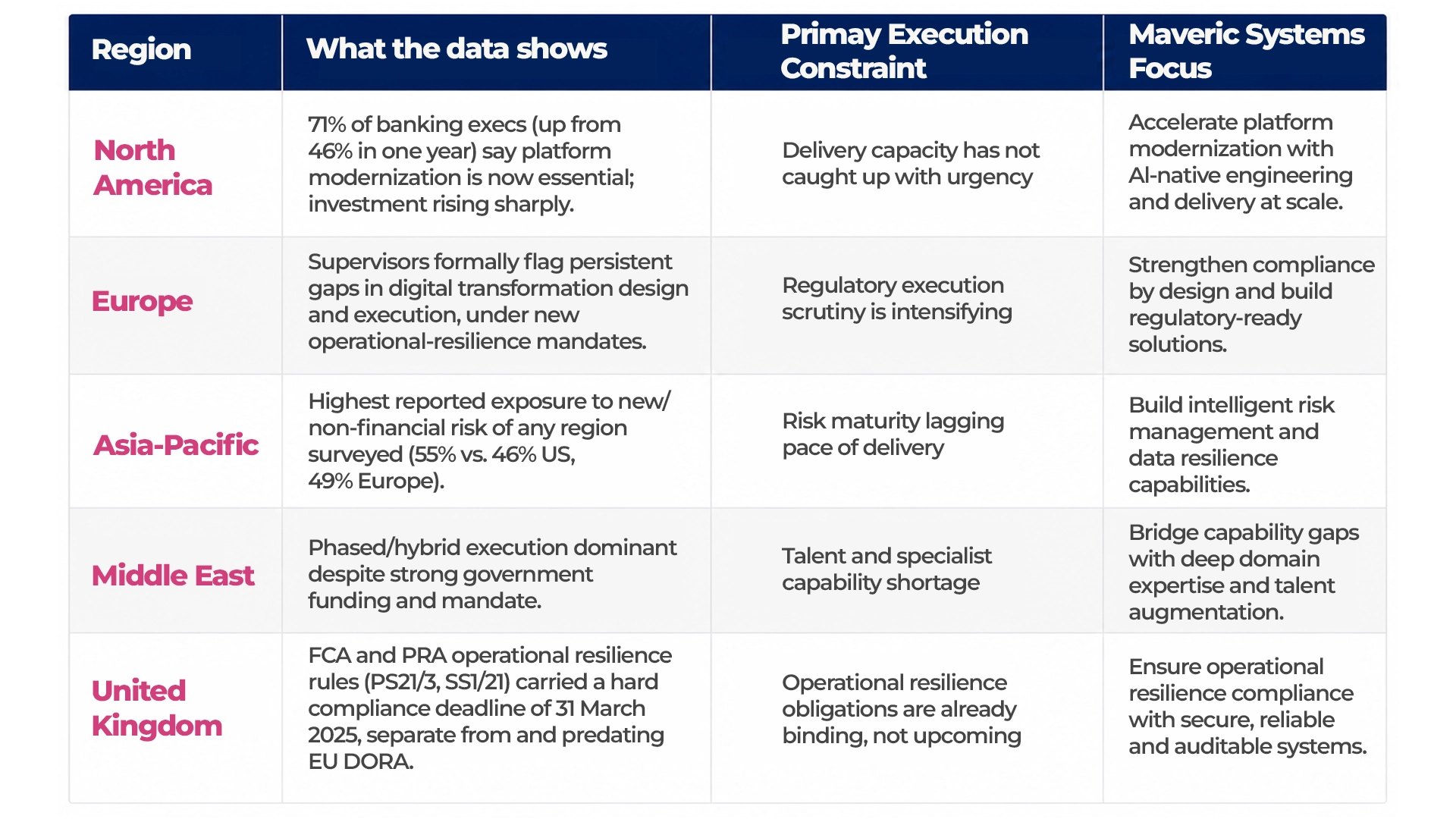
Banking transformation is a genuinely global agenda right now, and the regional data, while each market has its own regulatory and talent context, tells a strikingly consistent story: the ambition is aligned, and the constraint is delivery capacity.
North America: Urgency Is Outrunning Readiness
A 2026 survey of 200 U.S. banking executives found that 71% now agree their organizations need to modernize platforms to bring new products to market, up sharply from 46% just a year earlier. That is not a strategic shift; it is the same strategic priority banks have held for years, now acknowledged with far more urgency. The same research found the vast majority of institutions increasing technology investment for the year ahead. Urgency and investment are rising faster than delivery capacity typically can, which is precisely the condition under which execution gaps widen.
Europe: Regulation Is Making Execution Harder to Fake
European banking supervisors have said directly, in their own risk assessments, that persisting challenges in the design and execution of banks’ digital transformation strategies remain a supervisory focus area, not a historical footnote. That scrutiny has intensified with the EU’s Digital Operational Resilience Act, in force since January 2025, which requires banks to demonstrate operational resilience across any technology change, including active transformation programs. In Europe more than anywhere else, weak execution is no longer just a shareholder problem, it is now a documented supervisory one.
Asia-Pacific: Ambition Is High, and So Is the Risk Load
A cross-regional survey of 348 senior banking decision-makers across the United States, Europe, and Asia-Pacific found APAC institutions reporting the highest exposure to new and non-financial risk of the three regions, 55%, compared with 46% in the U.S. and 49% in Europe. APAC banks are not pursuing a more conservative strategy than their global peers; if anything, government-backed digital agendas across the region are pushing transformation harder. The higher reported risk load reflects execution moving fast against a wider and less mature risk surface, not a difference in ambition.
Middle East: Talent, Not Vision, Is the Binding Constraint
Gulf banks are backed by some of the largest sovereign technology commitments in the world, yet independent analysis of core banking modernization in the region found that phased and hybrid execution models dominate specifically because of capability and talent constraints, not because banks are hedging their strategic bets. Separate market analysis of the region’s largest digital transformation program found execution risk persisting because talent graduation rates lag demand, even as capital and government mandate are not the limiting factor. This is about as clean a natural experiment as exists: strategic ambition and funding are not the constraint; delivery capacity is.
United Kingdom: Operational Resilience Has Its Own Hard Deadline
UK banks sit outside the EU’s Digital Operational Resilience Act. Their equivalent obligation runs through the Financial Conduct Authority and the Prudential Regulation Authority directly, and it has already passed its hard compliance deadline. Under FCA Policy Statement PS21/3 and PRA Supervisory Statement SS1/21, banks and other in-scope firms had until 31 March 2025 to demonstrate they can remain within board-agreed impact tolerances for every important business service during a severe but plausible disruption.
That deadline has passed, which changes the nature of the obligation for any UK transformation program running today. This is no longer a target to prepare for. It is a standing requirement a transformation program must not put at risk. A modernization or AI initiative that touches an important business service, core banking, payments, onboarding, has to demonstrate, continuously, that the transformation itself does not push the institution outside its agreed impact tolerance while the work is underway.
For UK CIOs and Heads of Change, the practical implication mirrors the European DORA pattern described above, with one distinction worth naming directly: UK supervisors are past the transition period and into active supervision. The FCA has already published its own observations on where firms fell short during the transition, including inconsistent identification of important business services and incomplete third-party testing. A transformation program launching now, in a UK bank, is being built and reviewed against a regulator that has already seen where the gaps typically are.
Related reading: How data readiness underpins execution in every one of these regions, see the deep dive on data quality and governance as a transformation foundation.
Why “We Chose the Wrong Strategy” Is Usually the Wrong Diagnosis
Look across the strategic plans of large and mid-sized banks in any of the four regions above and the similarity is striking: modernize the core, put AI into customer-facing and operational workflows, reduce cost-to-serve, and manage rising regulatory and cyber risk. This is not a coincidence, it reflects genuine convergence on what matters. It also means that when one bank’s transformation delivers and another’s stalls, the difference is very rarely that one bank picked a smarter strategy.
Research into what actually separates successful transformations from unsuccessful ones consistently points to organizational factors ahead of strategic or even technological ones: clarity of leadership commitment, the caliber and depth of the team dedicated to the change, and, repeatedly cited as the single biggest obstacle, organizational culture and change readiness, ahead of the technology itself. None of that is a strategy problem. It is an execution capability problem, and it is solvable in ways that picking a different strategy is not.
There is a simple diagnostic test executive teams can apply here. If a competitor pursuing an almost identical strategy is delivering faster, with fewer stalled workstreams and fewer governance escalations, the shared strategy cannot be the explanation for the gap. What differs is nearly always organizational: who owns the decisions, how quickly governance responds, whether the data was ready before the build started, and whether the delivery team had the depth to execute at the pace the strategy assumed. Applying this test honestly, rather than defaulting to a strategy review whenever a program slips, is often the fastest way to identify the real constraint.
The Four Fault Lines Where Transformation Actually Breaks
Across the regional data above, and across the broader research on transformation failure, the same four fault lines recur. They rarely appear one at a time, most stalled programs show two or three simultaneously.
1. Governance Debt
Governance that is designed after a program is already underway, rather than before it starts, creates a permanent lag between what the business is building and what risk, compliance, and audit are prepared to approve. Every subsequent delay compounds: the later governance is bolted on, the more of the program has to be reworked to satisfy it. In practice, governance debt is often invisible in early status reports, the program looks on track right up until it reaches its first serious review, at which point months of work can be sent back for redesign.
2. Capability Debt
The Middle East data above is the clearest illustration: funding and mandate are not the constraint, specialist delivery capability is. This shows up everywhere in some form, not enough people who can translate a cloud or AI architecture into a working, compliant banking system, and not enough of them freed from business-as-usual work to focus on the transformation. Capability debt is also frequently hidden by generalist staffing: a program can appear fully resourced on a headcount basis while still lacking the specific specialist depth, data engineering, model risk, core platform migration, that the architecture actually requires.
3. Data Debt
Every modernization or AI initiative eventually runs into the same wall: data that is fragmented across systems, inconsistently governed, and not trustworthy enough to support the decision the new capability is supposed to make. Programs that treat data readiness as a parallel workstream that can catch up later are, in practice, choosing to discover this wall midway through delivery rather than before it.
4. Trust Debt
A capability that cannot be explained to a regulator, an auditor, or a customer does not stay in production, it gets pulled back for review, sometimes repeatedly, and each review cycle adds months. Programs that build explainability, auditability, and human oversight into delivery from the start accumulate far less of this debt than programs that treat governance as a sign-off gate at the end.
Related reading: A closer look at how trust debt specifically compounds in AI-driven banking programs, and how leading institutions are engineering it out from the start.
An Execution Readiness Framework
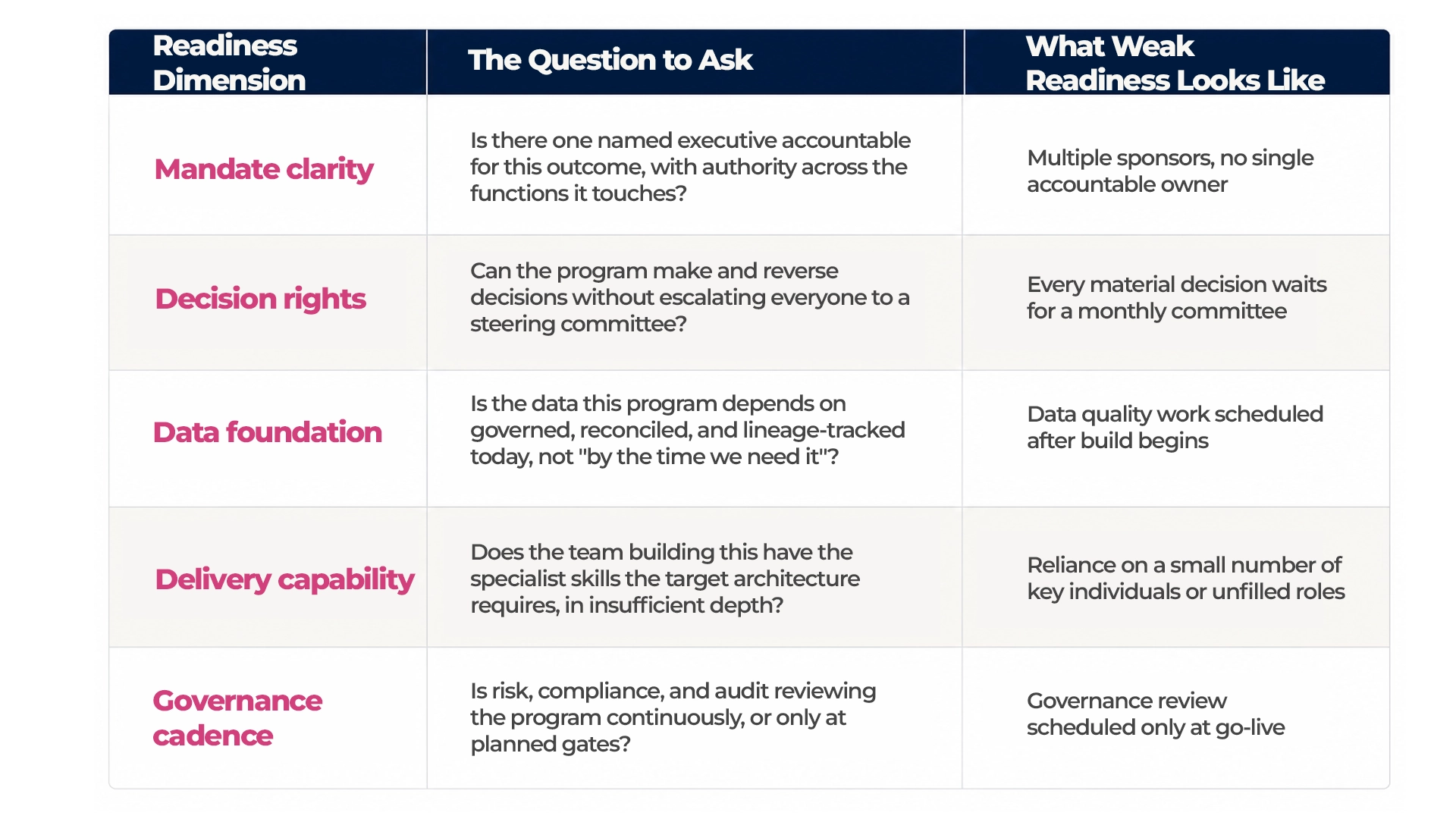
Before committing significant capital to the next phase of a transformation program, executive teams can assess readiness across five dimensions. Programs strong across all five in the current data consistently outperform programs strong in only one or two, even when the underlying strategy is identical.
What Separates Execution Leaders from Execution Laggards
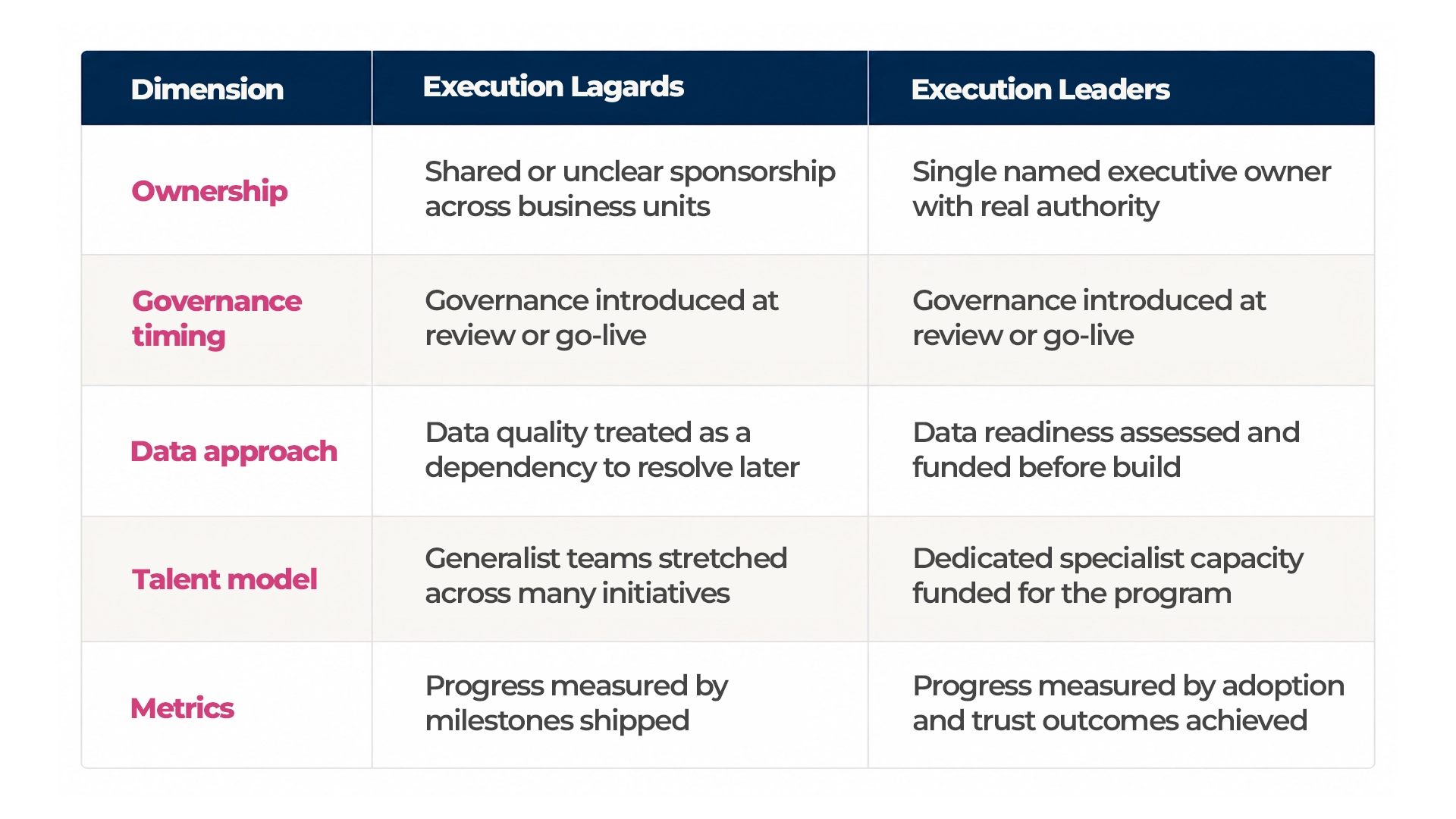
The institutions that consistently convert strategy into delivered capability, across all four regions studied, differ from the ones that do not in a small number of consistent, observable ways. None of these differences require a larger budget or a bolder strategy; several of the clearest examples in the regional data above come from institutions operating under real capability constraints that still out-executed better-resourced peers by getting these fundamentals right.
Regulatory Scrutiny of Execution Is Rising, Not Falling
A significant shift is underway in how regulators treat transformation programs themselves. In the United States, a risk-based examination framework effective January 1, 2026, explicitly treats an active technology transformation as a period of elevated operational risk, meaning examiners now assess whether a program has documented governance, tested rollback capability, and evidence of correctness at each stage, not just the eventual technology outcome. In Europe, operational-resilience obligations in force since January 2025 apply the same logic. The direction of travel is the same across jurisdictions: execution quality is becoming an explicit, examined dimension of transformation risk, not an internal management concern that stays inside the institution.
This changes the calculus for executives sponsoring transformation. A program that would once have been judged solely on whether it delivered the intended capability is now also judged on whether it was executed in a way a regulator would sign off on, which makes the governance and trust disciplines described above a matter of program survival, not just program quality.
The practical implication is that governance can no longer be scoped as a proportionate response to a program’s visible risk; it has to be scoped to withstand an examiner asking, at any point during delivery, to see evidence of controls, tested rollback capability, and documented decision rights. Institutions that build that evidence trail continuously, as a byproduct of how the program runs, are in a materially different position than institutions that try to assemble it retroactively when an examination is announced.
Measuring Execution Health, Not Just Program Status
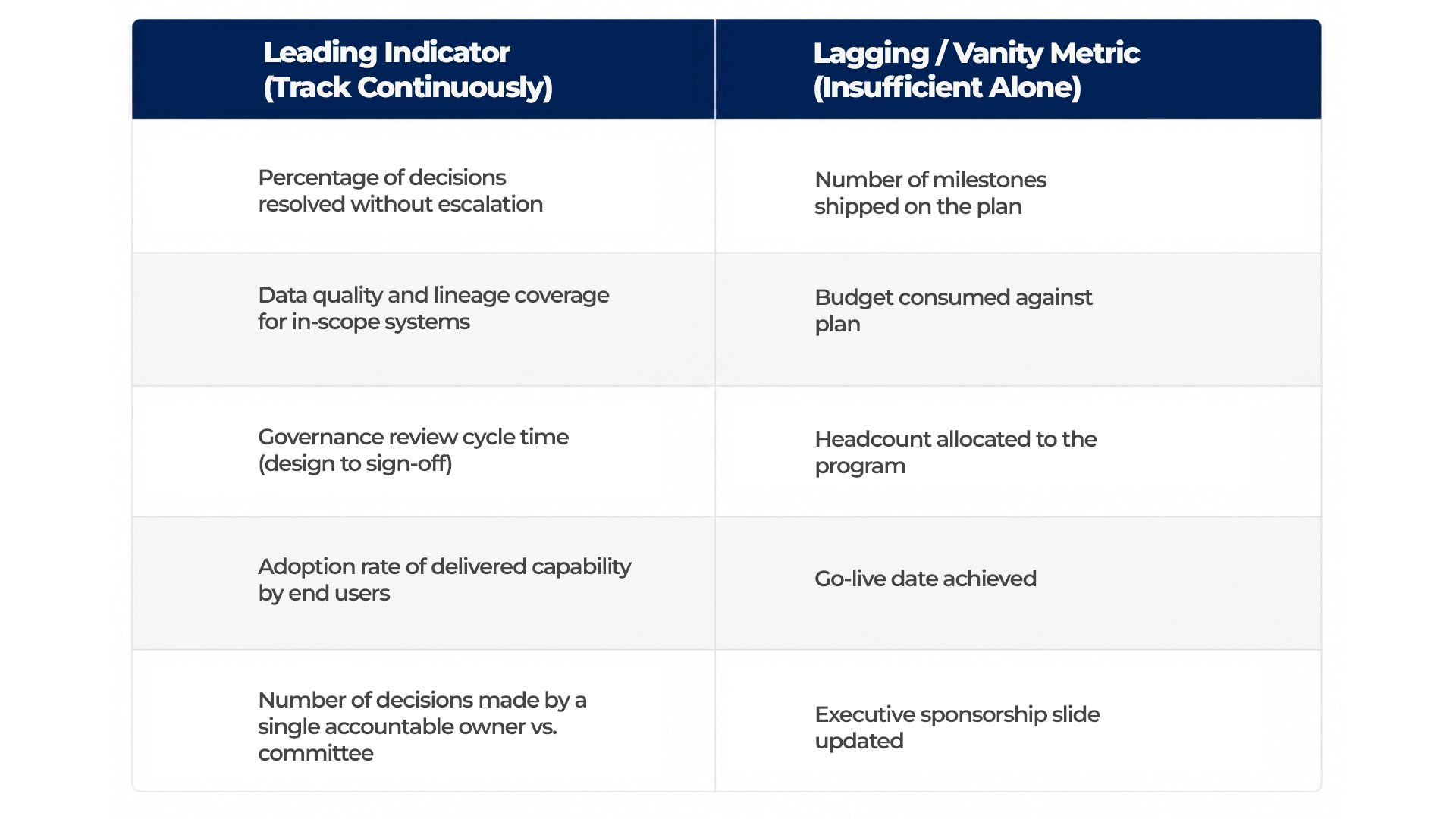
Status reports built around milestones shipped and budget consumed reliably fail to predict which programs are about to stall. Leading indicators of execution health are different, and worth tracking from week one rather than introduced only once a program is already in trouble. The distinction that matters is between metrics that describe motion, work has happened, money has been spent, and metrics that describe whether the organization is actually converting that motion into governed, adopted capability.
Five Disciplines for Execution-First Transformation
None of these disciplines require a different strategy. All five are available to any bank willing to change how it delivers the strategy it already has.
- Bring governance forward. Design the approval and monitoring model alongside the architecture, not after it, governance introduced late is what turns a design decision into a rebuild.
- Fund capability, not just tools. A modernization or AI budget that is 90% technology spend and 10% specialist capacity is, in the data reviewed here, a leading predictor of stalled delivery, particularly in markets with acute talent constraints.
- Treat data readiness as a workstream, not a dependency. Programs that assess and remediate data quality before build begins consistently avoid the mid-program wall that derails the rest.
- Build trust checkpoints into the delivery cadence. Explainability, auditability, and human oversight reviewed continuously move faster through governance than the same requirements addressed only at the end.
- Measure adoption and trust outcomes, not just delivery milestones. A capability that ships on schedule but is not adopted, or cannot pass an audit, has not actually been executed, it has been deployed.
A Phased Path to Execution Discipline
Closing an execution gap is not a single initiative, it is a sequence of changes to how a program is governed, staffed, and measured, layered onto the strategy that is very likely already correct.
Phase 1 (0–90 days): Diagnose the Real Constraint
- Run the five-dimension readiness assessment above against every active or planned transformation workstream, not just the newest one.
- Identify which fault line, governance, capability, data, or trust, is most acute for each workstream, rather than treating the program as a single undifferentiated risk.
- Name a single accountable owner for each workstream where ownership is currently shared or unclear.
Phase 2 (3–6 months): Close the Highest-Leverage Gap First
- Fund specialist delivery capacity for the workstreams most exposed to capability debt, rather than spreading new hires thinly across every initiative.
- Move governance review earlier in the delivery cycle for any workstream where sign-off has historically come only at the end.
- Complete a data readiness assessment for any workstream that assumes governed, reconciled data it does not yet have.
Phase 3 (6 months and beyond): Make Execution Health Visible
- Replace milestone-and-budget status reporting with the leading indicators described later in this guide, reviewed at the same cadence as financial reporting.
- Treat execution readiness as a standing agenda item for the same governance body that approved the strategy, not a one-time checkpoint.
Where This Goes From Here
Three forces are converging to make execution discipline the primary competitive differentiator in banking transformation over the next few years, more than strategic ambition itself. First, core banking vendor consolidation is compressing the window banks have to make deliberate modernization choices, with an increasing share of institutions globally adopting phased, lower-risk “sidecar” approaches rather than full replacements, a direct, structural response to execution risk, not a strategic retreat. Second, regulators are converging on a consistent, technology-neutral, risk-based posture toward transformation programs themselves, which means execution quality will keep becoming more visible to supervisors, not less. Third, as AI moves from pilot to production across every region studied, the trust and governance disciplines described in this guide stop being differentiators and start being the minimum bar for staying in production at all.
The strategic map for banking transformation is, at this point, largely shared across the industry and across regions. What will separate the institutions that own the next decade of banking from the ones still explaining a delayed program to their board is not a better strategy. It is the discipline to execute the one they already have.
FAQ
1. Do most banking transformations really fail?
Full success is genuinely rare, credible research puts it well under a third of programs, but “failure” is usually partial rather than total. The more accurate finding across the data is that most programs create some value but fall well short of their original targets, and the shortfall is concentrated in execution, not strategic direction.
2. Is banking transformation more likely to fail at strategy or execution?
The evidence points overwhelmingly to execution. Banks across every region reviewed here are pursuing highly similar strategies, modernization, AI adoption, cost efficiency, regulatory resilience, which means the variable that separates outcomes is how well each institution converts that shared strategy into governed, adopted, production capability.
3. What is the single biggest predictor of execution failure?
No single factor accounts for most failures on its own, but governance introduced too late in the delivery cycle is the most consistently cited cause across the research reviewed for this guide, it compounds every other gap, because decisions made without governance in mind often have to be reworked once governance catches up.
4. How are regulators changing the execution risk calculus?
Supervisors in both the U.S. and Europe now formally treat active transformation programs as a period of elevated operational risk requiring documented governance and evidence of control, meaning execution quality is now something regulators examine directly, not just something the institution manages internally.
5. Why do talent-constrained regions still attempt large transformation programs?
Because the constraint is delivery capacity, not appetite or funding. Markets such as the Middle East show clearly that strong government-backed investment and mandate do not, by themselves, solve an execution problem rooted in specialist talent availability, which is why phased and hybrid delivery models are becoming the norm rather than the exception.
6 How should an executive team measure whether a transformation program is actually on track?
Track leading indicators of execution health, decision cycle time, data readiness, governance review speed, and adoption of what is already been delivered, rather than relying solely on milestones shipped or budget consumed, which reliably fail to predict a stalling program until it has already stalled.
7 Should a bank pause a transformation program if it appears to be failing?
Not before diagnosing which failure mode is at work. Pausing to revisit strategy when the real problem is execution wastes the time already invested and typically produces a similar plan the second time around; the more productive response, in most of the cases reflected in this guide’s data, is to apply the readiness framework above to the existing strategy rather than replace it
Where to Go Next
This guide sits alongside a broader body of work on what it takes to build trustworthy, governed AI and transformation capability in banking, including deeper explorations of AI governance, responsible AI, data readiness, and quality engineering discipline. Explore the related pieces linked throughout this guide for a closer look at each fault line. The common thread across all of them is the same one at the center of this guide: strategy sets the direction, but execution, governed, resourced, and trusted at every step, is what actually determines whether a bank arrives.
Source
- Boston Consulting Group digital transformation success-rate research (30% fully met objectives / 44% partial value / 26% limited value) – BCG / PR Newswire.
- McKinsey research finding fewer than a third of organizational transformations sustain performance improvement – McKinsey & Company.
- Gartner research on the average annual cost of poor data quality – Gartner.
- ManpowerGroup 2026 Global Talent Shortage Survey – AI skills now the hardest capability category to hire for, 39,000+ employers across 41 countries – ManpowerGroup.
- EU Digital Operational Resilience Act (DORA), in force since 17 January 2025 – European Commission / EIOPA.
- UK operational resilience rules for banks: FCA Policy Statement PS21/3 and PRA Supervisory Statement SS1/21, compliance deadline 31 March 2025 – Financial Conduct Authority.
The North America 71%-up-from-46% executive survey statistic and the 348-respondent cross-regional new/non-financial-risk survey (55% APAC / 46% US / 49% Europe) could not be independently traced to a public, linkable source in this pass. Recommend confirming the original research citation Maveric holds for these figures (name of publisher, report title, publication date) before this page goes live, or replacing them with the equivalent, verifiable KPMG 2026 Banking Technology Survey and ManpowerGroup 2026 Global Talent Shortage Survey figures used elsewhere in this piece.
FAQ
1. Does DORA apply to UK banks?
No. DORA is an EU regulation. UK banks sit outside its scope following Brexit. UK banks and other in-scope firms instead answer to the Financial Conduct Authority and Prudential Regulation Authority’s own operational resilience regime, set out in FCA Policy Statement PS21/3 and PRA Supervisory Statement SS1/21, which carried a hard compliance deadline of 31 March 2025.
2. What should a Tier 2 or Tier 3 UK bank prioritize first when assessing execution readiness?
Start with whether any active or planned transformation workstream touches an important business service as defined under the FCA and PRA operational resilience rules. If it does, the program needs a documented, tested plan for staying within board-agreed impact tolerances throughout delivery, not just at go-live, before capital is committed to the next phase.
3. How is UK regulatory scrutiny of execution different from the US risk-based examination approach?
Both treat an active transformation as a period of elevated operational risk rather than an internal management concern. The UK regime is further along: firms are past the transition period and the FCA has already published observations on common gaps from the 2022 to 2025 implementation window, meaning UK institutions can benchmark their own readiness against documented supervisory findings rather than an approach still coming into force.