

The most visible AI failures in banking tend to attract immediate attention. A customer receives an incorrect response. A payment is blocked. A credit decision is challenged. These events create complaints, escalations, or operational alerts.
Back-office automation fails differently.
An AI-assisted reconciliation process may clear the wrong exception. A team may use an unapproved tool to analyse regulatory data. An employee may rely on an LLM to draft part of a submission or risk briefing. The output can move into an official workflow without creating an obvious signal that anything has gone wrong.
This makes back-office AI one of the least visible forms of AI risk in banking. The danger is not only that an automated output may be inaccurate. It is that the bank may not know where AI is being used, what influenced its output, or how to reconstruct the decision later.
Why Back-Office Automation Can Fail Silently
Back-office processes are attractive candidates for automation because they involve high volumes, repetitive analysis, demanding deadlines, and extensive exception handling. Reconciliation, regulatory data preparation, record matching, and operational reporting can all benefit from faster processing.
Yet these processes also lack the natural feedback mechanisms found in customer-facing operations.
An incorrect customer response may generate a complaint within hours. A wrongly cleared reconciliation item may remain unnoticed until an audit, regulatory examination, or downstream calculation exposes it months later. By then, the same automated logic may have influenced hundreds or thousands of other records.
This is how efficiency can become accumulated risk. The automation continues to process work, while the absence of visible failure is interpreted as evidence that it is functioning correctly.
The problem becomes more serious when employees independently adopt AI tools to meet operational demands. Such usage is often practical rather than malicious. A team member may use an AI-assisted matching tool because the approved process is slow. Another may use a language model to organise a complex analysis before a deadline. The immediate outcome may appear useful, but the institution inherits accountability for an automated process it may not even know exists.
Missing Lineage Is the Deeper Governance Failure
Shadow automation is often framed as a technology approval problem. But the deeper issue is missing lineage.
A governed automated decision should preserve the data it consumed, the model or tool that processed it, the version in use, the output produced, and the role of human review. This record allows the bank to reconstruct what happened and defend the result under examination.
An output created through shadow automation may preserve none of this.
A reviewer may sign off an exception without knowing that the underlying assessment was AI-generated. A regulatory figure may be incorporated into a submission without a reliable record of how it was derived. When challenged later, the institution may be unable to determine which inputs shaped the result or whether meaningful human judgement was exercised.
This makes lineage central to trusted AI in banking. Trust cannot rest on the final output alone. It depends on the bank’s ability to trace the full chain of production behind that output.
The whitepaper illustrates this through a regional bank where hundreds of exception items had been assessed using an unapproved AI-assisted matching tool. Because the tool produced no audit trail, the bank had to conduct a costly retrospective review. The governance failure was not simply that the tool lacked approval. It was that its decisions could not be reconstructed.
From Technology Inventory to Automation Register
Banks cannot govern shadow automation through an approved-vendor list alone. They need an automation register that reflects what is actually running across the operational estate.
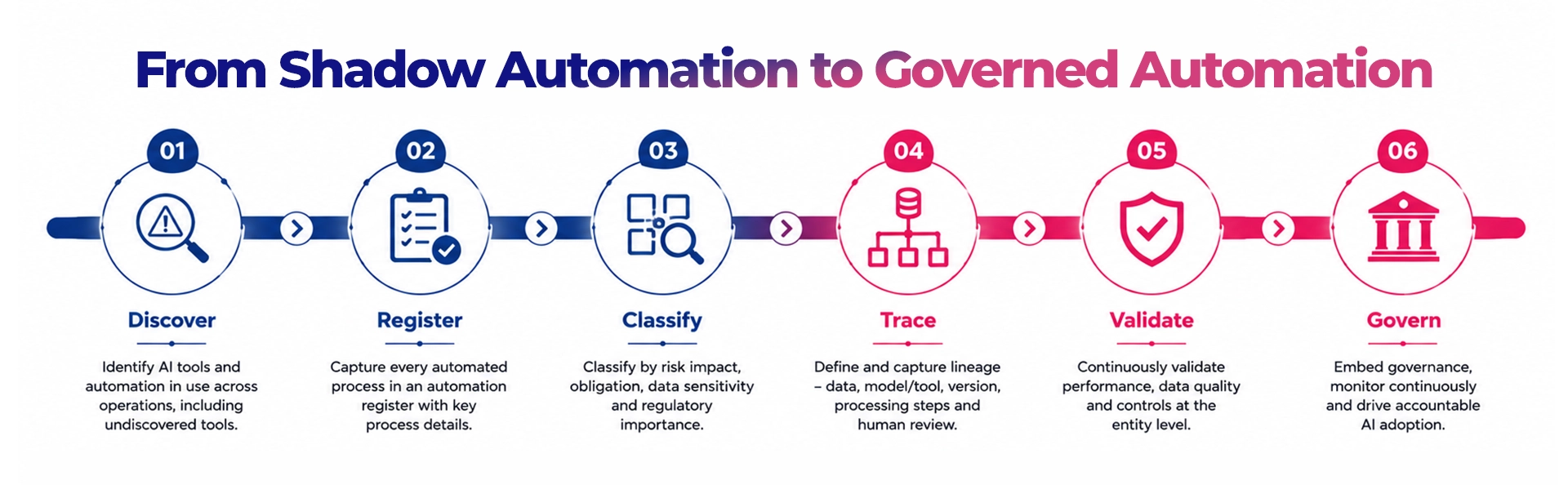
The register should identify the process supported, the data consumed, the output produced, the obligation that output fulfils, the human-review points, and the lineage required to reconstruct individual results. It must include formally sanctioned systems as well as tools discovered through operational assessment.
Building this register is foundational to responsible AI banking because it closes the gap between approved technology and real operational use. It also gives CIOs, COOs, risk leaders, and compliance teams a shared view of where automation affects accountable processes.
The objective is not to prevent employees from using AI. It is to bring useful adoption into a governed environment before invisible errors accumulate.
Conclusion
The next stage of banking operations automation will not be defined only by how much back-office work AI can perform. It will be defined by whether the institution can identify every automated process, trace every consequential output, and explain how human accountability was preserved. In back-office AI, what the bank cannot see may ultimately be what costs it the most.
Download the whitepaper to know more about intelligent automation in AI-first banking.
FAQ
1. What is shadow automation in banking?
Shadow automation is the use of AI or automated tools in operational processes without full visibility, formal approval, governance, or integration into the bank’s established control framework.
2. Why is back-office AI risk difficult to detect?
Back-office errors may not produce immediate customer complaints or system alerts. They can remain hidden until an audit, regulatory review, reconciliation failure, or downstream calculation reveals them.
3. What does lineage mean in AI-led banking operations?
Lineage is the record of the data, model or tool, version, processing steps, output, and human-review activity associated with an automated decision. It allows the outcome to be reconstructed and audited.
4. Why is an approved technology list not enough?
An approved list shows which tools the bank has formally sanctioned. It may not reveal AI tools independently adopted by teams or how approved tools are actually being used within operational workflows.
5. What is an automation register?
An automation register is a continuously updated inventory of sanctioned and unsanctioned AI-driven processes, including their data inputs, outputs, obligations, human-review points, and lineage requirements.