



Fraud and financial crime detection have traditionally worked by asking whether a transaction matches a known pattern. Amount thresholds, velocity rules, merchant categories, geographic anomalies, and predefined typologies have helped banks identify suspicious activity for years.
The limitation is structural. Fraud patterns evolve deliberately, and legitimate customer behaviour varies widely. A transaction that looks unusual for one account may be entirely normal for another. This is where AI changes the operating model. Instead of asking whether an event resembles fraud in general, it asks whether the event is unusual for the specific customer, account, or entity involved. That shift makes detection more precise. It also creates a new governance requirement: intelligence operating at the entity level must be monitored, explained, and validated at the entity level too.
From Common Rules to Individual Behavioural Context
Rules-based monitoring applies shared thresholds across categories or segments. AI-led detection can establish a behavioural baseline for each entity and compare every new event with that entity’s own history.
This distinction matters. Two transactions may have the same value, timing, and merchant category, yet deserve different outcomes because only one deviates from the originating account’s normal behaviour. AI can also assess patterns across longer timeframes and multiple geographies, revealing schemes that appear harmless when viewed as isolated events.
The result is not simply better pattern recognition. It is context-specific intelligence.
That intelligence can make AI for AML compliance more sensitive to genuine anomalies while also making it more specific about legitimate activity. This matters because traditional transaction monitoring can generate large volumes of false positives. Every unnecessary alert consumes investigation capacity, delays legitimate activity, and weakens the economic case for automation.
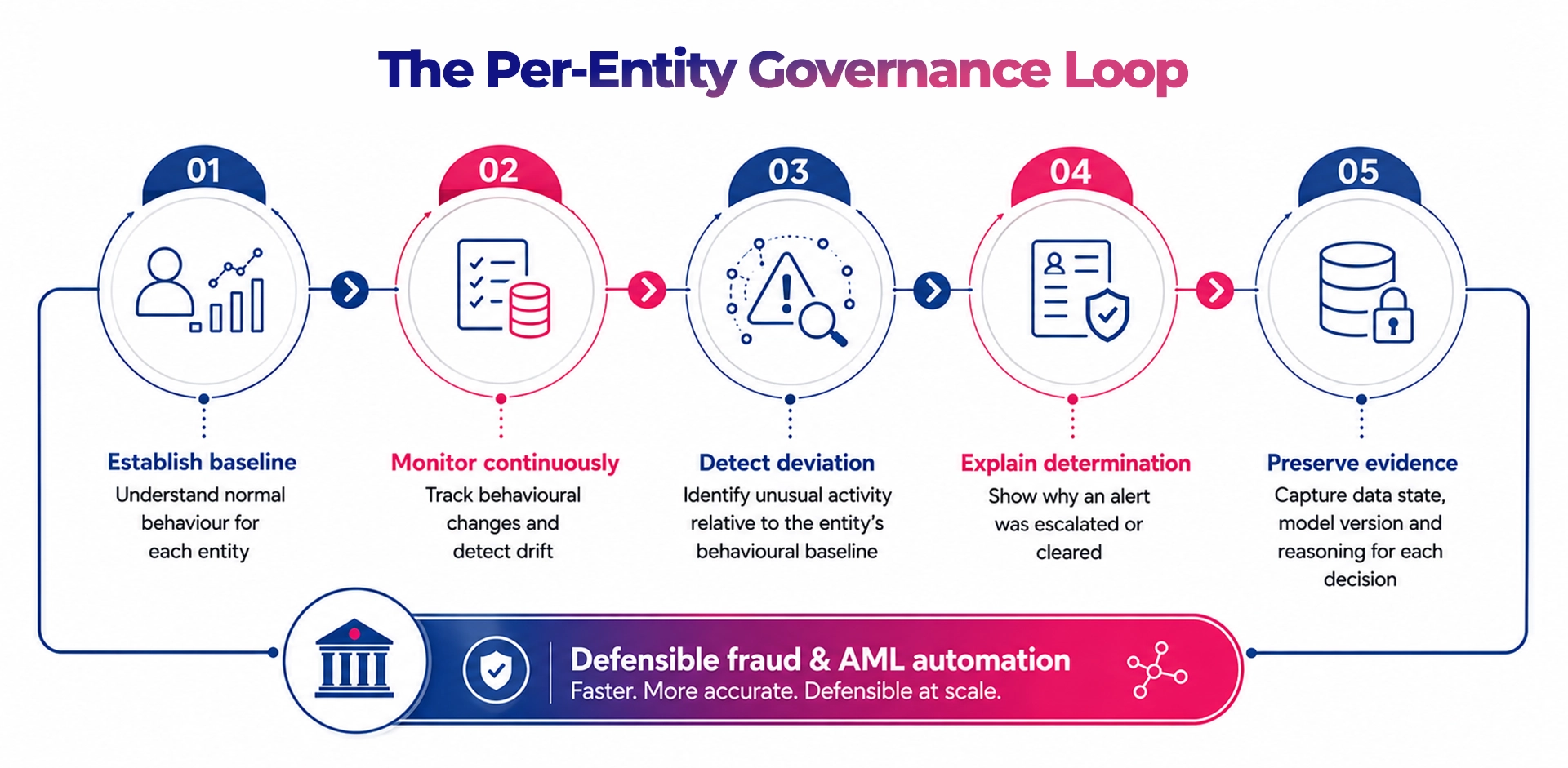
Per-entity baselines offer a way out of that trade-off. But their precision depends on the bank continuously understanding what “normal” means for different entities as their legitimate behaviour evolves.
Why Aggregate Metrics Can Conceal Model Failure
Many banks still govern AI models through programme-level measures such as aggregate accuracy, overall alert volumes, and quarterly performance reviews. These metrics can create a misleading sense of control.
A model may appear stable overall while performance deteriorates for a particular account type, customer-tenure group, geography, transaction pattern, or fraud typology. When results are averaged across the programme, localised degradation can disappear inside an acceptable headline number.
This is a critical dimension of AI risk in banking. Per-entity intelligence does not necessarily fail evenly. Drift may affect some sub-populations before others, particularly when upstream data changes alter the behavioural signals on which their baselines depend.
The whitepaper describes how a change in transaction categorisation caused false positives to rise after an AI fraud deployment had initially delivered significant improvement. The model itself had not suddenly become less capable. The data feeding its behavioural baselines had changed without an effective contract or alert reaching the governance team.
Monitoring therefore needs to match the model’s operating granularity. Banks require entity-segment measures of false positives and false negatives, continuous baseline updating, and automated detection when upstream data changes threaten baseline integrity.
Explainability Must Cover Escalations and Clearances
Per-entity monitoring is only half of the governance requirement. Banks must also be able to explain individual determinations.
For an escalated alert, the institution should be able to show which behavioural deviation triggered concern, what information informed the assessment, and why the event required review. But explainability cannot stop there. Alerts cleared as non-suspicious also need a documented basis, particularly in AML and sanctions operations where a regulator may ask why activity was not escalated.
This is where explainable AI banking becomes operational rather than theoretical. Explainability must exist at the determination level and in a form that supports investigation, suspicious activity reporting, audit, and regulatory examination.
The same obligation applies to third-party models. Vendor documentation alone does not allow a bank to defend a specific determination. The institution must understand how the model behaves within its own risk environment, monitor its production performance, and preserve the data state, model version, and reasoning associated with each decision.
Conclusion
Trusted fraud and AML automation therefore rests on a simple principle: governance must operate at the same level as the intelligence. If AI evaluates each entity individually, banks cannot rely only on averages, periodic reviews, or generic explanations. They need continuous per-entity monitoring and decision-level accountability. That is how automation becomes not only faster and more accurate, but defensible at scale.
Download the whitepaper to know more about intelligent automation in AI-first banking.
FAQ
1. What is per-entity fraud monitoring?
Per-entity fraud monitoring evaluates a transaction against the behavioural history of the specific customer, account, or entity involved, rather than applying only common thresholds across a broad segment.
2. Why are programme-level accuracy metrics insufficient?
Aggregate metrics can remain stable even when performance deteriorates for specific account types, customer groups, geographies, or transaction patterns. They can therefore conceal localised model drift or data problems.
3. How does per-entity intelligence reduce false positives?
It distinguishes genuine anomalies from activity that is normal for a particular entity. This makes detection more sensitive to meaningful deviations and more specific about legitimate behaviour.
4. What must banks explain in an AI-generated AML alert?
Banks should document the data considered, the behavioural deviation identified, the model version used, and the reason the alert was escalated. Cleared alerts should also retain the basis for the non-suspicious determination.
5. Why are data contracts important for per-entity fraud models?
Per-entity baselines depend on consistent upstream data. Data contracts define and monitor schema, freshness, completeness, and consistency standards so changes do not silently undermine model performance.