


The AI trust gap in banking is the space between what a bank’s AI systems are technically capable of and what the institution is actually willing to let them do unsupervised, and for the large majority of banks today, it is a bigger barrier to scaling AI than model performance, data availability, or budget
For a CIO attempting to explain why a technically successful pilot never reached production, the trust gap is usually the honest answer, even when the official reason cited is something else.
The Data Behind the Stall
Evident AI Index data shows that half of the AI tool announcements banks made in early 2026 never reached production, and the number of use cases stuck in pilot or testing nearly tripled year over year. Separately, the SAS IDC study Data and AI Impact Report: The Trust Imperative found that only 11% of banks have achieved internal confidence in AI alongside systems that are demonstrably trustworthy, and nearly half are caught in what researchers describe as a “trust dilemma”: either underusing AI they have already validated, or over-relying on AI that was never adequately tested. Read together, these figures describe the same underlying condition from two angles: banks are building AI capability faster than they are building the trust infrastructure required to deploy it with confidence.
Why “Still in Pilot” Is Rarely a Technical Statement
When a CIO is asked why a promising AI use case has not moved to production, the answer is seldom that the model fails to perform. More often, the honest answer involves one of four organizational gaps, none of which appears in a model performance report.
The first gap is an absence of accountability for the outcome. AI use cases are frequently scoped by technology teams without a business owner accountable for the result, which means no one holds the authority, or the incentive, to advance the use case through the final approval gates into production. The pilot succeeds technically and then has nowhere to proceed.
The second gap is the absence of an audit trail legal and compliance functions will accept. A model can perform well in testing and still stall at the compliance review stage because it cannot produce the traceable, defensible rationale a legal or compliance team requires to authorize a production deployment. The pilot demonstrated capability, not accountability, and those represent different standards entirely.
The third gap is that every use case reconstructs governance from first principles. Without an established, repeatable process for evaluating and approving AI use cases, each new pilot must build its own case for trust from the ground up, negotiating separately with risk, compliance, and legal. This process is slow enough that many pilots lose momentum and organizational interest before clearing it.
The fourth gap is that technology and risk functions frequently define trust differently. A technology team’s definition of a trustworthy model is often statistical: strong accuracy, stable performance across test sets. A risk or compliance team’s definition centers on accountability: whether the decision can be explained, defended, and audited. When these definitions are not reconciled explicitly, technology teams continue declaring pilots ready while risk teams continue declining to approve them, without either side being incorrect by its own standard.
The Shift from Innovation Layer to Decision Layer Raises the Stakes
This trust gap was more tolerable when AI operated at the periphery of banking, a recommendation here, a chatbot there, low-stakes enough that an error produced a mediocre customer experience rather than a compliance failure. That is no longer where AI operates. AI is moving from an innovation layer into the decision layer, embedded within credit decisions, fraud escalations, and regulatory reporting. At that level, the same organizational trust gap that previously only slowed adoption now forces a more consequential choice: deploy AI into production without having genuinely closed the gap, the source of the over-reliance half of the trust dilemma, or leave validated, functioning AI sitting in pilot indefinitely, the source of the underuse half. Neither position is one an institution can occupy indefinitely.
Closing the Gap Requires an Organizational Fix, Not Only a Technical One
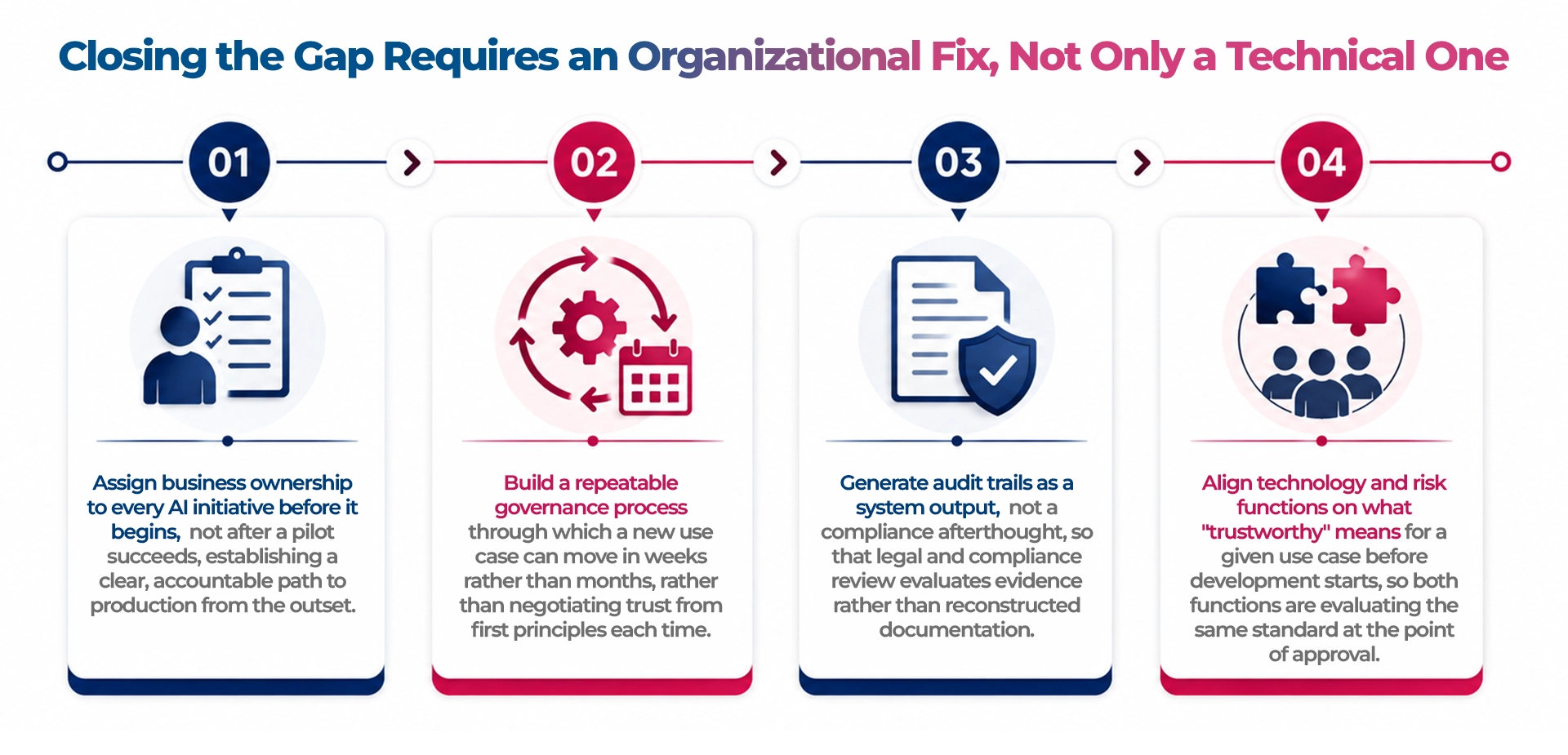
Because the trust gap is predominantly organizational, closing it requires organizational changes that a better model or additional computing capacity will not provide on their own:
- Assign business ownership to every AI initiative before it begins, not after a pilot succeeds, establishing a clear, accountable path to production from the outset.
- Build a repeatable governance process through which a new use case can move in weeks rather than months, rather than negotiating trust from first principles each time.
- Generate audit trails as a system output, not a compliance afterthought, so that legal and compliance review evaluates evidence rather than reconstructed documentation.
- Align technology and risk functions on what “trustworthy” means for a given use case before development starts, so both functions are evaluating the same standard at the point of approval.
What This Means for the CIO Agenda
Most banks do not have an AI capability problem. They have an AI trust infrastructure problem, and the two present identically from the outside, both surfacing as promising pilots that never scale, but they require entirely different remedies. Investing in better models will not close a gap that is fundamentally about accountability, governance, and organizational alignment.
Further reading: Where Trust Is Won or Lost in AI-First Banking and The Architecture of Trust in AI-Driven Banking whitepaper.
FAQ
1. What is the “AI trust gap” in banking?
It is the space between what a bank’s AI systems are technically capable of and what the institution is actually willing to deploy into production unsupervised. It is typically an organizational and governance gap, not a technical capability gap, which is why better models alone rarely close it.
2. Why do so many bank AI pilots never reach production?
Most commonly because of one of four organizational gaps: no business owner accountable for the outcome, no audit trail compliance will accept, no repeatable governance process, or technology and risk teams applying different definitions of “trustworthy” without reconciling them.
3. What is the “trust dilemma” in AI banking adoption?
It is the condition in which nearly half of banks either underuse AI systems they have already validated, leaving value on the table, or over-rely on AI systems that were never adequately tested, creating regulatory and reputational risk. Both are symptoms of the same underlying trust gap.
4. Why does the trust gap matter more now than it did a few years ago?
Because AI has moved from an innovation layer, where mistakes carried low stakes, into the decision layer, where it directly influences credit, fraud, and compliance outcomes. The same organizational trust gap that previously only slowed adoption now creates real regulatory exposure if it is not closed deliberately.
5. How does a bank actually close its AI trust gap?
By treating it as an organizational fix: assigning business ownership to every AI initiative before it starts, building a repeatable governance process, generating audit trails as a natural system output rather than a compliance afterthought, and aligning technology and risk functions on what “trustworthy” means before development begins.