

AI-first banking is the shift from using AI as a feature layered onto existing systems to embedding AI into a bank’s core systems, decisioning layers, and operations, so that intelligence, rather than automation alone, determines how the institution runs.
For community and regional banks in North America, this shift is no longer discretionary. It is the next core banking transformation cycle, and it is arriving faster than the internet or mobile waves that preceded it.
AI in Banking Has Already Happened. AI-First Banking Has Not.
Nearly every bank technology leader can point to some form of AI already in production: a chatbot, a fraud alert, a marketing segment, a coding copilot. That is AI in banking, useful, incremental, and largely peripheral to how the institution actually operates.
AI-first banking is a different proposition entirely. It requires AI to sit inside the systems of record, the credit decision engine, the KYC workflow, and the regulatory reporting pipeline, rather than adjacent to them. Evident AI Index data shows that half of the AI tool announcements banks made in early 2026 never reached production, and the number of use cases stuck in pilot or testing nearly tripled year over year. The industry is experimenting broadly. Very few institutions are operating AI at the core.
For a Tier 2 or Tier 3 bank, that gap constitutes a competitive risk rather than a curiosity. Larger institutions can absorb years of what McKinsey’s banking research calls “pilot purgatory” without material consequence. Regional and community banks, operating with leaner budgets and thinner margins for error, and often constrained by what their core banking vendor, whether Fiserv, FIS, Jack Henry, or Temenos, actually permits outside its own roadmap, cannot: every AI dollar has to convert into a measurable operating advantage, whether that is faster onboarding, lower cost-to-serve, stronger fraud detection, or tighter compliance.
From Execution Engines to Inference Engines
Every prior wave of banking technology, from core modernization to the internet to mobile, built faster, cheaper execution engines: systems designed to automate explicitly defined processes and reduce the cost per transaction. Success was measured by channel effectiveness, how quickly and frictionlessly a customer could complete a task on an app or portal. The underlying model still required a human to conceptualize the plan, define the rules, and structure the data in advance.
AI-first banking shifts the axis of banking technology from passive execution to active inference and orchestration. Rather than a human pre-building every rule a system might require, AI can conceptualize an objective, draw dynamically on unstructured data wherever it resides, and interpret context to render a real-time decision. This is a categorically different capability, not an accelerated version of the execution engine that preceded it, which is why treating AI-first transformation as “digital, but faster” consistently understates the scope of change a bank needs to plan for.
Why Speed Is the Wrong Framing for This Transformation
The prevailing instinct is to describe AI-first banking as a velocity upgrade, batch processing replaced by real-time, manual steps replaced by automated ones. That framing understates what is actually changing.
In the digital era, the smallest unit a banking system could deliver was a service: a repayment API, a customer profile feed, a report. A decision requiring something the service was not built for meant building a new service. AI changes the atomic unit of the architecture altogether. A bank’s AI layer can now assemble customer- and transaction-specific context on demand, drawing structured data, unstructured notes, and behavioral signals together for a single decision, at a single moment, without a data engineering project behind it. This is a different layer of banking technology, not an accelerated version of the one it replaces.
It also means AI can, for the first time, reason over the unstructured data banks have always held but never been able to use, including complaint narratives, compliance notes, and manual override justifications, incorporating it directly into the decision surface for credit, fraud, and compliance models.
The Four Foundations of AI-First Banking
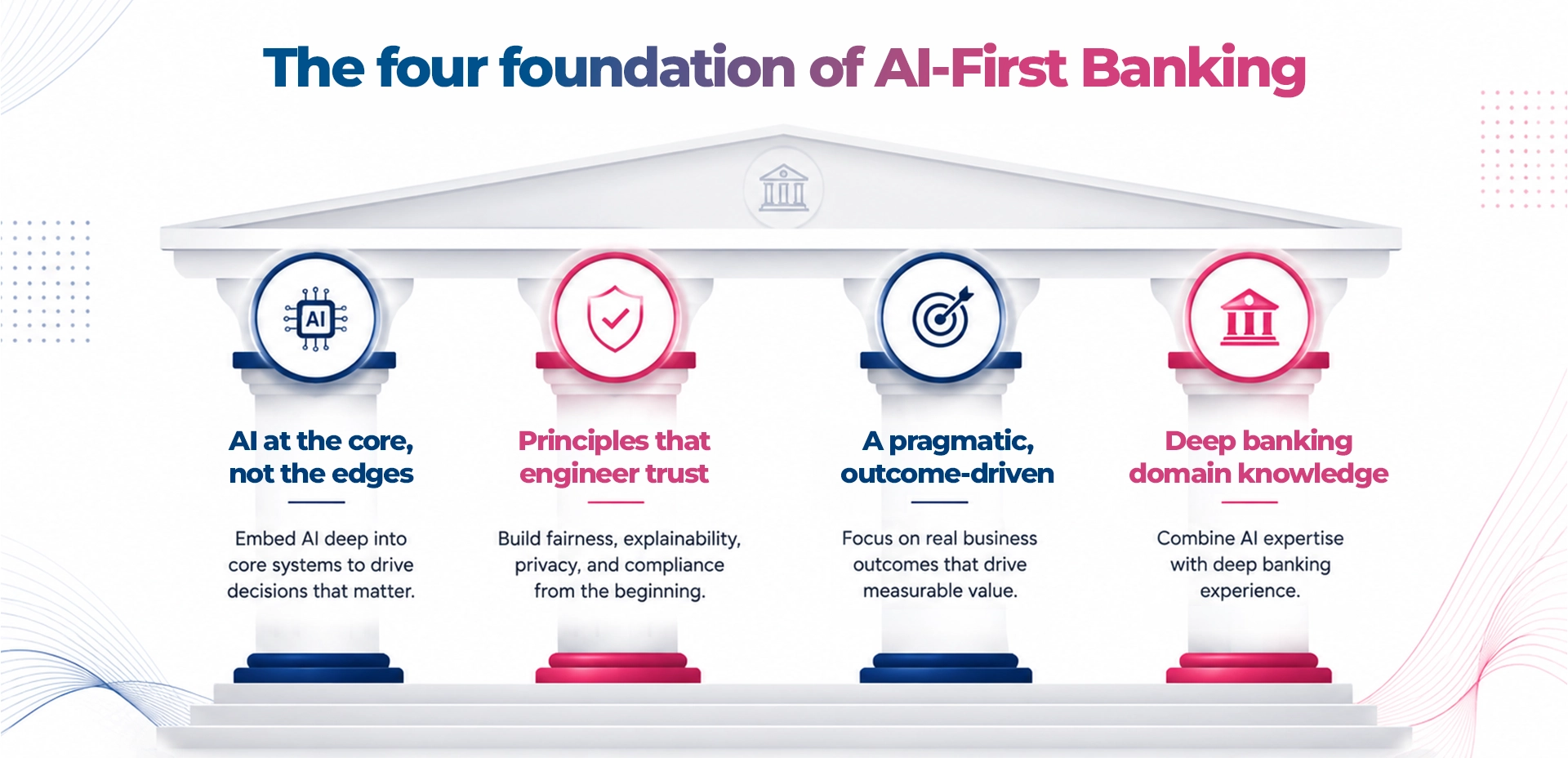
Moving AI to the core responsibly requires four elements operating together, not in sequence:
- AI at the core, not the edges: embedding AI into decision layers and core systems rather than sustaining isolated pilots.
- Principles that engineer trust: fairness, explainability, reliability, and privacy specified before model training, not audited after deployment.
- A pragmatic, outcome-driven approach: every AI initiative tied to a measurable business result, such as onboarding time, fraud loss, cost-to-serve, or decisioning speed.
- Deep banking domain knowledge: generic AI governance frameworks cannot address the specificity of BCBS 239, SR 11-7 (now SR 26-2), or the EU AI Act’s high-risk classification for credit and risk models, and for a US-chartered institution, cannot substitute for understanding the specific expectations of its own prudential regulator, whether the OCC, the FDIC, or the NCUA.
Omit any one of these four, and the result is not AI-first banking. It is a faster version of the same fragility banks already carry.
Why Most AI Initiatives Never Earn a Business Case
A significant share of stalled AI pilots fail for structural, not technical, reasons. AI use cases are typically scoped by technology teams without a business owner accountable for the outcome, which severs the link that would otherwise make impact measurable. The predictable result is an organization tracking activity metrics, adoption milestones, cost benefits observed in controlled tests, while the actual value gap widens, because those metrics measure deployment rather than impact. Industry tracking shows that only a small minority of banks share projected or realized gains from their AI initiatives at all.
Closing that gap requires three elements established before development begins, not after: identifying the specific operational improvement being targeted, establishing the measurement methodology that confirms the improvement holds once the system reaches production, and building the financial model that connects the operational metric to business value. This front-loaded discipline has a real cost: it slows the initial launch of an initiative, since the measurement framework has to exist before the first line of code, which is precisely why teams under delivery pressure skip it. The trade-off is worth making anyway, because the alternative is a pilot that ships faster and never earns the budget to scale. Research into AI investment returns has also found that initiatives focused on customer experience generate meaningfully higher returns than those focused purely on cost reduction, a strong argument for scoping AI-first initiatives around the customer and compliance outcomes that matter most to a given institution, rather than around whichever process happens to be easiest to automate first.
What This Means for the CIO Agenda
Taken together, these dynamics point to a specific discipline, not a technology purchase. The IDC research behind this shift found that only 11% of banks have achieved internal confidence in AI systems that are demonstrably trustworthy, and nearly half are caught in what researchers term the “trust dilemma”: either underusing validated AI or over-relying on AI that was never properly tested. Both are costly failure modes, and neither is resolved by faster deployment. For a CIO at a regional or community bank, the mandate is not to deploy AI faster than the competition. It is to build the infrastructure that allows AI to be trusted in production, under examination, at the scale the institution actually operates at, which is the foundation the rest of an AI-first strategy has to be built on.
“Trust in AI-first banking is not a focus area or a commitment statement. It needs to be engineered, layer by layer.”
Further reading: the Architecture of Trust in AI-Driven Banking whitepaper, part of Maveric Systems’ research on AI-first banking
FAQ
1. What does “AI-first banking” mean
AI-first banking means AI is embedded into a bank’s core systems and decision layers, including lending, fraud, compliance, and servicing, rather than added as a peripheral feature. Decisions are generated through AI-driven inference and context assembly instead of predefined rules and static reports.
2. How is AI-first banking different from digital-first banking?
Digital-first banking focused on channel speed and self-service, moving transactions online and onto mobile through faster execution engines. AI-first banking shifts the axis of banking technology from execution to inference: it can generate customer- and transaction-specific intelligence on demand, reason over unstructured data, and make real-time decisions without pre-built services or reports
3. Why do most bank AI initiatives stay stuck in pilot mode?
Most AI use cases are scoped by technology teams without a business owner accountable for the outcome, so there is no mechanism connecting AI activity to measurable business impact. Without output anchors, attribution frameworks, and governance built in from the start, pilots rarely earn the business case needed to scale into production.
4. Is AI-first transformation realistic for a Tier 2 or Tier 3 bank?
Yes. The path is different from what a global bank would take, but scale is not a prerequisite. Community and regional banks can move AI into the core selectively, starting with the highest-friction, highest-cost processes (onboarding, fraud, regulatory reporting) and building governance in from day one rather than retrofitting it later.
5. What is the biggest risk of deploying AI without a trust framework?
Ungoverned AI decisions in lending, fraud, or compliance can trigger regulatory inquiries, unexplainable credit denials, and audit failures, because there is no traceable link between the decision and the data or logic behind it. Trust has to be engineered into the system from the start, not reconstructed after an incident.