


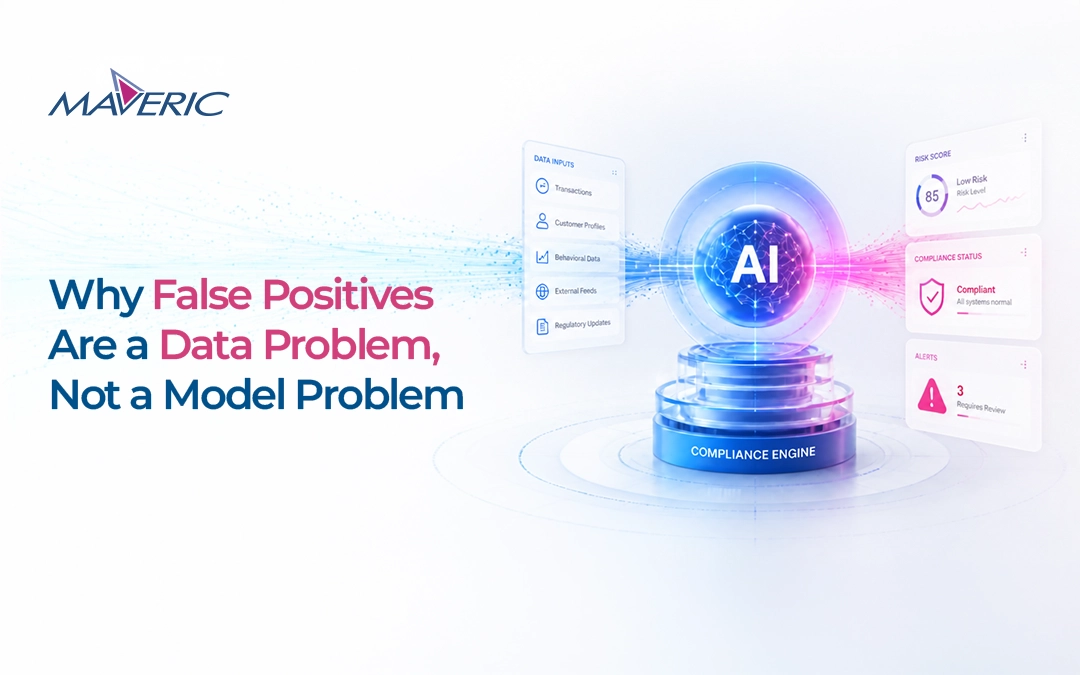
AI for AML compliance works by giving transaction monitoring models access to the unstructured context, including narratives, notes, and counterparty details, that structured data fields have always excluded, so the model can distinguish transactions that look identical on paper but are contextually different. For compliance and technology leaders at regional and community banks, this reframes a problem usually addressed with more rules and more analysts as, instead, a data architecture problem.
The Real Source of AML False Positives
Historically, Know Your Customer (KYC), Anti-Money Laundering (AML), and Financial Crime Management (FCM) have been run as separate compliance programs on separate tooling. That separation creates data redundancy and, more damagingly, high false-positive escalation rates, because each system is reasoning over a partial view of the customer and the transaction.
The deeper limitation isn’t the volume of alerts. It’s architectural: pre-AI transaction monitoring can query structured data, such as transaction values, dates, and counterparty IDs, but the narrative content of a payment description, the explanation behind a manual override, or the content of a customer document has historically been invisible to the model. It exists in the database. It can’t be reasoned over. Statistical and rule-based models were built to work with what could be represented as a number or a category; text, meaning, and context sat beyond the boundary of what the decisioning layer could access, no matter how sophisticated the underlying typology library was.
Making the Transaction Narrative Part of the Decision Surface
AI changes this by making the content of a text field queryable, not just the field itself. For AML transaction monitoring, that means the model can reason over the narrative content of a transaction description alongside the transaction value and counterparty data, which is where the contextual signals distinguishing a legitimate transaction from a suspicious one most often live. The same shift applies to regulatory reporting more broadly: a validation system can assess the meaning of an explanation field, not just whether a value is present, but whether the explanation is coherent, consistent with the transaction data, and sufficient for the regulatory purpose it serves.
In Maveric’s core modernization engagements, integrating unstructured data into the AML decision surface, enabling the model to weigh transaction narrative context alongside value and counterparty signals, has materially reduced false-positive escalation rates, by letting the model distinguish transactions that are structurally similar but contextually distinct. The improvement wasn’t in the model’s typology matching. It was in the model’s ability to actually read the transaction.
Unifying KYC, AML, and FCM Into One Risk Infrastructure
AI enables the convergence of KYC, AML, and FCM into a single, unified risk infrastructure by harnessing structured and unstructured data concurrently across all three disciplines instead of maintaining siloed tooling for each. Banks that build this convergence as unified infrastructure from the outset consistently realize higher fraud-loss reductions and avoid the integration debt that comes from bolting the systems together later. This matters more for a Tier 2 or Tier 3 bank than it might for a global institution: a smaller compliance team has less capacity to manually reconcile alerts across three siloed systems, so the cost of a fragmented architecture shows up faster, in headcount and in examiner findings, than it would for an institution that can absorb the inefficiency with scale.
Contextual Stratification: Moving Beyond Static Risk Thresholds
The traditional AML/KYC bottleneck is human effort: reviewing documents, validating addresses, chasing missing information against a rigid checklist. Agentic AI workflows handle this validation continuously, using contextual stratification rather than static, rule-based processing. This means evaluating a customer’s specific risk profile in real time, straight-through processing low-risk applicants instantly, and routing high-risk anomalies to compliance officers with a summarized context of exactly why the escalation occurred, instead of a raw alert with no narrative attached. This same pattern applied to onboarding, rather than ongoing monitoring, is what has taken customer onboarding times at some regional banking implementations from hours down to a handful of clicks, without loosening the underlying risk standard the institution is applying.
Why This Requires Deep Banking Domain Knowledge, Not a Generic AI Model
Generic AI governance frameworks can’t address the specificity that AML and KYC regulation demands. An AI-driven AML model isn’t just software. Under frameworks like BCBS 239 and evolving model risk management guidance (SR 11-7, now SR 26-2), it’s a regulated model requiring demonstrable data lineage and validation before deployment. Building AI for AML compliance without deep understanding of how KYC, AML, and FCM data actually flow through a bank’s upstream systems is how errors in data lineage end up surfacing in production, under regulatory examination, rather than in testing. A model that scores well on a benchmark dataset can still fail an examination if the institution can’t demonstrate where its training data came from, how it was validated, and why a specific escalation decision was made for a specific customer.
What This Means for the Compliance and Technology Agenda
Compliance automation in banking isn’t primarily about replacing analysts with alerts. It’s about giving the model, and the analysts reviewing its output, the full context a decision actually requires: structured and unstructured, current and historical, at the level of the individual transaction. Get that right, and false-positive rates fall without sacrificing detection quality, freeing analyst time for the genuinely ambiguous cases that need human judgment. Get it wrong, and you’ve just automated the noise, generating alerts faster without making them any easier to triage.
See how AI-enabled compliance infrastructure works
The CIO’s Guide to AI-Enabled Core Banking Modernization details how unstructured data integration and query-level validation intelligence apply directly to AML transaction monitoring and regulatory reporting, including implementation results from Maveric’s core modernization engagements.
FAQ
1) How does AI reduce false positives in AML transaction monitoring?
By giving the model access to unstructured data, such as transaction narratives, compliance notes, and counterparty context, alongside the structured transaction values it already used. This lets the model distinguish transactions that are structurally similar but contextually different, rather than flagging both because they match the same typology pattern.
2) What is contextual stratification in KYC/AML compliance?
It’s an AI-driven approach to risk assessment that evaluates a customer’s specific risk profile in real time, rather than applying static, rule-based thresholds uniformly across a segment. Low-risk applicants are processed straight through; high-risk anomalies are routed to compliance officers with a summarized explanation of why the escalation occurred.
3) Why should banks unify KYC, AML, and Financial Crime Management infrastructure?
Because managing them as separate, siloed programs creates data redundancy and high false-positive rates, as each system reasons over a partial view of the customer. AI enables convergence by processing structured and unstructured data concurrently across all three disciplines, which banks that build this way from the outset use to achieve better fraud-loss reduction and lower long-term integration costs.
4) Is an AI-driven AML model considered a regulated model?
Yes. Under frameworks like BCBS 239 and model risk management guidance such as SR 11-7 (updated to SR 26-2), an AI-driven AML or KYC model is treated as a regulated model requiring demonstrable data lineage, validation, and documentation before deployment, not simply software.
5) Can a regional or community bank realistically deploy AI for AML compliance?
Yes, but it requires deep banking domain knowledge, not a generic AI model. Understanding the lineage of the data feeding the AML system, and how KYC, AML, and FCM data flow through upstream applications, is what prevents errors from surfacing in production or under regulatory examination instead of during testing.