

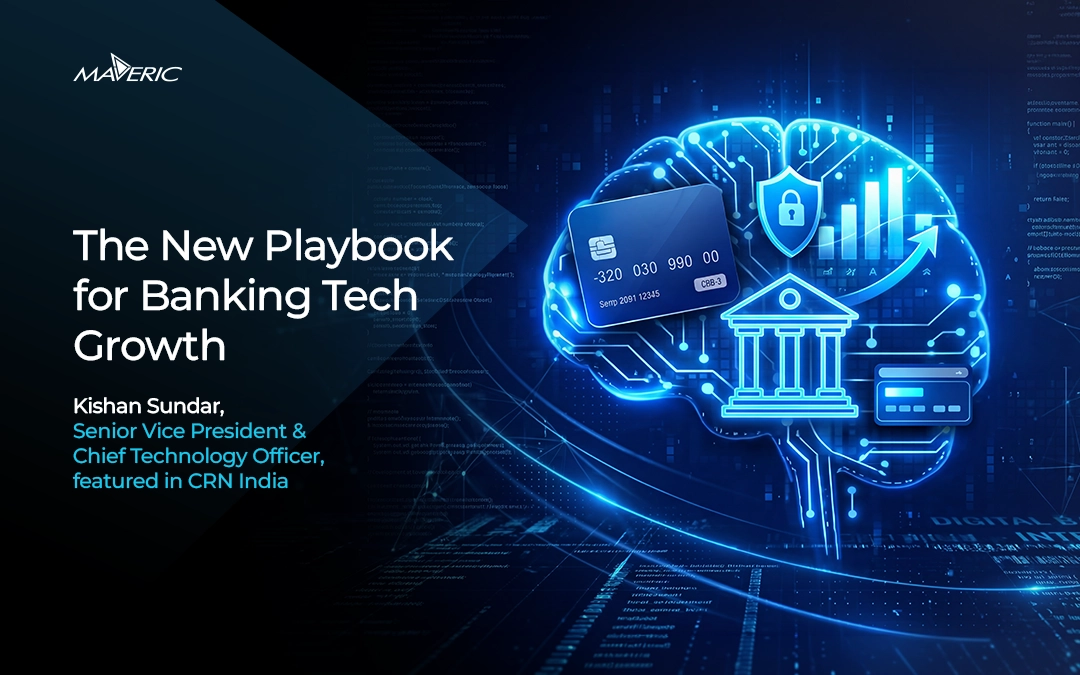
Maveric Systems is turning customer-built AI solutions into scalable banking platforms while expanding ecosystem partnerships and evaluating acquisitions in India and the US.
Banking technology firms are looking beyond traditional services revenue as they invest in proprietary AI platforms, industry-specific intellectual property and outcome-driven solutions.
However, according to Kishan Sundar, CTO of Maveric Systems, the shift towards platforms does not signal a move away from services. Instead, services, platforms and ecosystem partnerships are becoming interconnected as firms look to create new growth engines while remaining embedded in customer transformation programmes.
“The strategy is very clear. It is not a binary choice between platforms and services,” Sundar told CRN India. “Both will coexist and continue to grow together.”
The company, which has built a portfolio of AI-driven platforms and solutions including PulseAI, PrismAI and FraudSightAI, positions these offerings as an extension of its services-led business rather than a standalone product strategy.
Platforms evolve from delivery, not R&D
Unlike vendors that build products in isolation and take them to market later, Maveric’s platforms have largely emerged from customer engagements and production environments.
According to Sundar, most of the AI platforms and solutions have been developed alongside banking customers and refined through real-world deployments.
“These are not backend R&D projects that have been developed in isolation,” he said. “Most of them have been incubated alongside customers and are already running in production environments.”
This approach reflects the realities of the banking sector, where technology adoption is shaped by regulatory oversight, model-risk frameworks, security controls and operational governance requirements.
As a result, the focus is shifting from demonstrating technical capability to building systems that can operate reliably in production environments.
“We know what it takes to move these solutions into production. They are not just technology demonstrations,” Sundar said.
The company’s AI portfolio spans both platforms and targeted solutions aligned to banking use cases, including customer service, operational efficiency, fraud detection and compliance.
Rather than enforcing a single delivery model, Maveric is offering flexibility in how customers consume these solutions. Some banks deploy and manage the solutions independently after implementation. Others rely on Maveric to integrate, operate and support them as part of ongoing managed services engagements.
The company is also seeing “growing interest in outcome-based commercial models”, particularly among smaller institutions that may not have the internal capabilities required to build and manage AI environments on their own.
“If a bank has its own technology capabilities, we work alongside their teams and hand over operational control,” Sundar said. “In other situations, customers prefer us to manage the implementation and ongoing operations.”
For smaller financial institutions such as credit unions and building societies, the company is exploring outcome-based pricing models that reduce upfront investment requirements and align spending with measurable business outcomes.
At the same time, Maveric’s services heritage continues to play a critical role as customers move from experimentation to full-scale deployment.
Implementation, integration, governance and ongoing operations remain essential components of transformation programmes, even as platform adoption increases.
Partnerships and acquisitions shape the next growth phase
As platforms become a larger part of the business, ecosystem partnerships are emerging as a key growth lever.
Maveric works with technology providers across banking platforms, cloud infrastructure and data ecosystems, positioning itself as an implementation, integration and transformation partner.
Sundar pointed to engagements involving Databricks as one example of this model. In such programmes, the technology provider manages product licensing, while Maveric focuses on implementation, integration and support.
“There are opportunities where we partner with the product company and help drive implementation and transformation programmes for customers,” he said.
The company has also invested in banking-specific accelerators across data engineering, digital engineering and core banking transformation, helping customers reduce deployment timelines and accelerate value realisation.
Maveric’s relationship with Temenos further illustrates this approach.
The company works across implementation, migration, testing and integration programmes involving the banking platform, allowing banks to work through a more coordinated delivery model.
According to Sundar, banks prefer arrangements where “product vendors and implementation partners operate as a unified team” rather than as separate providers responsible for different workstreams.
Historically, multiple vendors handled different phases of a programme, creating dependencies that banks themselves had to coordinate.
“When there are multiple providers involved, banks often end up managing the dependencies and timelines across different workstreams,” Sundar said.
By aligning closely with platform providers, the aim is to reduce execution risks and improve programme coordination.
“We know where the fragile areas are and we understand how the teams operate,” he said. “That helps reduce delays and improve execution.”
Beyond partnerships, acquisitions are expected to play an important role in the company’s next phase of growth.
Sundar said Maveric is actively evaluating acquisition opportunities in both India and the United States as it looks to expand capabilities, strengthen domain expertise and increase market presence.
At the same time, he clarified that the company is not positioning itself to be acquired.
“We do not want to be acquired and lose the identity we have built,” he said. “We are looking at acquisitions as part of our growth journey.”
Sundar believes the balance between platforms and services will become important as banking customers look for technology partners capable of delivering platforms, implementation expertise and business outcomes through a single engagement model.
While AI platforms and banking-specific solutions are expected to contribute a larger share of future growth, services remain the foundation of the business.
“The traditional services business will continue,” Sundar said. “Platforms and solutions will create additional growth, but both will coexist.”
As the company expands its partner ecosystem and evaluates acquisition opportunities across India and the US, that coexistence between platforms and services is expected to define its next phase of growth.
FAQ
1. Why are banking technology firms rethinking their growth models?
Traditional services-led models are no longer sufficient for sustained growth. Firms are increasingly investing in AI platforms, proprietary IP, and outcome-driven solutions to create differentiation and new revenue streams.
2. Do services still matter in this new model?
Yes—services remain foundational. However, they are evolving to support and scale platform-led offerings, creating a hybrid model that combines execution with reusable, IP-driven solutions.
3. What role do AI platforms play in this shift?
AI platforms enable standardization, repeatability, and scale. They help firms move beyond one-off services engagements to delivering consistent, outcome-driven value across clients.
4. How is differentiation changing in the banking technology space?
Differentiation is shifting from effort-based delivery to ownership of platforms, IP, and measurable outcomes, with firms expected to deliver scalable impact rather than just execution.
5. How are firms like Maveric responding to this evolution?
Firms like Maveric are investing in platform-led offerings that combine domain expertise with AI-driven capabilities, helping banks transition from service consumption to scalable, outcome-focused transformation.
About the Author
 As the Chief Technology Officer, Kishan Sundar helms the technology strategy for Maveric. His leadership in creating engagement and impact through customized technology solutions and emerging technologies will play a crucial role in accelerating Maveric’s revenue growth and fuelling its aspiration of becoming one of the top three Bank Tech companies.
Originally Published in CRN India