

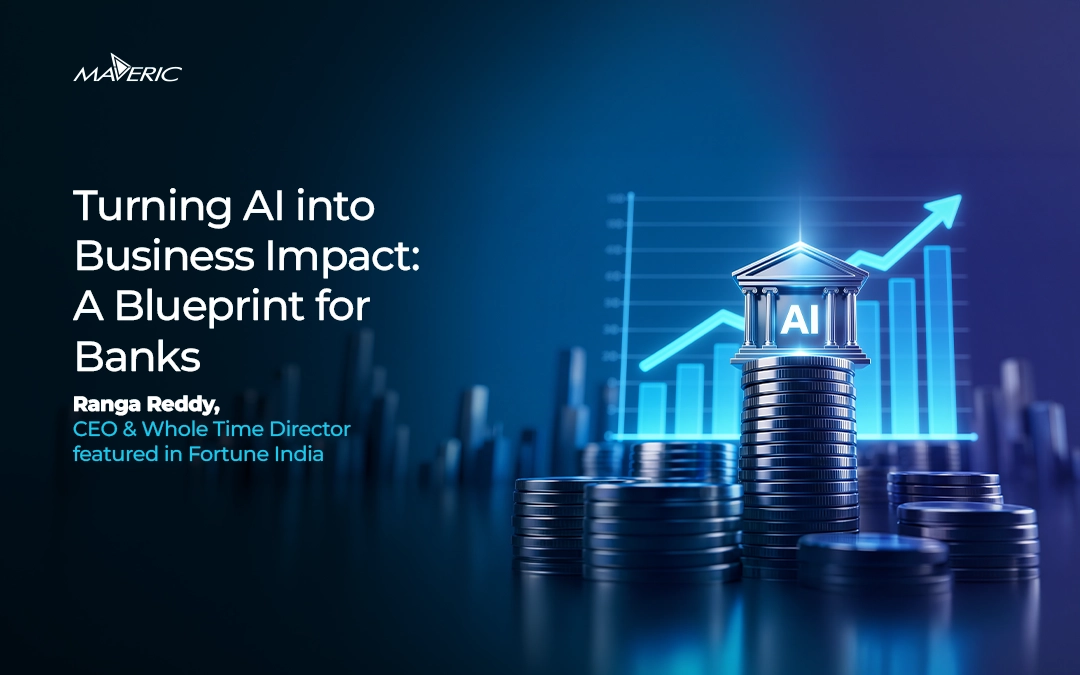
The next phase of AI in banking will be led by institutions that focus on core areas for AI-led change. Applying AI at the core means focussing on fundamental performance parameters at the line of business or function level and analysing how AI can drive measurable impact.
For the past few years, much of the financial industry’s energy has been directed towards experimentation. Banks ran pilots, tested use cases, created internal proofs of concept, and explored areas where AI could improve productivity or customer experience. This phase of innovation was necessary as it helped banks understand the technology and identify early value areas.
Financial institutions soon realised that AI in pilots works well in sandboxes but fails to scale across lines of business and functions. We now see the shift from innovation across pockets of novelty to operational impact. The AI value is judged by the outcomes and impact it creates across the functions where it is applied, rather than the number of pilots launched. To make this happen, banks need to focus on the following three areas.
Apply AI at the core rather than the edges
Applying AI at the core means focussing on fundamental performance parameters at the line of business or function level and analysing how AI can drive measurable impact. While improving isolated tasks at the periphery of operations through pilots can deliver incremental benefits, applying AI at the core business functions and decision-making processes drives sustained value creation.
Consider a credit card acquisition function. It has defined economics, including the cost of acquiring each customer, monthly acquisition volumes, approval rates, servicing costs, delinquency patterns, and long-term customer value. Applying AI at the periphery may mean automating a document check after onboarding. That improves efficiency, but it does not materially change the economics of the function.
Applying AI at the core means asking a harder question: can AI reduce acquisition cost while increasing customer throughput and improving decision quality? That requires more than one use case. It may involve smarter segmentation, better lead scoring, faster document validation, AI-supported risk checks, automated servicing triggers, and improved delinquency prediction. Individually, each use case may help. Together, they begin to change the function.
The same applies to technology teams. If AI-assisted coding, AI-led quality assurance, and AI-supported requirement structuring are run as separate initiatives, each will create partial gains. But if they are integrated across the software delivery lifecycle, it changes end-to-end delivery throughput.
Shift from scattered use cases to measurable outcomes
Many financial institutions run on complex technology estates, with legacy platforms, modern digital layers, multiple data systems, and strict regulatory expectations. A pilot can demonstrate potential in a contained environment. The moment it gets introduced into the complex production environment, it is no longer a standalone technology but one that affects
people, processes, controls, data flows, and operating models. It raises the bar for trust, traceability, consistency, and, more importantly, outcomes. This is why many AI applications don’t move beyond pilots.
The question for leadership is not “where can we use AI?” The more useful question is “which performance metric are we trying to change?” On the business side, that metric could be customer acquisition cost, servicing cost, delinquency rate, first-call resolution, onboarding time or customer lifetime value. On the technology side, it could be release frequency, sprint throughput, defect leakage, regression effort or system stability.
To drive operational impact through AI, banks need to shift to an outcome-focussed mindset. It begins with re-envisioning core business parameters and clearly defining measurable business outcomes. This further translates into reimagining how people, processes, and technology come together, with AI, ML, and automation as enablers. Once this blueprint is established, the focus shifts to disciplined execution through design, build, validation, deployment, and ongoing governance. This entire approach drives the shift from isolated initiatives to meaningful, enterprise-wide transformation.
Initiate operational discipline before deployment
A common misconception is that discipline begins when a model is deployed. In reality, it begins much earlier. Before any AI system gets developed, banks must assess whether the data required for AI is available, reliable, and usable. Trust must be architected from the start through an engineering approach that embeds global banking and AI standards across every layer. Banks should have clear governance structures, defined ownership, agreed controls, and teams that understand technology and the banking context. Without this alignment, even well-designed models struggle to deliver sustainable value in production.
Furthermore, they need to know where AI should not be applied. Some areas may be far higher in terms of maturity of AI adoption with clear processes, reliable data, and measurable outcomes. Others may still require foundational digital and data work before AI can create meaningful value.
The next phase of AI in banking will be led by institutions that focus on core areas for AI-led change, define clear outcomes, establish guidance through global trust and governance principles, and continuously track performance. Ultimately, applying AI at the core is a leadership mindset, one that starts with business vision, translates into process and technology design, and is sustained through disciplined governance, outcome measurement, and ongoing improvement.
FAQ
1. Why is there a shift from AI pilots to operational impact in banking?
While AI pilots have helped banks explore use cases and validate potential, they often fail to scale across complex, real-world environments. The focus is now shifting toward embedding AI into core operations to deliver sustained, enterprise-wide impact.
2. What does applying AI at the core of banking operations involve?
Applying AI at the core means integrating it into fundamental business functions such as customer acquisition, risk assessment, and servicing. This approach enables banks to improve decision-making, efficiency, and overall business performance at scale.
3. How should banks define and measure AI-driven outcomes?
Banks must move from tracking isolated use cases to focusing on measurable business metrics such as acquisition cost, onboarding time, service efficiency, delinquency rates, and customer lifetime value. Clear outcome definition is essential for demonstrating real impact.
4. What role do governance and data readiness play in scaling AI?
Successful AI deployment requires strong governance frameworks, reliable and accessible data, and clear ownership across teams. Embedding trust, traceability, and compliance mechanisms from the outset is critical to ensure consistent and responsible AI adoption.
5. What mindset shift is required for banks to realize AI’s full potential?
Banks need to transition from asking “Where can AI be used?” to “Which business outcomes need improvement?” This outcome-driven mindset enables institutions to align AI initiatives with strategic goals and achieve true transformation.
About The Author
 As CEO and Co-founder of Maveric Systems, Ranga leads the company’s vision to help financial institutions succeed in their AI-first journey by engineering trust into every layer of transformation. Under his leadership, Maveric has evolved into a trusted transformation partner, enabling banks across retail banking, corporate banking, wealth management and capital markets to modernize, scale, and transform with confidence.
Originally Published in Fortune India