


Why Trust is Central
When we talk about AI in banking, most of the conversation revolves around economics and ROI. In my first article, I proposed a bold idea: New England’s community banks pooling resources into a Shared AI Exchange to level the playing field against fintechs and national giants. In my second piece, I unpacked the economics, showing how collaboration can make AI affordable.
But as Tom Grottke, CEO of The NBS Group, asked me recently: “Even if Banks can afford it, how do we make sure regulators — and our customers — trust it?”
That’s the right lens. Unlike ATMs or ACH rails, an AI Exchange touches the very core of banking: customer data, lending decisions, fraud alerts, and service interactions. Any misstep in governance could erode the very thing community banks are built on — trust.
The good news? With the right design, governance and regulation don’t have to be barriers. They can become differentiators.
The Governance and Regulatory Hurdles
Data Privacy and Security: Community banks handle sensitive customer data, regulated by the Gramm-Leach-Bliley Act (GLBA) and state frameworks. Pooling data raises obvious concerns. The solution: federated learning (models train locally; only weights are shared) combined with differential privacy to safeguard individuals.
Model Risk Management: Under SR 11-7 guidance, banks must validate and monitor models continuously. A Shared AI Exchange could establish a Model Risk Office to manage validation on behalf of members — lowering costs and raising consistency.
Fairness and Explainability: The CFPB insists lenders explain credit decisions, even when AI is used. Black-box models won’t cut it. With Explainable AI (XAI) tools (like SHAP, LIME), banks can show which variables drove outcomes, reassuring regulators and customers.
Third-Party Oversight: FDIC rules require oversight of vendor risks. In a consortium, dependencies multiply. The fix: standardized vendor contracts, audits, and security certifications built into the Exchange’s governance.
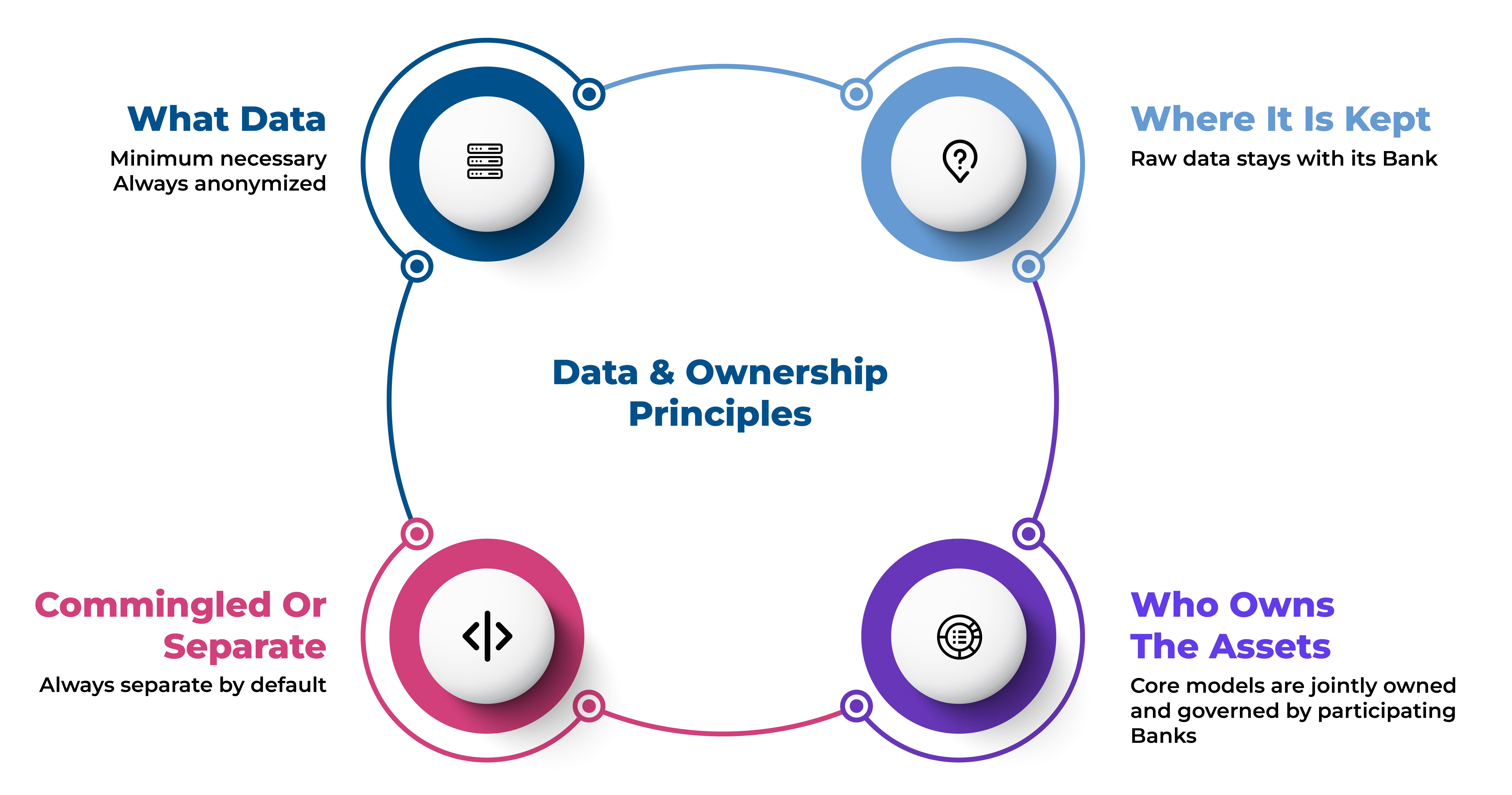
A Shared AI Exchange must also be clear about what data is shared, where it’s kept, and who owns the outputs:
- What Data: Transaction metadata (fraud/AML), anonymized credit features, aggregated transcripts — always stripped of PII.
- Where Kept: Raw data remains local; the Exchange hosts only model weights. Every interaction logged for audit.
- Commingled or Separate: Separate by default. Synthetic or anonymized aggregates may be created for benchmarking.
- Who Owns Assets: Core models and dashboards = joint IP. Bank-specific customizations remain individual property. Departing members keep rights to models built during their tenure.
This mirrors past utilities like The Clearing House or ATM networks: shared infrastructure with individual flexibility.
Turning compliance into strength
Instead of treating compliance as a burden, community banks can make it their differentiator:
- Position the Exchange as “the most explainable AI in banking.”
- Share compliance costs across members.
- Partner with universities like UConn and Northeastern’s Roux Institute for neutral fairness audits.
- Reinforce customer confidence by framing it as “AI you can trust.”
A Practical Governance Framework
- Charter: Define roles, rules, and audit rights.
- Guardrails: Federated learning + mandatory explainability.
- Alignment: Involve regulators early; publish quarterly compliance reports.
- Oversight: Engage auditors and academics for independent validation.
Global Inspiration
- Europe’s GDPR & draft AI Act: Mandating explainability and risk classification.
- Singapore’s AI Governance Framework: Human-in-the-loop oversight embedded in finance.
- Canada’s Pan-Canadian AI Strategy: Governance and ethics tied to funding.
These examples show governance can be built in from the start — not bolted on later.
The Promise
If the economics of a Shared AI Exchange answer “who pays?”, governance answers “who can we trust?”
For community banks, the answer must be: trusted by regulators, trusted by customers, trusted by communities. By embedding privacy, fairness, explainability, and ownership principles from day one, they can turn compliance into a competitive edge.
The result? Not just an AI Exchange that works — but one people believe in. That is the true promise of trust by design.
About the Author
 As the Director and Regional Head of the North America region at Maveric Systems, Pankaj Misra is responsible for driving strategic growth, scaling accounts, building new client relationships, and forming industry partnerships. He is also entrusted with spearheading the marketing initiatives to establish a strong brand presence for Maveric.