

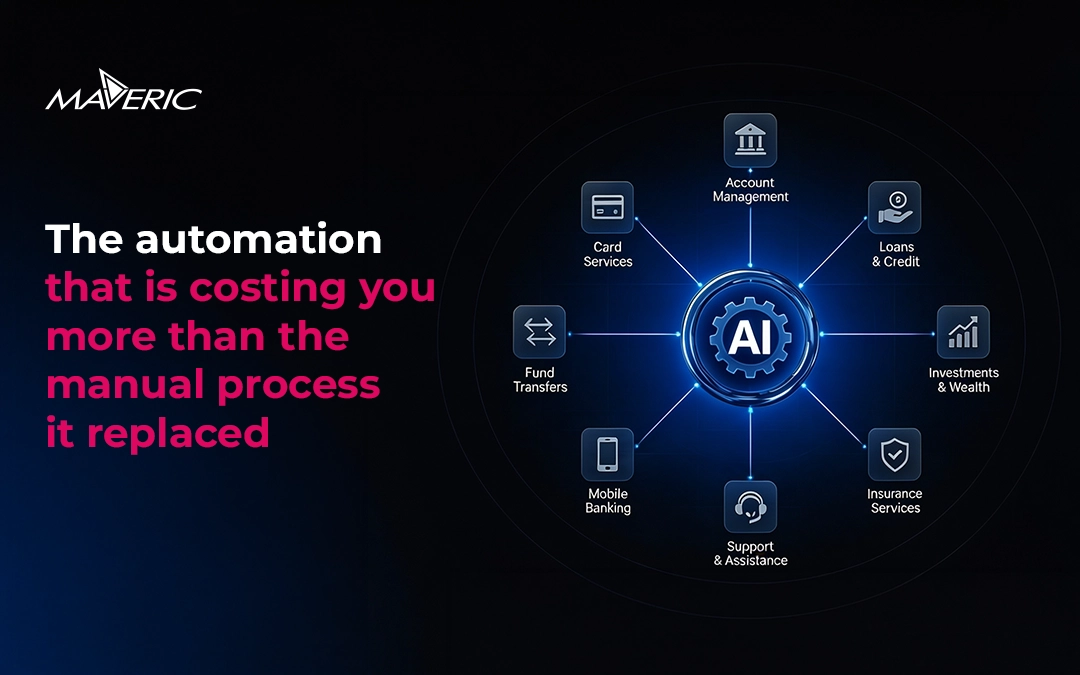
The efficiency case for AI-led automation in banking is compelling and well-documented. Fewer manual steps. Faster decisioning. Lower cost per transaction. The boards that approved these programmes did so on the basis of projections that were, in many cases, accurate – for the automation that was built correctly.
The question that most post-implementation reviews are not asking clearly enough: what happened to the automation that was not built correctly? Not the automation that failed visibly and was corrected. The automation that is currently running, processing decisions at volume, generating outputs that appear complete – but that is either operating on unreliable data, cannot account for its own decisions under regulatory challenge, or is accumulating a lineage gap that will only surface when an examination or audit asks a question no one in the institution can answer.
This is not a theoretical concern. It is the predictable consequence of scaling automation before the governance infrastructure beneath it is adequate to the decisions being made.
The Reclassification Problem – When Automation Moves Cost Rather Than Removes It
The most common version of this problem does not feel like a problem until you look at the numbers carefully. An institution replaces a human alert review function with an AI-driven alert triage system. The volume of alerts processed increases dramatically. The number of human reviewers decreases. The cost-per-alert metric improves.
What the cost-per-alert metric does not capture: the cost of the investigation infrastructure required to process the AI-generated alerts that reach human review. If the AI system is generating alerts at a false positive rate of 95–98% – which industry analysis shows is typical for traditional rules-based systems, and which AI systems without per-entity baseline monitoring can replicate – then the investigation overhead per genuine suspicious transaction is enormous. The cost has not been removed. It has been reclassified as investigation cost rather than alert generation cost. And in many cases the total cost of the AI-generated investigation workload exceeds the cost of the manual review process it replaced.
This is automation that has moved cost from one column of the ledger to another, while appearing in the programme metrics as a reduction.
The Amplification Problem – When Automation Scales the Wrong Thing
The more serious version of the problem is not reclassification but amplification. Automation that processes decisions at volume on unreliable data does not produce unreliable decisions at the same rate as a manual process operating on unreliable data. It produces unreliable decisions faster and at greater scale – because the volume and velocity of automation compounds errors in ways that manual processes cannot.
A lending automation model operating on customer data with a 48-hour latency from the core banking system is making credit decisions on a representation of the customer’s financial position that is two days old. For most applications, this is immaterial. For applications where the customer’s position has changed materially in the previous 48 hours – a large transaction, a missed payment, a change in employment status – the decision may be wrong. At manual processing volumes, this produces a manageable tail of decisions that require correction. At automated processing volumes running hundreds of decisions per hour, the tail can represent thousands of decisions before the data lag is identified as the cause.
The remediation cost in this scenario is not the cost of fixing the automation. It is the cost of identifying which decisions were affected, reviewing them, correcting the ones that were wrong, notifying affected customers, and potentially re-filing regulatory documents. That remediation consistently runs at five to ten times the cost of the data contract governance infrastructure – a defined, monitored, enforced specification of what every upstream feed to the model must meet – that would have prevented the latency problem from reaching production.
THE MULTIPLIER THAT CHANGES THE BUSINESS CASE
Remediation programmes triggered by examination findings in automated operational processes – covering customer remediation, model correction, governance programme construction, and regulatory response – consistently run at five to ten times the cost of the validation and data governance infrastructure that would have made the automation defensible from the start. This multiplier is not theoretical. It is visible in published enforcement action disclosures and regulatory correspondence across major jurisdictions. The automation investment that saved $2M per year in operational cost can require $15-20M in remediation. The business case looks very different when the remediation risk is included.
The Measurement Problem – Why Automation Rate Is the Wrong Metric
Both the reclassification problem and the amplification problem share a root cause: the metric being used to measure automation success does not capture the failure mode.
Automation rate – the proportion of decisions that are AI-driven, the volume of manual effort eliminated, the throughput improvement – measures deployment. It does not measure reliability. An automation rate of 87% tells you that 87% of decisions are being made by AI. It tells you nothing about whether those decisions can be explained, validated, and audited under the regulatory obligations that apply to them.
Defensible automation rate is the metric that matters. It measures the proportion of AI-driven decisions that can be explained specifically (not just ‘here is how the model works in general’ but ‘here is why this specific decision was made for this specific customer’), validated against the data governance standards the model’s accuracy depends on, and audited to the standard an examination or legal challenge would require.
For most operational automation programmes, the defensible automation rate is materially lower than the automation rate. The gap between the two is not a future risk. It is a current liability, accumulating at the speed of deployment.
How to Close the Gap Before It Becomes a Finding
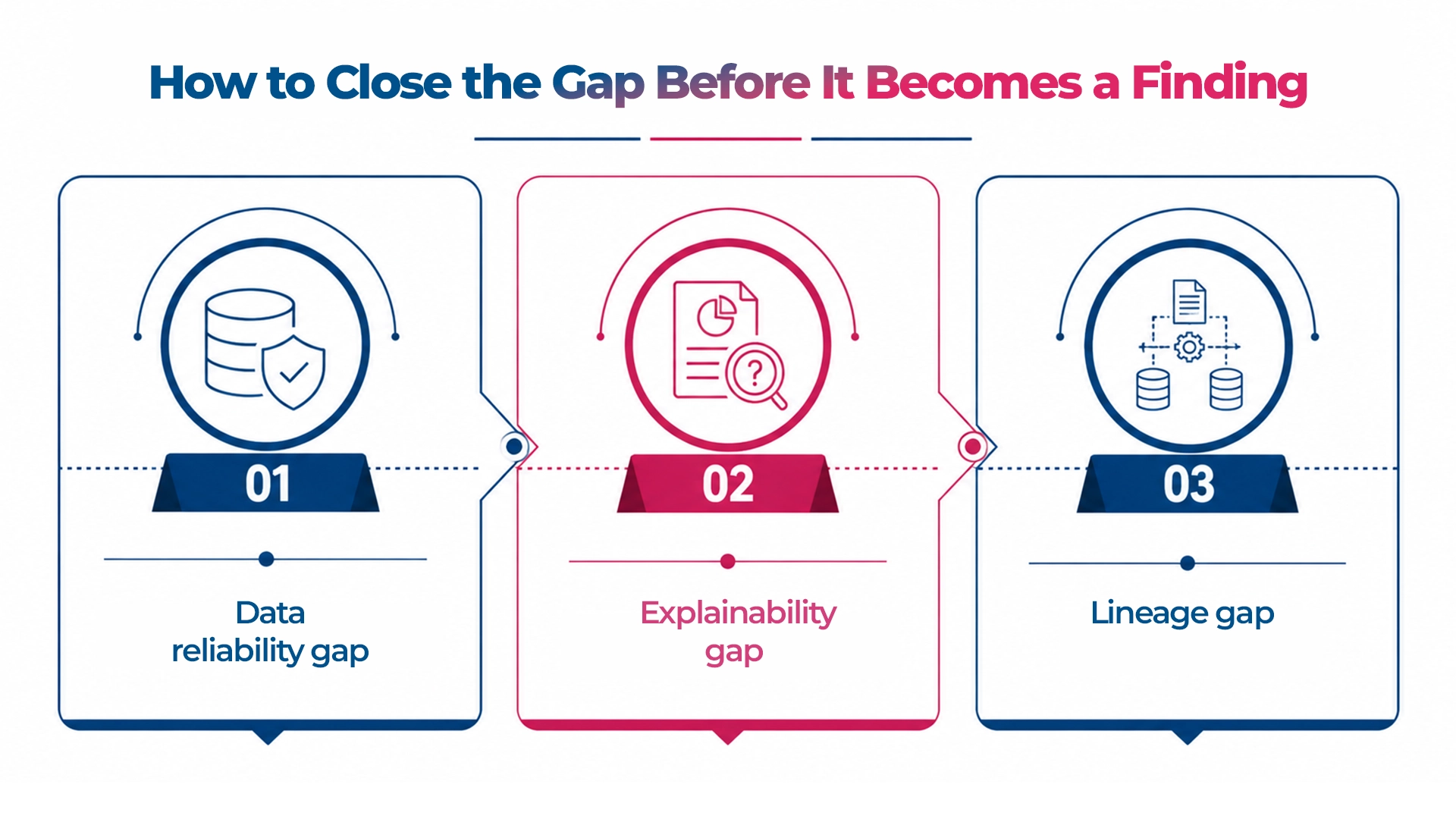
The gap between automation rate and defensible automation rate has three primary components, each with a specific governance response:
- Data reliability gap – Automation producing decisions faster than the data governance infrastructure can guarantee their accuracy. Response: data contract governance for every upstream feed to every production model – a defined, monitored, enforced specification of what each feed must provide, at what freshness, with what completeness standard.
- Explainability gap – Automated decisions that cannot be reconstructed at the individual decision level for regulatory or legal challenge. Response: decision-level explainability infrastructure built at the point of model design, producing a specific account of each decision at the time it is made, preserved in the audit trail for the required retention period.
- Lineage gap – Automated decisions produced by ungoverned tools or processes whose outputs cannot be traced back to a governed data input, a governed model version, and a governed logic record. Response: the automation register – a comprehensive inventory of every AI-driven process in the operational estate, sanctioned and unsanctioned, with the lineage record that makes each output reconstructable.
Each of these responses requires investment. None requires stopping or slowing the automation programme. All require building the governance infrastructure in parallel with the automation – not after the first examination finding reveals its absence.
Automation rate improves every time a new AI process is deployed. Defensible automation rate only improves when the governance infrastructure beneath the automation is adequate to the decisions being made. Only one of those metrics reflects the institution’s actual risk position.
The defensible automation rate framework – including the 90-day action checklist, the data contract governance architecture, the decision-level explainability requirements, and the automation register – is set out in full in CIO Mandate Series Paper 3.
Download: Engineering Trusted Automation in AI-First Banking Operations