

AI adoption is no longer the difficult part of software engineering. The harder question for banking CIOs is whether the additional output is translating into faster, safer delivery. Requirements can be synthesized from large document sets, designs explored rapidly, and code, tests and deployment scripts generated in minutes. Yet the whitepaper’s central warning is that faster activity is not the same as faster institutional flow. AI can amplify strong engineering systems, but it can also amplify fragmented knowledge, tightly coupled architecture and weak controls.
For banks, that distinction matters more than it does in many industries. Software carries credit policy, pricing logic, fraud controls, customer consent and regulatory obligations. An agent can execute an instruction without inheriting the business reasoning that gives the instruction meaning. When requirements, architecture, engineering, quality and operations work from different versions of reality, AI increases the speed at which those differences travel through delivery.
The Context Gap Is Becoming the New SDLC Constraint
The first wave of AI-assisted development concentrated on individual developer productivity. Copilots could draft functions, explain unfamiliar code and create unit tests. The next wave is broader. Specialized agents are beginning to participate across requirements, design, development, quality engineering, release and operations. The SDLC is moving toward human-governed delivery orchestrated by multiple agents.
The problem is assurance. The whitepaper describes an emerging context gap: models provide intelligence and tools provide the ability to act, but neither automatically gives an agent a reliable understanding of the enterprise in which it is acting. Business intent may live in a product document, an exception in an operations manual, a regulatory obligation in a policy repository and an architectural constraint in a decision record. Unless those elements reach the agent together, the output can be technically plausible and institutionally wrong.
Faster Stages Can Still Produce a Slower Bank
This is why measuring AI success at the task level can be misleading. A developer may generate code in minutes, but the feature does not reach production faster if testing, security approval or deployment remains constrained. Optimizing one stage can simply move the queue downstream. The same problem appears earlier in the lifecycle. A requirements agent can produce a polished user story without understanding the intent behind it. A design agent can produce a plausible architecture that violates an approved banking constraint. A test agent can generate comprehensive tests against an incomplete requirement and create false assurance.
For CIOs, the unit of productivity therefore has to move from artefact generation to end-to-end flow. The question is not how much code an agent produced, but whether an idea moved into production with less rework, stronger traceability and acceptable stability. That requires the context behind each decision to survive every hand-off.
Context Engineering Makes Enterprise Knowledge Usable by AI
Context engineering is the discipline of creating that continuity. The whitepaper defines it as a governed continuum of intent, knowledge, constraints, evidence and memory from demand to production. It is not a larger prompt and it is not another document repository. Its purpose is to assemble the smallest set of current, authorized and high-signal information an agent needs for the task at hand, while preserving source, version, ownership and provenance.
That distinction is important for banks. A requirements agent does not need exactly the same context as a release agent. Product intent, domain rules and customer needs may dominate the first task; operational telemetry, security controls and rollback procedures dominate the second. Loading everything creates noise. Loading too little creates ambiguity. Context engineering makes that selection deliberate and governable.
The CIO Decision Is Shifting From More Models to Better Context
For Tier 2 and Tier 3 banks, the issue is particularly acute because critical context often crosses organizational boundaries. Core platforms, fintech partners and managed services may hold data models, APIs or operating knowledge that the bank does not fully control. An AI agent working inside the bank can still be incomplete if the context contract stops at the bank’s boundary.
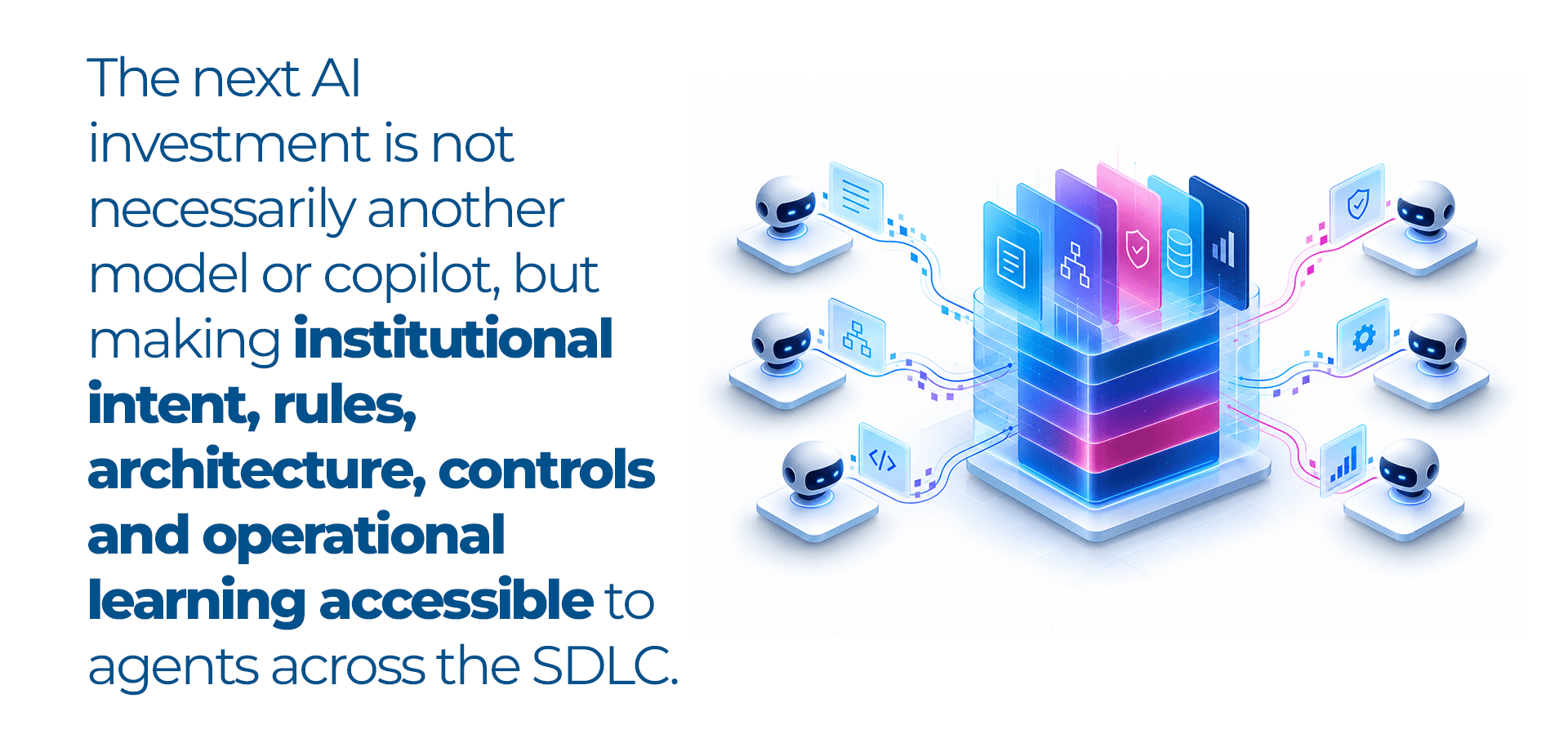
The next AI investment decision is therefore not necessarily another model or another copilot. It is whether the institution can make its intent, rules, architecture, controls and operational learning visible to the agents already entering the SDLC. AI will continue to make individual activities faster. Context engineering determines whether
Go Deeper: Engineer the Context Continuum
Maveric’s whitepaper, The Context Continuum: Engineering Trust Across the AI-Powered SDLC, examines how banks can close the context gap across requirements, design, development, quality and production. It sets out the banking context stack, the mechanisms through which context is lost, context contracts for verifiable hand-offs, and an operating model for scaling AI-assisted delivery without separating speed from control.
Download the whitepaper to explore how context engineering can become the control plane for AI-powered banking delivery.
FAQ
1. What is the context gap in an AI-powered SDLC?
The context gap is the difference between an AI agent being able to execute a task and having the business intent, domain rules, architecture, controls and operational knowledge required to execute it correctly for the bank.
2. What is context engineering in software development?
Context engineering is the governed assembly and maintenance of the intent, knowledge, constraints, evidence and memory an AI system needs at the point it reasons or acts.
3. Why is context engineering important for banks?
Banking software encodes regulated business rules and customer-impacting decisions. Context engineering helps AI-driven delivery preserve explainability, control, provenance and trust as work moves across the SDLC.