

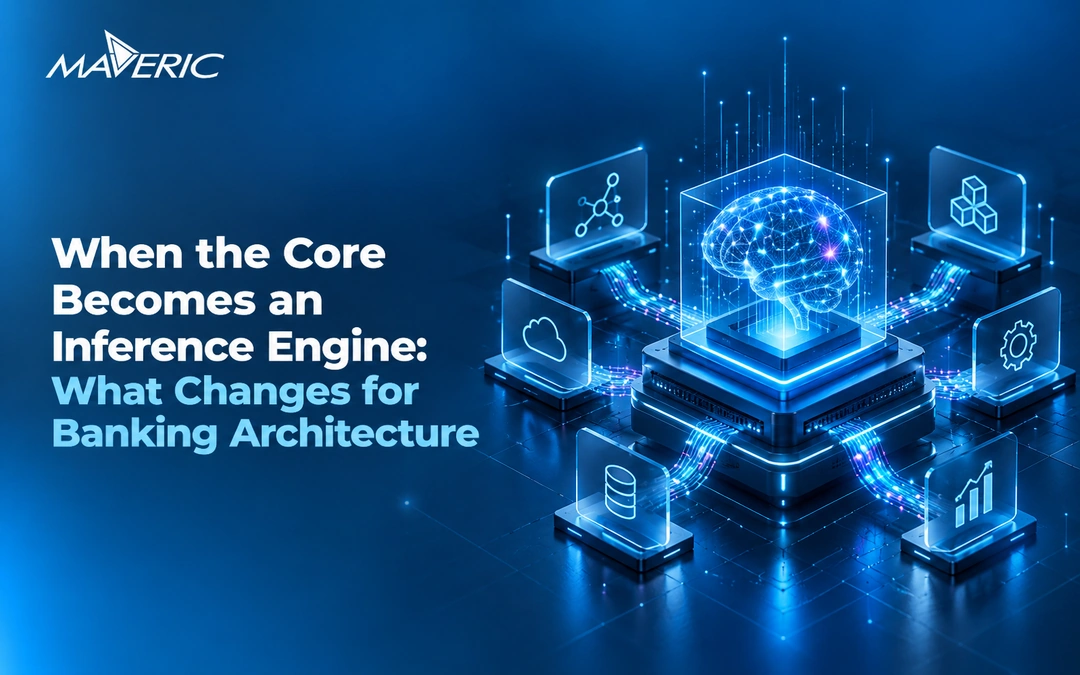
AI-enabled core banking is not simply a faster core with models attached. It introduces an inference layer that assembles context for a customer, transaction, or decision at run time. This shifts architecture, data governance, testing, and accountability from predefined service behavior toward dynamic but controlled intelligence.
What is an AI-enabled core banking system?
An AI-enabled core combines reliable systems of record with an intelligence layer that can retrieve relevant data, interpret context, validate evidence, and support or orchestrate decisions. Its outputs vary by situation, so governance must cover the context, prompts, models, tools, and workflows that produce each outcome.
The modernization debate is still too focused on processing speed
Core modernization is often framed as a move from monoliths to modular platforms, from batch to real time, and from on-premises infrastructure to cloud. Those shifts matter. They improve resilience, change velocity, and product flexibility. Yet they do not by themselves create an AI-ready bank.
The deeper change is from predefined constructs to context-specific intelligence. A traditional service answers a question it was explicitly built to answer. An inference layer can assemble an answer for a specific customer or transaction from multiple sources. That capability changes where decision logic lives and how it must be controlled.
From service calls to contextual inference
Consider a commercial loan approaching a bullet repayment. A conventional core can return the amount, due date, account status, and transaction history. A relationship manager still needs to interpret cash-flow patterns, covenant information, customer communications, collateral, and policy before deciding whether to intervene.
An inference layer can retrieve those inputs, identify material signals, and produce a contextual view for action. The output is not simply another field in the core. It is a decision artifact assembled at run time. The same pattern applies to payment exceptions, disputes, collections, servicing, and financial crime investigations.
Structured and unstructured data become one decision surface
Banking architecture has long privileged structured records. However, material context often sits in payment narratives, case notes, agreements, statements, emails, and policy documents. AI can make that content usable, but only if retrieval respects authorization, provenance, freshness, and purpose.
The architectural requirement is not to move everything into one repository. It is to create governed access across relevant sources and preserve the link between an output and the evidence that informed it. For regional banks, this can unlock value from existing estates while avoiding a multiyear data-consolidation dependency.
Inference introduces variability that testing must address
A predefined API can be tested against expected inputs and outputs. AI outputs may vary while remaining acceptable, or appear plausible while violating policy. Validation must therefore evaluate meaning, evidence, and risk, not only syntax.
Banks need test sets based on real business scenarios, including edge cases across products and customer segments. They need thresholds for factual grounding, policy adherence, fairness, and escalation. They also need regression testing when models, prompts, knowledge sources, or tools change. This is quality engineering for decision behavior.
The system of record and system of intelligence need separate duties
The core should remain authoritative for balances, positions, product terms, and posted transactions. The intelligence layer should interpret and recommend within explicit authority. This separation allows the bank to evolve AI capabilities without weakening ledger integrity.
Clear contracts are essential: which source is authoritative, which decisions are deterministic, which outputs are advisory, when human approval is mandatory, and what evidence must be retained. A well-designed boundary enables innovation while preserving control.
A progressive path for regional banks
Begin with a decision that currently requires employees to assemble information across systems. Create a governed context specification defining the sources, permissions, freshness, and business rules. Introduce AI first as decision support, capture exceptions and feedback, and automate only when evidence supports the next level of authority.
This approach ties modernization to business value. API, event, data, and workflow investments are made because a priority decision requires them. The bank builds an intelligence architecture alongside the core rather than waiting for a complete replacement.
What this means for banking leaders
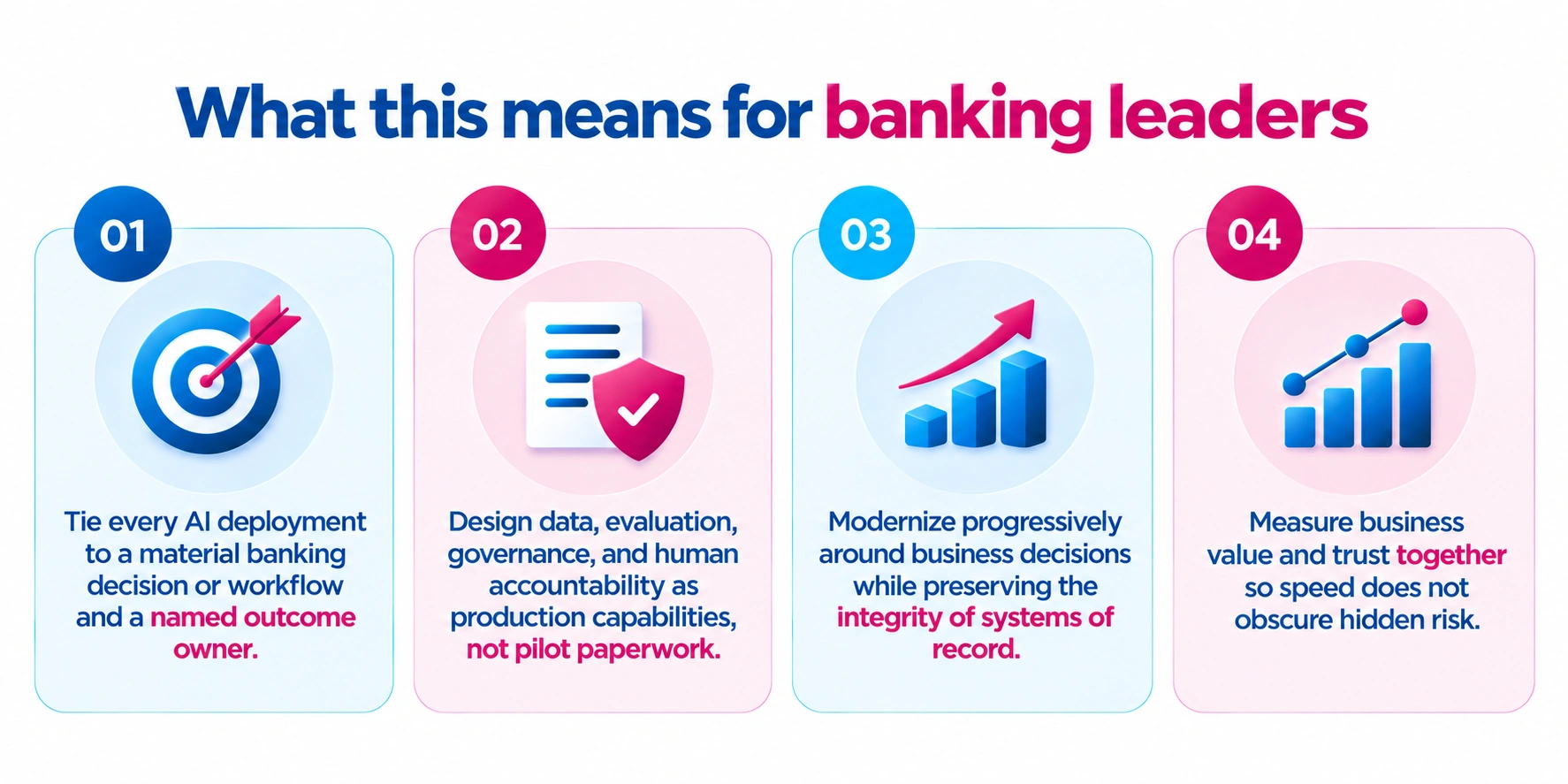
- Tie every AI deployment to a material banking decision or workflow and a named outcome owner.
- Design data, evaluation, governance, and human accountability as production capabilities, not pilot paperwork.
- Modernize progressively around business decisions while preserving the integrity of systems of record.
- Measure business value and trust together so speed does not obscure hidden risk.
Conclusion
The AI-ready core is not defined by a model embedded in a transaction system. It is defined by the bank’s ability to assemble context, generate a useful decision artifact, validate it, and preserve accountability. CIOs who treat inference as a new architectural layer can modernize deliberately while creating capabilities that change how the bank operates.
Explore the full executive perspective
The CIO’s Guide to AI-Enabled Core Banking Modernisation develops the architecture, operating implications, and leadership priorities behind this shift.
FAQ
1. Is an AI-enabled core the same as a cloud core?
No. Cloud can improve scalability and change velocity, while AI enablement requires governed contextual inference, evaluation, lineage, and decision controls.
2. What is contextual inference in banking?
It is the run-time assembly and interpretation of relevant customer, transaction, document, policy, and risk context for a specific decision.
3. Can legacy cores support AI?
Yes, when stable interfaces, governed data access, and an external intelligence layer protect the system of record while enabling new decisions.
4. How should AI-generated core decisions be tested?
Use business-scenario test sets, evidence-grounding checks, policy and fairness tests, thresholds, escalation tests, and regression evaluation across changes.
5. What remains deterministic in an AI-first core?
Ledger integrity, product constraints, regulatory rules, authority limits, and other non-negotiable controls should remain deterministic where appropriate.