


Only 28% of bank and credit card app customers use virtual assistants. Satisfaction with them drops sharply at the moments customers need help most: fraud, disputes and problems.
That finding comes from J.D. Power’s 2026 digital banking studies, based on more than 18,000 customers. Users of virtual assistants are more satisfied overall, by 18 points on a 1,000-point scale, which suggests assistants work well for simple tasks. The study’s conclusion on complex ones was less flattering. Assistants “consistently fall short in resolving complex customer service and fraud-related issues,” said J.D. Power’s Jennifer White, “where limited escalation options often trap customers in frustrating self-service loops that erode trust.”
For AI in banking customer service, that is the central problem. Balance checks and card controls are easy to automate and matter little to the relationship. A frozen card abroad, a disputed charge or a suspected fraud are hard, emotional and decisive, and they are where customers decide whether to trust the bank.
The Resolution Gap at Regional Banks
The stakes are higher for regional banks than the headline suggests. J.D. Power’s 2026 U.S. Retail Banking Satisfaction Study found that satisfaction with problem resolution rose 49 points at national banks, to 587, while it fell 27 points at midsize banks, to 548. In the same study, 20% of customers had moved money away from their primary bank in the past three months.
Problem resolution has long been a place where regional banks could compete on relationship and local knowledge. If the largest banks are now resolving problems better, partly through heavier investment in service technology, that advantage narrows. A regional bank cannot match their spending line for line. It can choose to invest where the gap is widest: the hard cases.
Why First-Generation Chatbots Failed
The first wave of banking chatbots was built as decision trees. The bot recognized a set of intents and followed a scripted path for each. When a question fell outside those paths, it either looped or handed the customer to a person with little or no context, and the customer explained the problem again.
Regulators noticed. The CFPB’s 2023 issue spotlight on chatbots in consumer finance3 estimated that about 37% of the US population had interacted with a bank’s chatbot in 2022. It warned that poorly deployed chatbots could fail to recognize when a consumer was invoking their federal rights, leave customers in “repetitive loops of unhelpful jargon,” and block access to a person. Its guidance was direct: institutions “should avoid using chatbots as their primary customer service delivery channel when it is reasonably clear that the chatbot is unable to meet customer needs.”
Generative AI has made assistants far more fluent. It has not, on its own, fixed the structure underneath. An assistant that writes better sentences but cannot see the customer’s case history, cannot act across systems and cannot hand over cleanly will still fail at the same moments.
What Multimodal Servicing Changes
From Digital-First to AI-First draws a distinction between multiple channels and multimodal intelligence. Digital banking gave customers separate channels: chat, phone, email, branch. Multimodal servicing gives the bank one layer of intelligence that can process and move between text, voice, image and video within a single interaction.
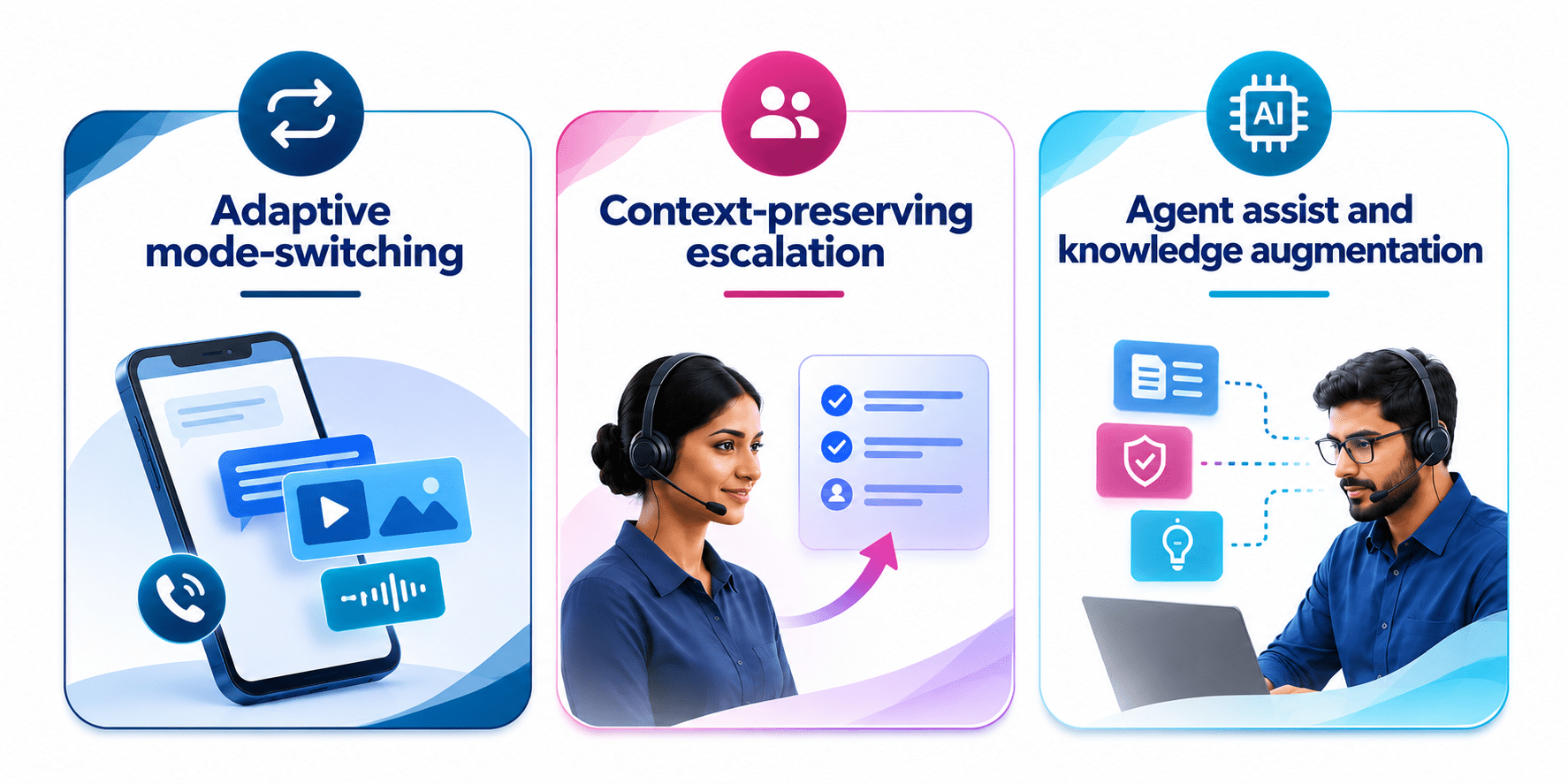
Three capabilities make the difference in practice.
Adaptive mode-switching. When a customer is struggling with written instructions, the system notices the confusion and changes approach, for example by generating a short visual walkthrough or offering a call, instead of repeating the same text.
Context-preserving escalation. When a person needs to take over, they receive the full conversation, the customer’s sentiment, what has already been tried and a suggested resolution. The customer does not start again.
Agent assist and knowledge augmentation. Human agents work with an AI layer that surfaces the relevant policy, account history and next-best action during the conversation. This is often where the fastest gains sit, because it improves the hard cases that already reach people.
A fourth capability, proactive service, changes the starting point. Monitoring for failed payments, unusual declines or service disruptions lets the bank contact the customer before they contact the bank, which removes the problem from the queue altogether.
Design for the Hard Cases First
Most AI service programs start with the easiest intents because they are quick to automate and produce impressive containment figures. The evidence points the other way for the investment that matters. Banks that want to protect relationships should design escalation for fraud, disputes and complaints first, and automate the simple intents around that design.
In practice, that means three rules. Any conversation that touches fraud, a dispute, a vulnerable customer or a complaint gets a clear and immediate route to a person. The assistant hands over with full context, every time. And the customer is never asked to repeat information they gave the assistant.
These rules also address the regulatory concern. A customer invoking dispute rights, for example, needs to be recognized and routed correctly, whatever words they use. An assistant designed to escalate early on these topics is easier to defend than one designed to contain them.
Branches Still Carry the Hardest Conversations
Digital service has not replaced the branch for difficult problems. The Accenture Banking Consumer Study 2025, covering 49,300 customers in 39 countries, found that chatbots had the lowest satisfaction of any service channel and that 64% of customers still rely on branches to resolve conflicts they cannot settle online.
For a regional bank with a branch network, that is an advantage worth connecting to the rest of the service model. When a branch colleague can see the chat transcript and the call notes, the customer who walks in after two failed digital attempts is treated as a continuing case.
Measure Resolution Across the Whole Journey
Containment, the share of contacts an assistant handles without a person, is the most common measure for AI in customer service. It is also misleading. A customer who gives up on the assistant, waits on the phone and explains the problem again counts as contained in one report and as a call in another, and nobody counts them as a failure.
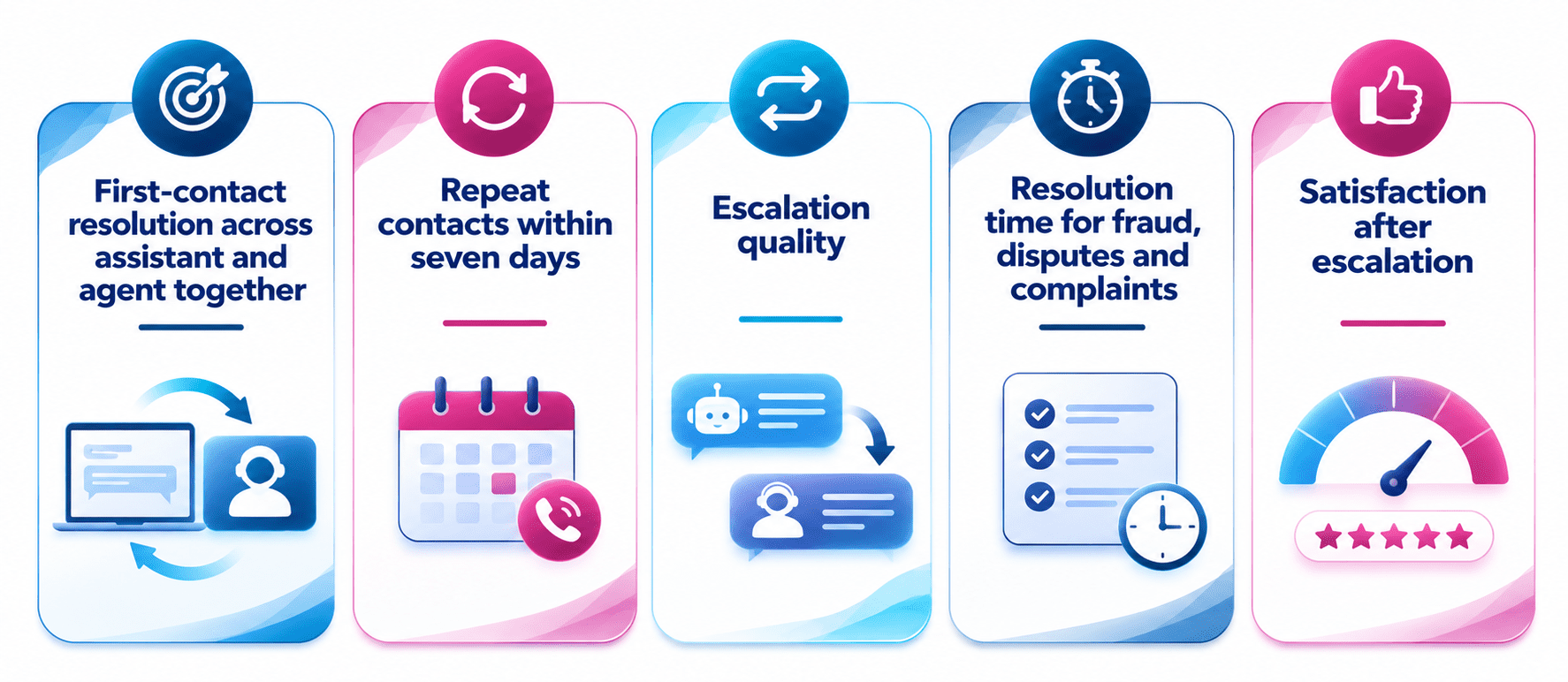
- A better measurement set for a banking contact center follows the customer across channels:
- First-contact resolution across assistant and agent together, measured from the customer’s first attempt.
- Repeat contacts within seven days on the same issue, in any channel.
- Escalation quality: the share of handovers where the agent did not need to ask the customer to repeat information.
- Resolution time for fraud, disputes and complaints specifically, reported separately from simple requests.
- Satisfaction after escalation, which shows whether the handover helped or hurt.
The whitepaper treats first-contact resolution as a core measure of servicing quality. It is also the measure that aligns digital and contact center teams, because neither can improve it alone.
Who Owns Resolution
At many regional banks, the assistant belongs to the digital team and the contact center belongs to operations. Each is measured on its own figure: containment for one, handling time for the other. The customer who falls between them belongs to neither.
Naming one owner for end-to-end resolution, across assistant, agents and branches, changes the incentives. Containment stops being a goal in itself, and escalation becomes a designed part of the experience.
Score Your Servicing Readiness
Multimodal customer servicing carries 18% of the weight in the CX Readiness Assessment from Maveric Systems. Its six capabilities, from adaptive mode-switching to proactive service, show whether your service model resolves problems or only routes them. The customer experience in banking guide shows how servicing connects to onboarding, personalization and trust.
When a customer’s card was frozen for suspected fraud last month and they started in your app, how many times did they have to explain the problem before it was fixed?
AI in Banking Customer Service Key Questions
How is AI used in banking customer service?
Banks use AI for virtual assistants in apps and websites, agent assist tools that support contact center staff, call and chat summarization, sentiment analysis, routing and proactive alerts. The most effective programs combine automated handling of simple requests with fast, context-rich escalation for complex ones.
Why do bank chatbots struggle with complex issues?
Many were built as scripted decision trees that fail outside their programmed paths, and even newer AI assistants often lack access to case history or clear escalation routes. J.D. Power’s 2026 digital studies found satisfaction with virtual assistants drops sharply for fraud, disputes and problem resolution.
What is multimodal customer service in banking?
Multimodal customer service uses one layer of intelligence that can work across text, voice, image and video within a single interaction, switch modes when a customer is struggling, and transfer full context to a human agent. It differs from multichannel service, which offers separate channels that do not share context.
What should banks measure instead of chatbot containment?
Measure first-contact resolution across assistants and agents together, repeat contacts on the same issue, escalation quality, resolution time for fraud and disputes, and satisfaction after escalation. These follow the customer’s experience rather than the performance of one channel.
Sources
- J.D. Power, 2026 U.S. Banking Mobile App, Online Banking, Credit Card Mobile App and Online Credit Card Satisfaction Studies, press release, 28 May 2026.
- J.D. Power, 2026 U.S. Retail Banking Satisfaction Study, press release, 26 March 2026.
- Consumer Financial Protection Bureau, “CFPB Issue Spotlight Analyzes ‘Artificial Intelligence’ Chatbots in Banking”, 6 June 2023.
- Accenture, Banking Consumer Study 2025, “Where Is the Love? How Advocacy Drives Loyalty and Organic Growth in Banking”.