When your payment-repair agent releases a held transaction, could you show which version of which procedure it applied, and who owns that procedure?
AI agents need more than access to banking documents. They need a living, governed model of how the bank works.
IN BRIEF
- An enterprise knowledge fabric is a governed, living digital twin of the bank’s domain.
- Search and RAG find relevant content; the fabric adds the relationships, authority and controls that show what applies.
- Four capabilities make it work: ontology and knowledge graph, versioned institutional memory, semantic retrieval and a shared context API.
- Start with one bounded decision, such as payment exceptions, and measure context quality ahead of graph size.
Document access stops short of understanding
Banks hold extensive institutional knowledge across product configurations, policies, operating procedures, application code, architectural decisions, test cases and incident records. Yet that knowledge remains fragmented across systems, documents and employees. For the CIO or Chief Data Officer of a US regional bank, much of it sits in legacy cores and in the heads of long-tenured teams.
A customer may be represented differently across platforms. A procedure may describe the approved process while an incident reveals an operational exception. A control may appear in a policy, while its implementation sits in application logic.
Giving an agent access to these sources does not establish which information is authoritative, current or applicable. Nor does it explain how products, processes, systems and controls relate. For agentic banking, that gap separates retrieving information from understanding the context required to act.
The gap is becoming urgent because agents are moving toward production. KPMG’s Q2 2026 AI Quarterly Pulse Survey found that over half of the organizations across the banking industry are adopting AI agents in some capacity, and that scaling remains constrained by foundational challenges, including data readiness, access limitations and the inherent complexity of agentic systems.
Why agents need connected context
An agentic system can interpret goals, plan steps, query systems, call tools and initiate actions. Its context must therefore support decisions as well as answers.
Consider a payment-repair agent investigating a held transaction. It needs to connect the payment with the customer, account, legal entity, applicable policy, exception reason, required controls and approval threshold. It must distinguish the authoritative system from derived copies and identify the procedure version effective at the relevant time.
Independent search results cannot assemble those relationships on their own. Retrieving the right procedure is insufficient if the agent applies it to the wrong product, jurisdiction or customer. Reliable action depends on assembling the right institutional context before execution.
Beyond document search
Retrieval-augmented generation, or RAG, helps models use enterprise information rather than relying solely on pretrained knowledge. Semantic search can find relevant material even when a query uses different terminology from the source.
However, similarity does not establish applicability. A relevant passage may describe an outdated policy. A document mentioning a control does not necessarily explain which processes it governs or which systems implement it.
A knowledge fabric complements semantic retrieval with explicit relationships, structured metadata and shared definitions. Search locates relevant content, and the fabric then connects it to its meaning, dependencies and decision context.
What is an enterprise knowledge fabric? A living digital twin of the banking domain
An enterprise knowledge fabric is a governed, evolving representation of the bank’s institutional knowledge: a living digital twin of its domain.
It connects business concepts, operational processes, technology assets, data, controls and evidence. Its value comes from making these connections machine-interpretable and available to people and agents.
For banks, this also makes decades of architectural choices, regulatory context and domain expertise usable in daily work. The aim is to activate historical material as well as preserve it, linking past decisions to present requirements so that relevant lessons stay accessible as teams, systems and responsibilities change.
Four capabilities make this possible
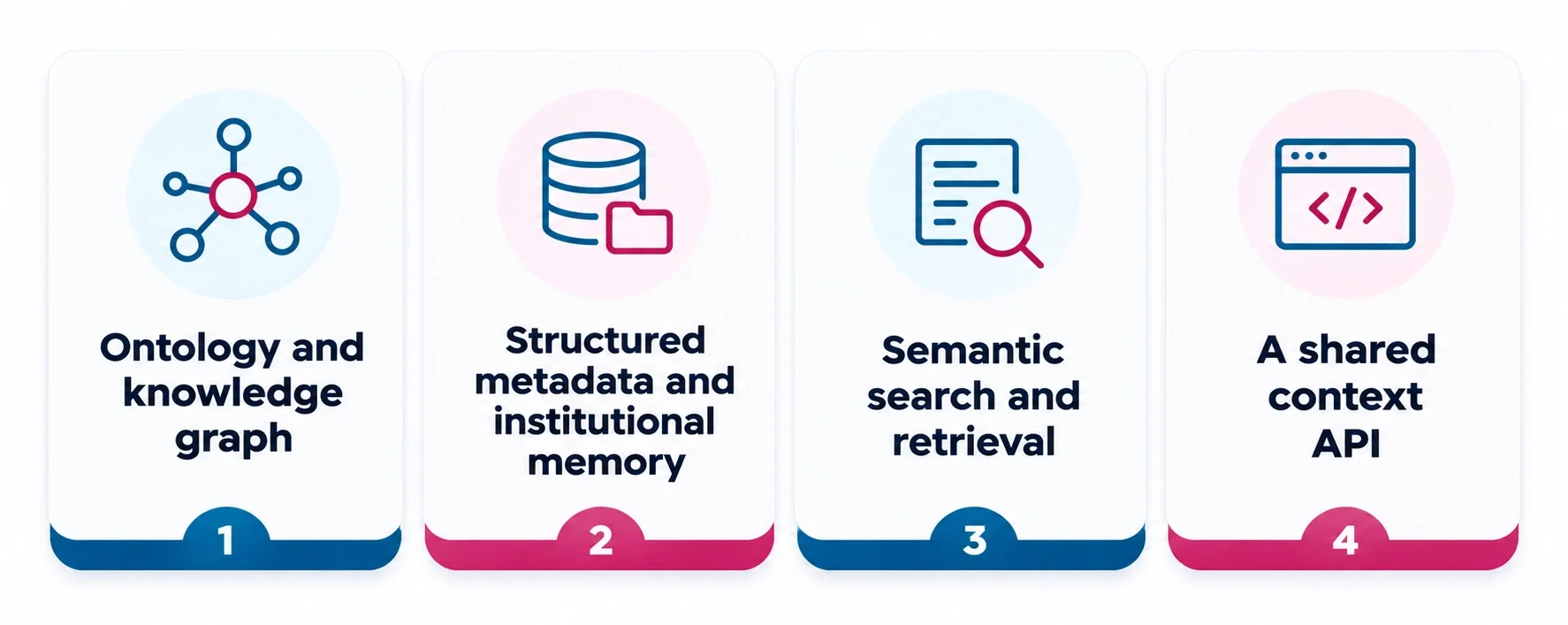
1. Ontology and knowledge graph
The ontology defines concepts, relationship types and constraints. The knowledge graph connects actual entities, artifacts and decisions using that shared language.
Requirements can link to code, code to incidents, and incidents to rules. Multi-hop traversal follows these connections across several steps, allowing an agent to investigate dependencies rather than retrieve isolated references.
For banking, the same principle connects obligations, policies, controls, processes, applications and tests. The graph makes institutional relationships explicit, so an agent can answer what else a change touches.
2. Structured metadata and institutional memory
The fabric also needs versioned records of decisions, artifacts and delivery events. These records should be queryable, attributable and auditable.
An architectural decision should retain its rationale and history along with its latest description. An incident should remain connected to the affected code and relevant rules. This preserves knowledge beyond individual employees, makes earlier decisions available when similar questions arise.
3. Semantic search and retrieval
Vector embeddings help retrieve relevant decisions and supporting material even when terminology differs. Combined with graph relationships, semantic retrieval supports context that is both relevant in language and connected to the task.
RAG then supplies that context to agents. Graph traversal and vector retrieval serve complementary purposes, and agents need both.
4. A shared context API
An always-available context API makes the same evolving knowledge accessible across agents, workflow stages and human tasks.
Instead of repeatedly gathering background from scattered sources, each participant draws from a shared fabric. This provides continuity between requirements, design, development, testing and operational work, while reducing repeated context assembly.
Context must carry authority and control
Connected knowledge alone is not enough. Agents also need to understand whether information can support the decision at hand, which makes data governance in banking a precondition for agentic action. In EY-Parthenon’s 2025 survey of 100 retail and commercial banks, 79% of respondents cited the need for enhanced data governance.
Material knowledge should carry its source, owner, effective dates, approval status and access restrictions. The fabric should distinguish confirmed relationships from inferred or disputed ones and preserve the evidence behind important decisions.
For the payment-repair agent, context should include applicable controls, permitted actions, approval requirements and evidence obligations. Knowing what a transaction means must remain connected to knowing what the agent may do.
Versioned metadata supports reconstruction: which facts were available, which policy applied and which decision followed. This turns institutional memory into a basis for accountability and for trusted AI in banking.
Making change impact visible
A knowledge fabric also helps banks understand the consequences of change.
Suppose a cross-border payment rule changes. The affected estate may include procedures, services, interfaces, screening controls, data fields, reports and test cases. Document search can identify references to the rule, but references alone do not reveal dependency. A KYC rule change raises the same problem across onboarding journeys, screening thresholds and regulatory reporting fields.
Graph traversal can follow the rule through policies, controls, process steps, application services and tests. Links between requirements, code and incidents add delivery history to that assessment.
The distinction matters because search finds what mentions a change, while a bank assessing impact needs to know what depends on it. Agents can use those dependency paths to propose impact assessments supported by evidence.
Keeping the fabric alive
A digital twin loses value when it stops reflecting the domain. Policies change, applications evolve, incidents expose missing relationships and architectural decisions supersede earlier choices.
The fabric therefore needs continuing updates from enterprise sources, versioned mappings, clear ownership and validation of consequential relationships. Delivery events and operational outcomes should enrich its institutional memory.
That is the real trade-off: a fabric is a standing operating cost with named owners, and one that nobody maintains becomes the next stale repository. Regulators know how long this discipline takes. The Basel Committee’s November 2023 progress report on 31 global systemically important banks found that, nearly ten years after the BCBS 239 risk data principles were published, “additional work is required at all banks to attain or sustain full compliance.” The live open question for most banks is who owns a definition when business lines describe the same customer differently.
The fabric must also distinguish durable knowledge from live operational state. It may identify the authoritative source for account status, while the current value still comes from that source at decision time.
The objective is sufficiently current, connected and controlled knowledge for defined decisions.
Start with one decision and expand from there
Begin with a bounded workflow where fragmented context creates visible friction, such as payment exceptions or technology change assessment.
Define the minimum entities and relationships the agent needs. Establish authoritative sources, ownership, refresh requirements and decision boundaries before expanding coverage.
Measure context quality ahead of graph size: authoritative-source coverage, stale information, unresolved conflicts, human overrides and reconstructable decisions. Reuse established concepts across adjacent workflows so knowledge accumulates from one workflow to the next. Waiting has its own cost: each agent team assembles its own context, and the bank rebuilds fragmentation one agent at a time.
For AI in banking, the strategic shift is from information access to institutional understanding. A knowledge fabric gives agents a connected account of what the bank knows, how that knowledge evolved and how it applies to the task. The defining question is whether the agent has enough trusted context to act, and whether the bank can explain the decision.
Take one held payment your team released last week. Could you show which procedure version applied, which system was authoritative for each fact the agent used, and who owns each of those definitions?
Enterprise Knowledge Fabric for Agentic Banking: Key Questions Answered
1. What is an enterprise knowledge fabric in banking?
An enterprise knowledge fabric is a governed, evolving representation of a bank’s institutional knowledge: a living digital twin of its domain. It connects business concepts, operational processes, technology assets, data, controls and evidence, and makes those connections machine-interpretable for people and AI agents.
2. Why is document search or RAG not enough for AI agents in banking?
Retrieval-augmented generation and semantic search find relevant material, but similarity does not establish applicability. A relevant passage may describe an outdated policy, and a document that mentions a control may not explain which processes it governs. A knowledge fabric adds explicit relationships, structured metadata and shared definitions so agents can tell what applies to the task.
3. What are the core capabilities of an enterprise knowledge fabric?
Four capabilities: an ontology and knowledge graph that make institutional relationships explicit; structured metadata and versioned institutional memory; semantic search and retrieval using vector embeddings; and a shared context API that gives agents, workflow stages and human tasks access to the same evolving knowledge.
4. How does a knowledge fabric help banks assess change impact?
When a rule changes, document search finds what mentions it. Graph traversal follows the rule through policies, controls, process steps, application services and tests, so the bank can identify what depends on the change. Agents can use those paths to propose impact assessments supported by evidence.
5. Where should a bank start building a knowledge fabric?
Start with one bounded workflow where fragmented context creates visible friction, such as payment exceptions or technology change assessment. Define the minimum entities and relationships the agent needs, establish authoritative sources, ownership, refresh requirements and decision boundaries, and measure context quality ahead of graph size.
About the Author
 Anoop Karumathil Melethil has two decades of experience in conceptualizing, creating, and driving technology-focused marketing initiatives across tier 1 as well as mid-size global IT services organizations. He has built his expertise in building marketing functions from the ground up, encompassing areas including but not limited to media, public relations, influencer marketing, digital marketing, employer branding, thought leadership, brand outreach, field marketing, ABM, and internal communication.
Sources
1. KPMG, Q2 2026 AI Quarterly Pulse Survey: Banking (June 2026).
2. EY-Parthenon, AI in banking: GenAI survey insights (September 19, 2025; 100 retail and commercial banks).
3. Basel Committee on Banking Supervision, Progress in adopting the Principles for effective risk data aggregation and risk reporting (November 28, 2023).
4. BIS media release on the BCBS 239 progress report (November 28, 2023).