

Enterprise data quality controls tell a bank whether a dataset meets general standards. AI decisions need a more granular answer: whether the specific evidence retrieved for this customer, transaction, question, and moment is fit for this purpose. Query-level validation is the control layer that makes contextual intelligence dependable.
What is query-level validation in banking AI?
Query-level validation evaluates the data and evidence used for a specific AI request at the moment of decision. It checks relevance, authority, freshness, completeness, permission, consistency, and policy constraints before the output is accepted, automated, or escalated.
Why enterprise data quality is necessary but insufficient
anks have invested in data catalogs, quality rules, lineage, master data, and reconciliations. These controls remain essential. Yet a dataset can pass an enterprise threshold and still be unsuitable for a particular AI decision.
A customer address may be valid but stale for a fraud investigation. A policy document may be accurate but superseded in one state. A transaction narrative may be available but restricted for the employee or agent making the request. AI retrieves and combines information dynamically, so fitness must be evaluated at the same level.
The query becomes the new control boundary
In a conventional reporting model, controls are applied to a predefined dataset and report. In an AI-first core, the system may select different passages, records, and tools for each request. The query and its context specification determine what evidence enters the decision.
Validation must ask: Is the source authoritative for this question? Is it current enough? Does the user or agent have permission? Are required fields and perspectives present? Do sources conflict? Does policy allow the proposed action? The answer can vary from one query to the next even when the underlying sources are unchanged.
Validation should produce an action, not only a score
A confidence score is useful only when it changes behavior. High-confidence, low-risk cases may proceed. Incomplete context may trigger additional retrieval. Conflicting evidence may route the case to a specialist. A material policy exception may stop automation entirely.
This requires validation to be integrated with workflow orchestration. The bank needs explicit thresholds, reason codes, and escalation paths. Employees reviewing an exception should see what failed and what evidence is missing, rather than receiving a generic low-confidence warning.
Design validation around banking consequences
The cost of an error differs by use case. An imprecise knowledge-search response is not equivalent to an incorrect adverse action, sanctions decision, payment release, or regulatory submission. Validation intensity should match the consequence.
For lending, checks may cover policy version, customer identity, source completeness, prohibited attributes, and reason-code consistency. For payments, they may cover message format, beneficiary data, sanctions context, anomaly signals, and authorization. For servicing, they may focus on customer consent, product eligibility, disclosure accuracy, and safe escalation.
What CIOs should require from the architecture
First, context specifications should be versioned and owned like software artifacts. Second, source-level and passage-level lineage should be retained where feasible. Third, validation results should travel with the output into downstream workflows. Fourth, monitoring should identify changes in retrieval quality, exception rates, and business outcomes. Fifth, material changes should trigger regression evaluation before release.
These controls make it possible to answer not only what the AI produced, but why the bank considered that output fit for use at the time.
Why this is a practical modernization priority
Query-level validation can be introduced around high-value decisions without redesigning the entire estate. It creates a reusable boundary between legacy data and new intelligence. It also reveals where source quality, ownership, or permissions must improve.
For regional banks, that is valuable discipline. Modernization funding can be directed toward weaknesses that affect real decisions, rather than broad programs disconnected from business outcomes.
What this means for banking leaders
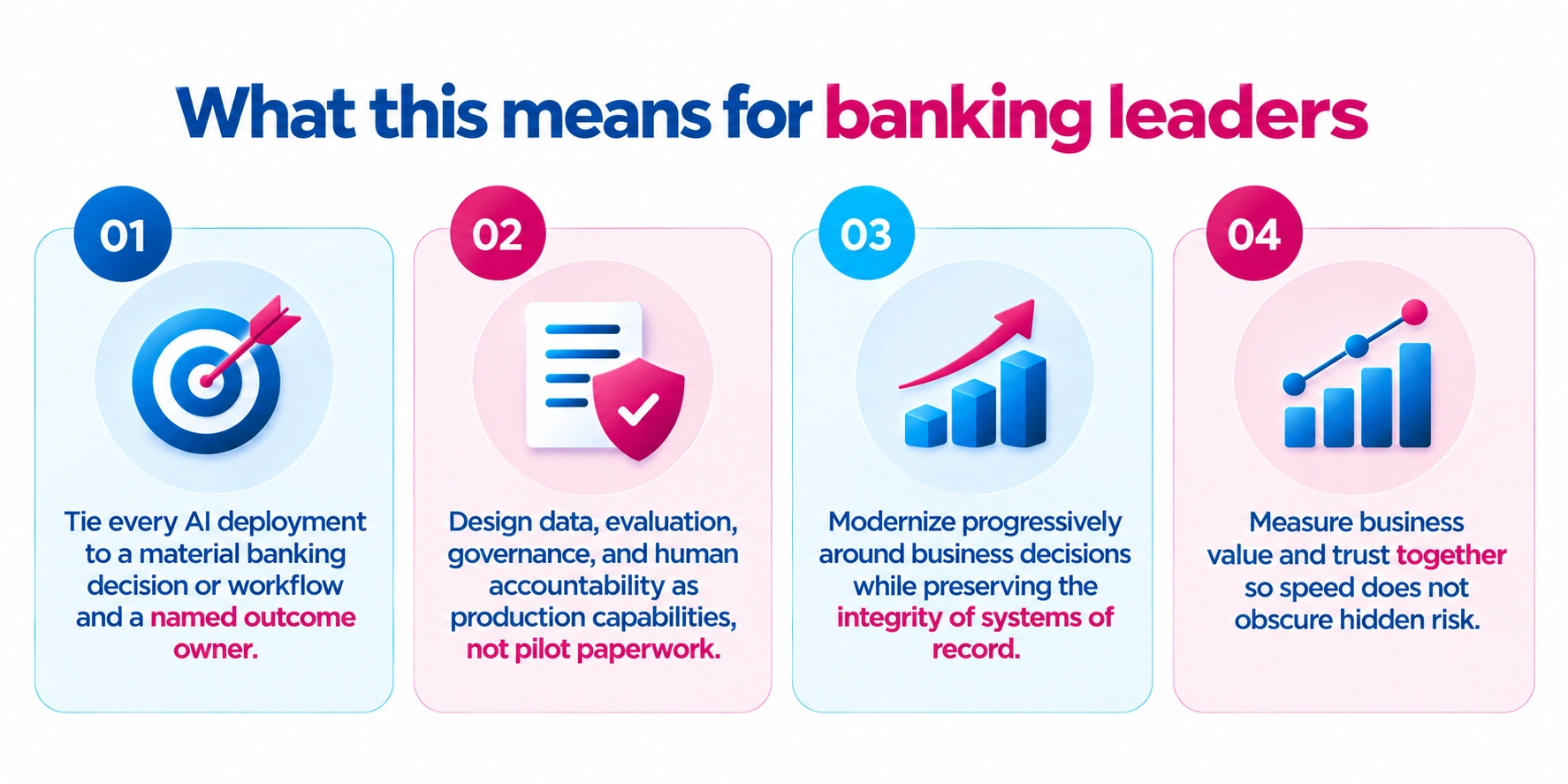
- Tie every AI deployment to a material banking decision or workflow and a named outcome owner.
- Design data, evaluation, governance, and human accountability as production capabilities, not pilot paperwork.
- Modernize progressively around business decisions while preserving the integrity of systems of record.
- Measure business value and trust together so speed does not obscure hidden risk.
Conclusion
Data quality in banking is moving from a periodic property of datasets to a real-time property of decisions. Query-level validation supplies the missing control: it tests whether the evidence used for a specific outcome is relevant, permitted, current, and complete. Without it, an AI-enabled core may be intelligent but cannot be reliably trusted.
Explore the full executive perspective
The CIO’s Guide to AI-Enabled Core Banking Modernisation develops the architecture, operating implications, and leadership priorities behind this shift.
FAQ
1. How is query-level validation different from data quality?
Data quality evaluates datasets against general rules. Query-level validation evaluates the particular evidence used for a specific request and purpose.
2. What checks should query-level validation include?
Typical checks include authority, freshness, relevance, completeness, permission, consistency, policy compliance, and risk-specific thresholds.
3. Does query-level validation eliminate human review?
No. It determines when a case can proceed, needs more evidence, or requires accountable human review.
4. Where should banks start?
Start with a material workflow that combines several data sources and currently creates manual rework or decision uncertainty.
5. Why is lineage important?
Lineage lets the bank reconstruct which sources and passages informed an output, supporting investigation, audit, and model improvement.