

Generative AI can turn a user story into test ideas in seconds. For a bank, speed is only the first test of value. The harder questions are whether the generated scenarios reflect the bank’s products and controls, whether important edge cases are missing, whether sensitive information is protected, and whether a reviewer can understand why an output was produced.
Used without context and governance, generative AI can create more test content while increasing review noise and false confidence. Used within a controlled quality engineering model, it can expand coverage and redirect specialist effort toward judgment.
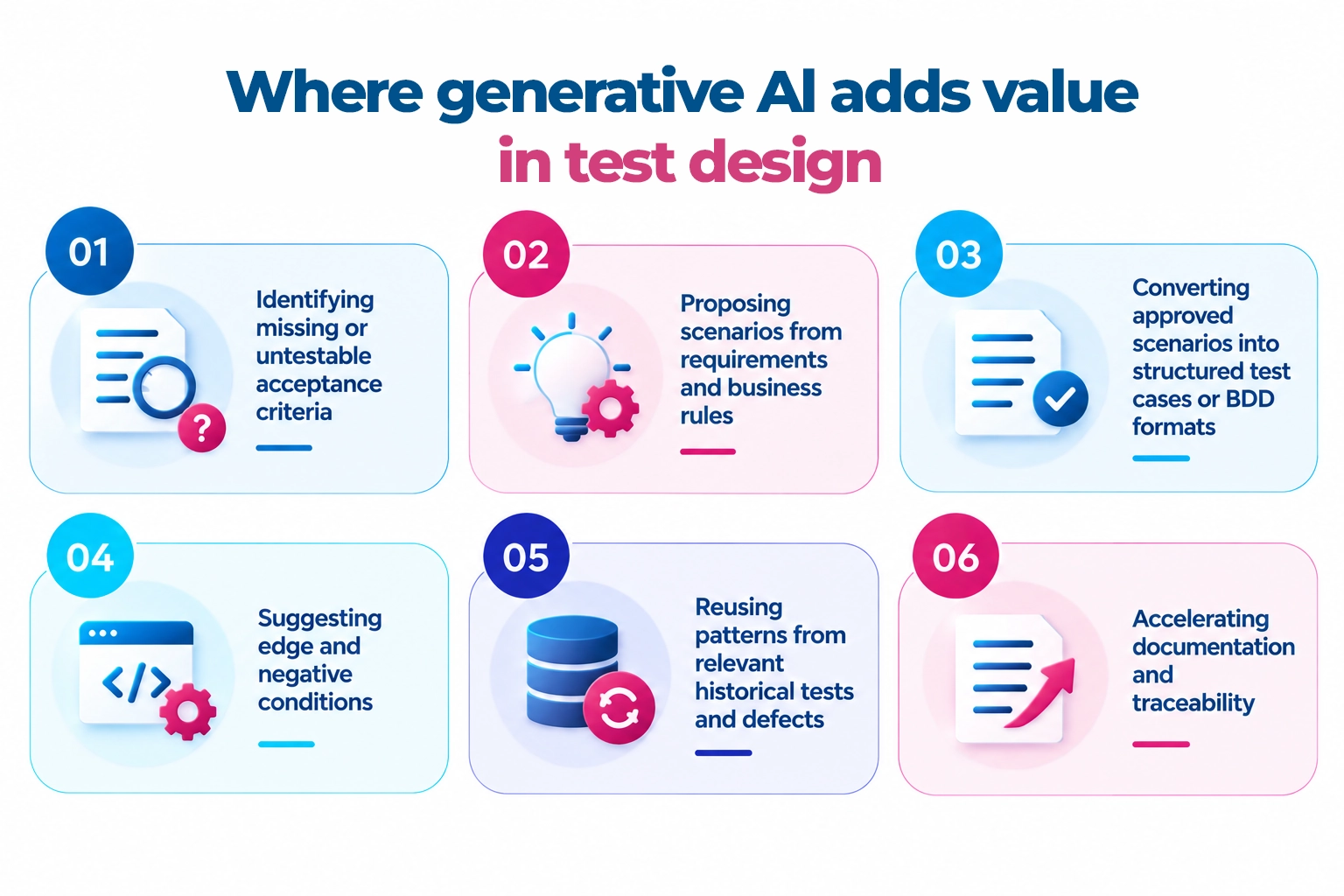
Where generative AI adds value in test design
Banking test design is reasoning-intensive. Teams interpret requirements, identify ambiguities, relate changes to processes and dependencies, and develop positive, negative, boundary, integration, and regulatory scenarios.
Generative AI can assist by:
- Identifying missing or untestable acceptance criteria
- Proposing scenarios from requirements and business rules
- Converting approved scenarios into structured test cases or BDD formats
- Suggesting edge and negative conditions
- Reusing patterns from relevant historical tests and defects
- Accelerating documentation and traceability
This can be especially valuable where specialists are scarce, and release demand is rising. But generation should not be confused with assurance.
Four AI risks banks must control
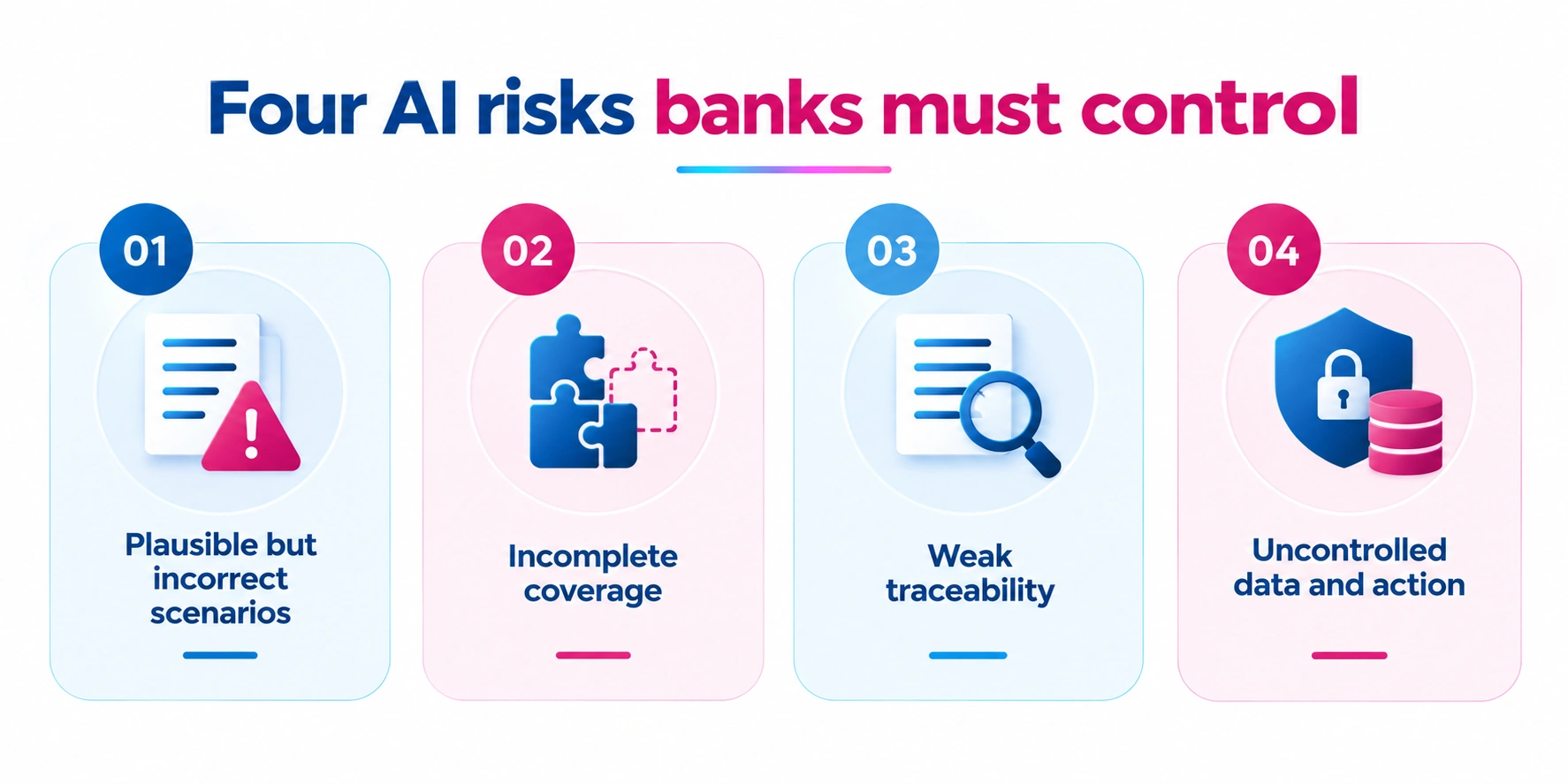
1. Plausible but incorrect scenarios
An output can read convincingly while misinterpreting a product rule or inventing a dependency. Banking fluency must come from approved institutional context, not from a general model’s apparent confidence.
2. Incomplete coverage
Generative AI may emphasize obvious happy paths while missing boundary conditions, state transitions, entitlements, integration failures, or operational exceptions. Coverage requires systematic risk and impact analysis.
3. Weak traceability
If a scenario cannot be connected to its requirement, rule, risk, or source evidence, it becomes difficult to review and defend. Explainable AI in banking should include visibility into the basis for quality recommendations.
4. Uncontrolled data and action
Prompts and retrieved artifacts may contain sensitive information. Generated outputs may also flow into automation or pipelines. Access controls, approved inference gateways, logging, model governance, and approval points are essential.
NIST’s Generative AI Profile reinforces the need to manage risks across design, development, use, and evaluation. For banking quality engineering, that means treating the model as one component inside a governed system rather than as an independent test authority.
A responsible pattern for AI-assisted test design
A trustworthy workflow should combine five controls.
- Grounding: Retrieve context from approved requirements, business rules, process documents, test assets, and defect history.
- Purpose limitation: Use role-specific prompts and workflows for defined quality tasks rather than open-ended generation.
- Traceability: Preserve the relationship between source material, generated scenario, risk rationale, reviewer action, and final test artifact.
- Human accountability: Require specialists to review, refine, reject, or approve outputs before they progress.
- Continuous evaluation: Monitor accuracy, coverage contribution, overrides, defects, and drift to improve the system over time.
Human review should not become a ceremonial click. The interface must make it possible to inspect assumptions and evidence quickly. The objective is augmented judgment, not automated consent.
How PULSEAI applies this model
PULSEAI combines a governed Knowledge Fabric with a cognitive layer, curated prompt library, and purpose-built quality engineering agents. It uses banking artifacts and domain context to support story refinement, behavior and risk mapping, intelligent test design, and regression planning. Generated outputs can be reviewed and approved by subject matter experts before moving into automation and execution.
This approach reflects Maveric’s broader position on trusted AI in banking: speed, explainability, reliability, and accountability must be engineered together.
Generative AI can improve test design without increasing AI risk, but only when the bank governs the entire decision path around the model. The model generates. The system grounds and traces. The accountable expert decides.
What explainability should mean in test design
Explainability in this context does not require exposing every internal model parameter. It requires enough evidence for a reviewer to understand and challenge the output. A proposed scenario should show the requirement, business rule, process, dependency, defect pattern, or risk that informed it. The reviewer should be able to identify uncertainty and record why the scenario was accepted, changed, or rejected.
This creates two benefits. First, review becomes faster because specialists do not have to reconstruct the model’s reasoning from scratch. Second, the decision leaves an audit trail that can improve future prompts, retrieval, and controls.
Use the human feedback as a risk signal
Banks should measure how people interact with generated outputs. High rates of rejection may indicate weak source data, poor retrieval, ambiguous requirements, or unsuitable prompts. Repeated additions by reviewers may expose a missing rule or scenario class. Differences between teams can identify inconsistent practices that need standardization.
Human intervention is therefore not merely a safeguard. It is operational data for improving the quality system. PULSEAI governed workflows and continuously evolving knowledge layer provide the foundation for capturing that learning.
A controlled pilot for banking test design
A responsible pilot can focus on a bounded product enhancement with accessible documentation and known reviewers. The bank can compare AI-assisted and conventional design across time, scenario relevance, edge-case coverage, reviewer changes, and defects identified.
The pilot should define information boundaries, approved models, access permissions, retention rules, and escalation paths before generation begins. It should also specify which outputs require mandatory approval and prevent unreviewed artifacts from reaching automated execution.
The objective is not to prove that a model can produce more test cases. It is to determine whether governed generative AI helps the bank create more relevant coverage, with less effort and no loss of accountability.
See human-governed, context-aware AI test design in action. Schedule a PULSEAI demo
FAQ
Can generative AI create banking test cases?
Yes. It can propose scenarios and structured test cases from requirements and approved context. Human review remains necessary to validate banking rules, risk, and completeness.
What is the biggest risk of AI-generated test design?
The largest risk is false confidence: outputs may appear complete while being incorrect, insufficiently contextualized, or poorly traced to requirements and risk.
What does human-in-the-loop mean for banking testing?
It means accountable specialists can inspect the evidence and rationale, refine or reject generated outputs, and approve them before they progress into automation, execution, or release evidence.