

Banking technology is moving faster than the testing models built to protect it. Agile delivery, DevOps practices, and AI-assisted coding have compressed release cycles, while the systems behind those releases remain deeply interconnected. A seemingly small change in one product or process can affect upstream applications, downstream integrations, data flows, business rules, and release readiness.
That creates a difficult reality for the software testing banking teams perform today: more change is moving through the system, but much of the knowledge required to judge risk still sits with individuals. Traditional testing can automate execution, but it often struggles to understand what changed, where the impact travels, what deserves priority, and whether the resulting evidence is strong enough to support release confidence.
The problem is no longer execution speed alone
Conventional testing models are often organized around defined test phases: review the requirement, design scenarios, assemble regression packs, execute them, log defects, and report status. The process can work, but it becomes fragile when delivery velocity rises faster than the team’s ability to interpret change.
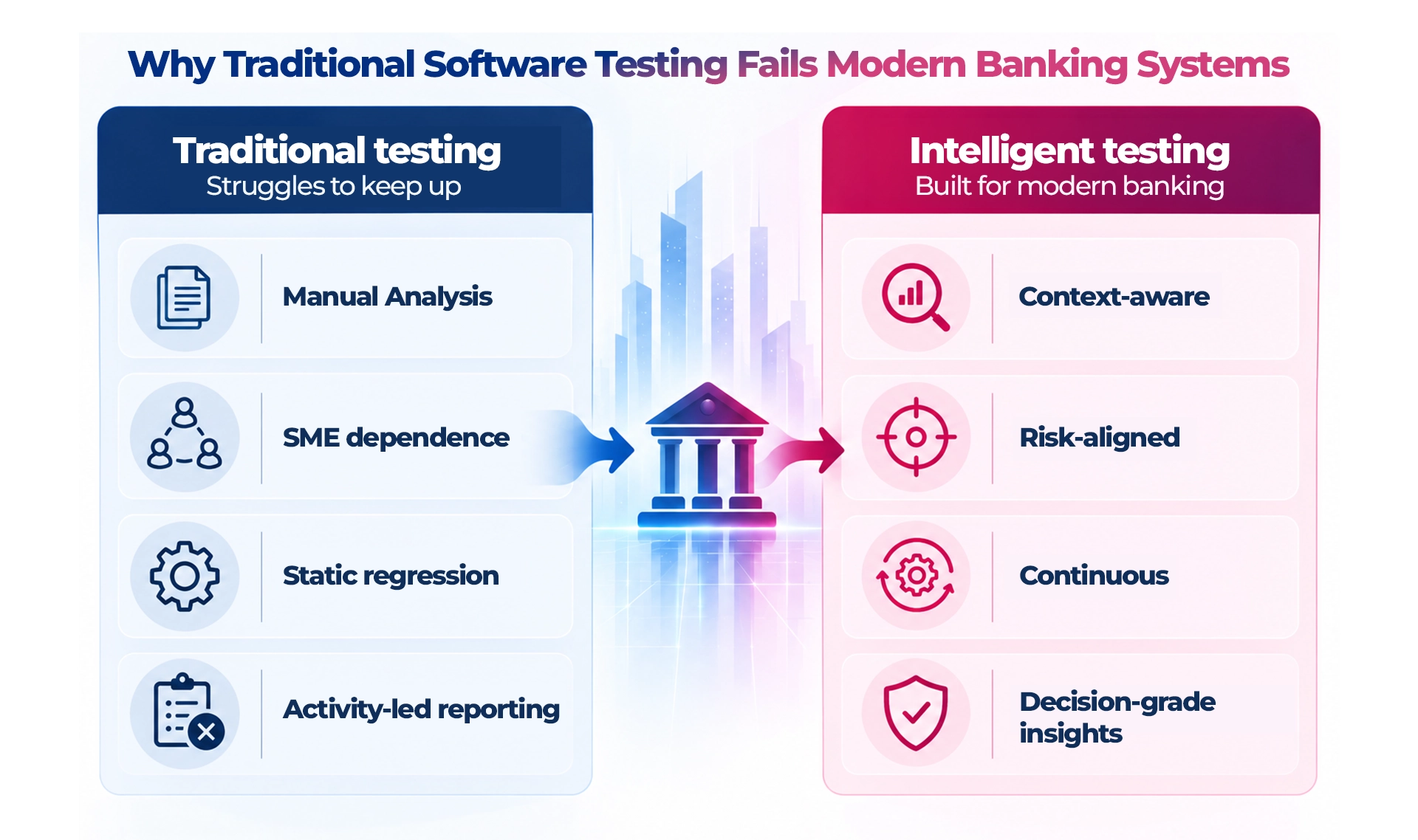
The result is testability debt. User stories are reviewed manually, gaps are found late, and domain context may remain implicit. Impact analysis depends heavily on SMEs, while test scope is often shaped by experience rather than system-wide evidence. In AI-first banking, this creates a basic mismatch: the testing process may be active, yet still lack a complete view of business context and cross-system dependencies.
Automation alone does not solve that mismatch. A larger automated pack can still contain redundant tests, miss edge conditions, or overlook areas affected indirectly by a change. That is why modern quality engineering has to move beyond “how many tests can we run?” toward “how intelligently can we understand what must be tested?”
Static regression cannot keep up with dynamic banking change
The regression testing banking teams rely on is often built around what was tested before, what teams remember, or what has historically been considered important. But banking changes are rarely isolated. A new capability can affect product configuration, servicing flows, integration points, compliance logic, and downstream applications at the same time. If dependencies are not mapped systematically, teams can end up either testing too much or missing what matters most.
A more effective model is context-aware and risk-aligned. It connects requirements, historical defects, business processes, test assets, and system relationships so that coverage can be selected based on impact rather than intuition. This matters as AI in banking accelerates the volume and pace of software change: automation has to become part of an intelligence-led quality process, not simply a faster execution mechanism.
Release confidence needs continuous quality intelligence
The final weakness of traditional testing appears at release time. Reporting is often driven by activity, defect counts, and test completion. Those signals show what happened, but not always whether the release is genuinely ready.
Modern banking delivery needs decision-grade quality insights: early risk visibility, evidence-backed sign-off, leading quality signals, and traceability from change intent through test design and execution. It also needs continuous execution that can integrate with delivery pipelines rather than depend on fixed testing windows.
This is the shift behind PULSEAI continuous quality intelligence approach. Instead of treating quality as a phase, it combines banking context, AI-native knowledge management, impact analysis, risk-based regression, agentic workflows, low-code automation, BOT-driven execution, and human review across the software testing lifecycle.
Conclusion
The broader lesson is simple: traditional testing fails modern banking systems when it remains reactive, fragmented, and activity-led. The answer is not simply more automation. It is quality engineering that can understand context, preserve institutional knowledge, prioritize risk, and produce explainable confidence at the speed modern banking delivery now demands.
Download the whitepaper to know more about intelligent software testing in AI-first banking.
FAQ
1. Why does traditional software testing struggle with modern banking systems?
Traditional testing often depends on manual story reviews, SME knowledge, fixed test scopes and phase-based execution. As banking delivery accelerates, these approaches can leave gaps in testability, change-impact visibility, dependency understanding and release confidence.
2. Why is test automation alone not enough for modern banking?
Automation can make test execution faster, but it does not automatically determine what has changed, which systems are affected, where risk is concentrated or whether the test pack provides the right coverage. Without context, teams can automate tests that are redundant while still overlooking important scenarios.
3. How should regression testing evolve for banking systems?
Regression testing should move from static packs and intuition-led selection toward context-aware, risk-based prioritization. Requirements, business processes, system dependencies, historical defects and existing test assets can be connected to identify impacted areas and focus coverage where it matters most.
4. What is continuous quality intelligence?
Continuous quality intelligence embeds quality across the software testing lifecycle rather than treating testing as a separate phase. It brings together testability assessment, impact analysis, intelligent test design, risk-based execution, defect intelligence, quality reporting and evidence-backed release readiness.
5. How does PULSEAI address these traditional testing limitations?
PULSEAI combines AI-native knowledge management, cognitive intelligence, QE agents and workflows, context-aware regression, low-code automation and BOT-driven continuous execution. It is designed to convert dispersed banking and testing knowledge into contextual, risk-aware quality decisions while retaining human review and accountability.