

Gulf banking is backed by some of the largest sovereign technology commitments anywhere in the world. National digital transformation strategies carry explicit government mandate. Capital is, by global standards, not the constraint most institutions in the region are working around. And yet independent analysis of core banking modernization across the Middle East found that phased and hybrid execution models are common. Direct replacements, specifically because of capability and talent constraints, not because banks are hedging a strategic bet or lack the funding to move faster.
This is close to a natural experiment in what actually limits transformation execution speed. Take capital and mandate largely off the table as constraints, and what is left as the binding factor is specialist delivery capacity, the same conclusion that keeps surfacing across every region examined in this research, just harder to obscure here because the usual excuses do not apply.
What “Capability Constraint” Actually Means in This Context
Separate market analysis of one of the region’s largest digital transformation landscapes found execution risk persisting specifically because talent graduation rates are lagging demand even as capital and government backing remain firmly in place. This is a precise and useful way to think about the constraint: it is not that the region lacks ambition, funding, or technical infrastructure investment. It is that the pipeline of specialists – engineers who can execute a core banking migration, architects who understand both legacy Gulf banking infrastructure and modern cloud-native design, data professionals who can build the governed foundation an AI-first bank needs has not grown at the same pace as the capital committed to using them.
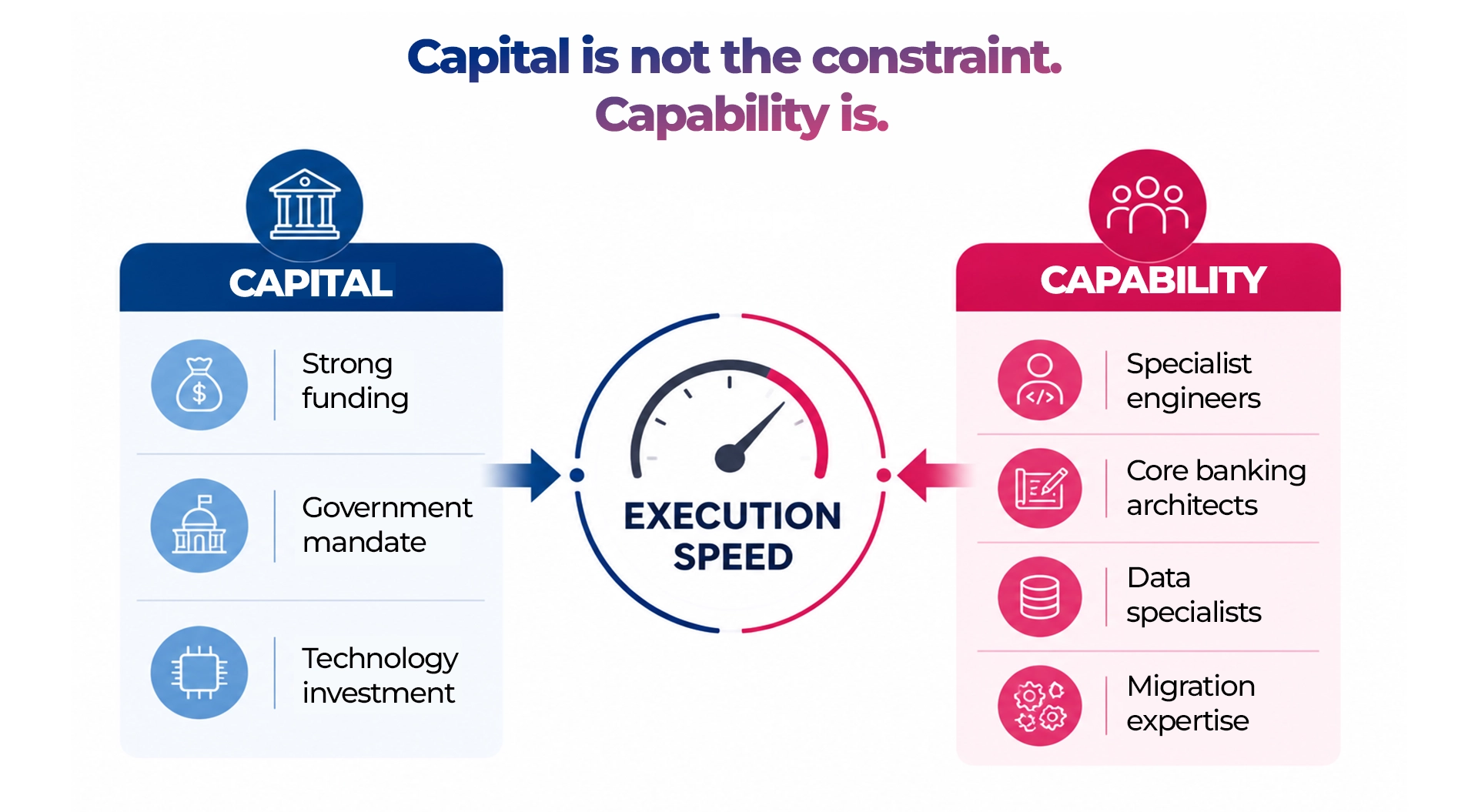
The result is a genuinely counterintuitive pattern for executives used to thinking about transformation risk primarily in terms of funding approval. A fully-funded, fully-mandated program can still stall not because anyone lost confidence in the strategy, but because there simply are not enough qualified specialists available in the market to staff every concurrent initiative at the depth it requires.
Why Phased and Hybrid Models Are a Rational Response, Not a Compromise
It would be easy to read the region’s preference for phased and hybrid execution modernizing around a legacy core in stages, rather than replacing it outright in a single program as evidence of caution or limited ambition. The more accurate reading, given the underlying data, is that it is a rational adaptation to a real capacity constraint. Attempting a full, direct core replacement with a talent pool that has not yet scaled to support it invites exactly the kind of stalled, under-resourced program that shows up throughout the broader research on transformation execution. A phased approach concentrates scarce specialist talent on a smaller number of workstreams at a time, which is a defensible, and often the only realistic, way to sustain delivery quality against a genuine capability shortage.
This has an important implication for how success should be measured in the region. A transformation program that takes a phased path to modernization is not, by that fact alone, executing more slowly or less ambitiously than a peer attempting a single large-scale replacement elsewhere. It may simply be the more disciplined choice, given an honest assessment of available delivery capacity and the broader data on execution failure suggests that disciplined sequencing against real capacity constraints outperforms ambitious sequencing that outruns them, virtually every time.
The Global Talent Context Behind the Regional Pattern
The Middle East’s specific capability constraint sits inside a much larger global pattern. Recent global workforce research spanning tens of thousands of employers found that AI-related skills have, for the first time, become the hardest capability category to hire for worldwide overtaking traditional engineering and IT roles entirely. Banking-specific research echoes the same shortage: a large majority of bank board members and C-suite leaders now identify AI expertise as the single most urgent capability gap their organization needs to close, ahead of even M&A integration skills. This is not a constraint unique to the Gulf. It is a global scarcity that hits hardest in markets like the Middle East, where transformation ambition and funding are moving faster than the regional talent pipeline can organically supply.
What This Means for Program Design
For executive teams in the region, the practical implication is to treat specialist delivery capacity as a first-class constraint in program planning, on equal footing with budget and regulatory approval rather than assuming that securing funding and government mandate is sufficient to guarantee delivery speed. That means building specialist capacity through a deliberate combination of local talent development, and experienced delivery partners who bring the specific migration and integration depth the regional talent pipeline has not yet scaled to produce internally, rather than assuming a well-funded program will naturally attract the specialists it needs simply because the budget exists.
It also means being explicit, in program planning, about which phase of a phased modernization actually requires the scarcest specialist skills, and sequencing accordingly concentrating the region’s limited pool of the most specialized talent on the highest-risk stages of the program, rather than spreading it thinly across every workstream running concurrently. Institutions applying this discipline are the ones converting the region’s substantial capital and mandate advantage into delivered capability, rather than into an ambitious plan still waiting on the people to build it.
Related reading
- Why Most Banking Transformations Fail at Execution (pillar guide)
- Capability Debt: Why Headcount Is not the Same as Delivery Capacity.
Source
- Core banking modernization in the Middle East
- ManpowerGroup 2026 Global Talent Shortage Survey
- Bank Director’s 2026 Compensation & Talent Survey
- Middle East Digital Transformation Market Size and Share
FAQ
1. Why do Gulf banks favor phased and hybrid core modernization over full replacements?
Independent analysis attributes this to capability and talent constraints, not funding limits or strategic caution. Phased execution concentrates a scarce specialist pool on a smaller number of workstreams at a time, which sustains delivery quality against a genuine capacity constraint.
2. Is a phased modernization path a sign a Gulf bank is executing more slowly or less ambitiously?
Not by that fact alone. Given the region’s talent constraint, disciplined sequencing against real capacity outperforms ambitious sequencing that outruns it, which makes a phased approach the more defensible choice, not a compromise.
3. What should executive teams in capability-constrained markets do instead of waiting for the talent market to recover?
Concentrate scarce specialists on the highest-risk decisions rather than spreading them thinly as advisors, invest in upskilling domain experts who already understand the regulatory context, and bring in delivery partners for the specific specialist depth the internal team lacks.